Famous Food In Dubai: What Locals Order
Dubai's famous food is not one dish but a short list of Emirati classics and street staples that locals order without a menu. Here is that list, where each dish comes from, and what it costs.
Short answer
The food Dubai locals order most spans Emirati classics like machboos, harees and luqaimat, plus everyday street staples: shawarma, falafel, samboosa and karak chai. A casual neighborhood meal runs a reported 15 to 40 AED per person, while a guided tasting walk bundles the famous dishes into one route through Old Dubai.
The most famous food in Dubai is not found on a single menu. It is a short list of dishes that appears again and again at local tables, in Deira cafeterias and in the heritage lanes of Al Fahidi: machboos, harees, luqaimat, karak chai, shawarma, falafel and samboosa. Visitors mostly meet the street half of that list. Locals order the Emirati half too, and knowing both is the difference between eating like a tourist and eating like a resident. For a first taste of the resident side of that list, the guide to must-eat dishes in Dubai points you to where each one is served best.
This page lays out what the famous dishes actually are, what locals order them with, where in Old Dubai they surface, and what they cost at street level. Where a figure comes from a tour listing, it says so. Where a price is a reported street figure, it says that too.
What Is The Famous Food In Dubai?
The famous food in Dubai splits into two layers: Emirati classics such as machboos, harees, balaleet and luqaimat, and everyday street staples such as shawarma, falafel, samboosa and karak chai. Machboos is widely described as the UAE national dish, long-grain rice slow-cooked with meat, dried limes and baharat spices. Both layers sit side by side in Old Dubai, and locals move between them daily.
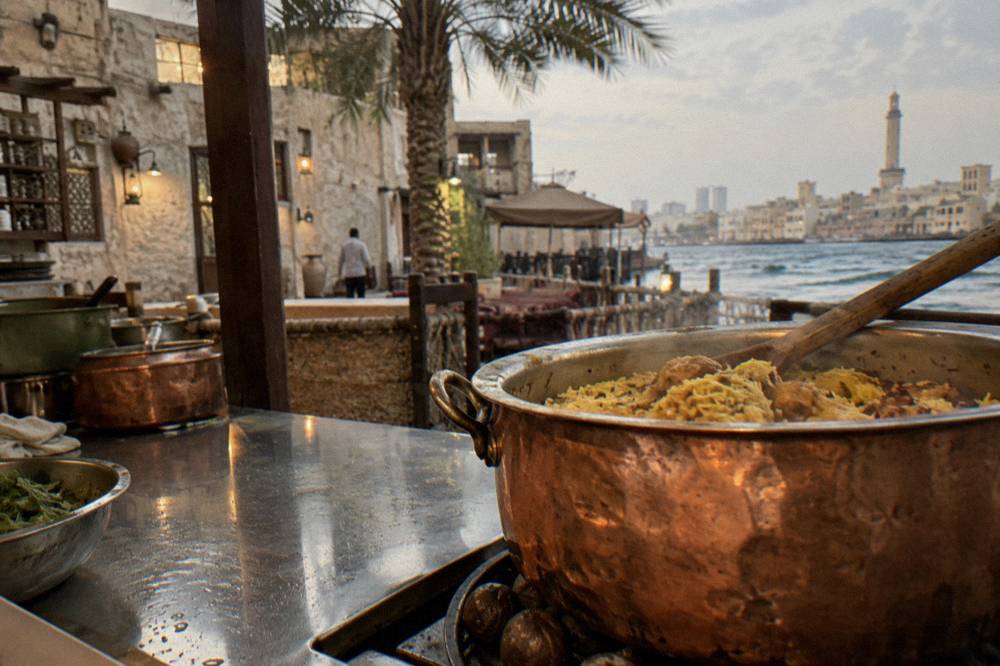
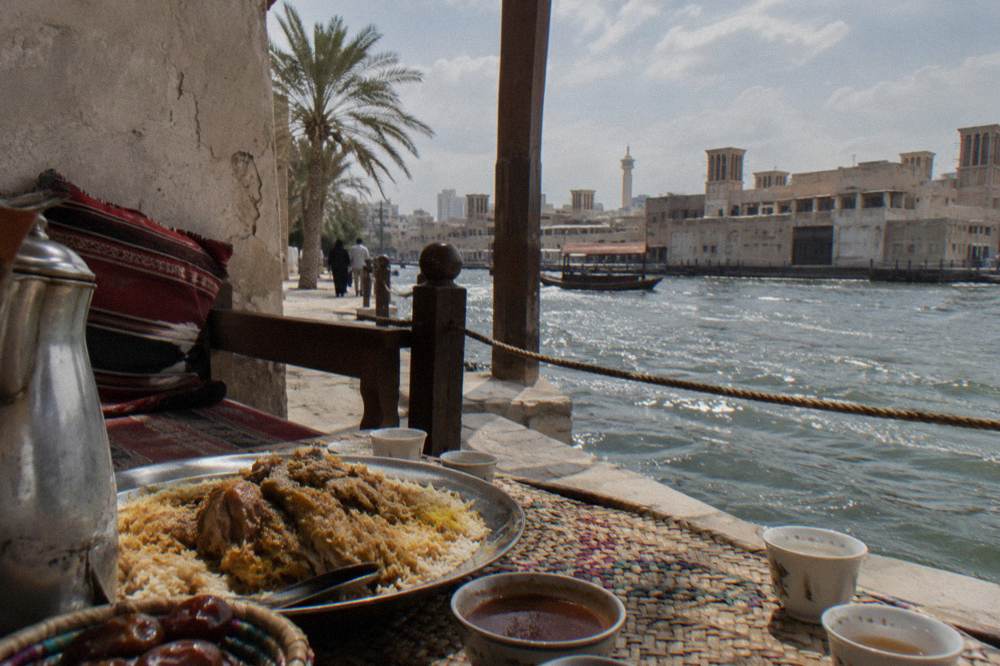
The Emirati layer is the one most visitors miss. Machboos is served family-style on a platter, often with tomato sauce or pickles. Harees is wheat and meat slow-cooked for six to eight hours until it turns smooth and porridge-like, finished with ghee, a comfort dish at gatherings and during Ramadan. Balaleet is sweet saffron and cardamom vermicelli topped with a thin omelette, a breakfast dish. Chebab are saffron, cardamom and turmeric pancakes eaten with cream cheese and date syrup. Madrouba is a thick, spiced salted-fish porridge, and thareed is a meat and vegetable stew ladled over thin regag bread so the bread soaks up the broth.
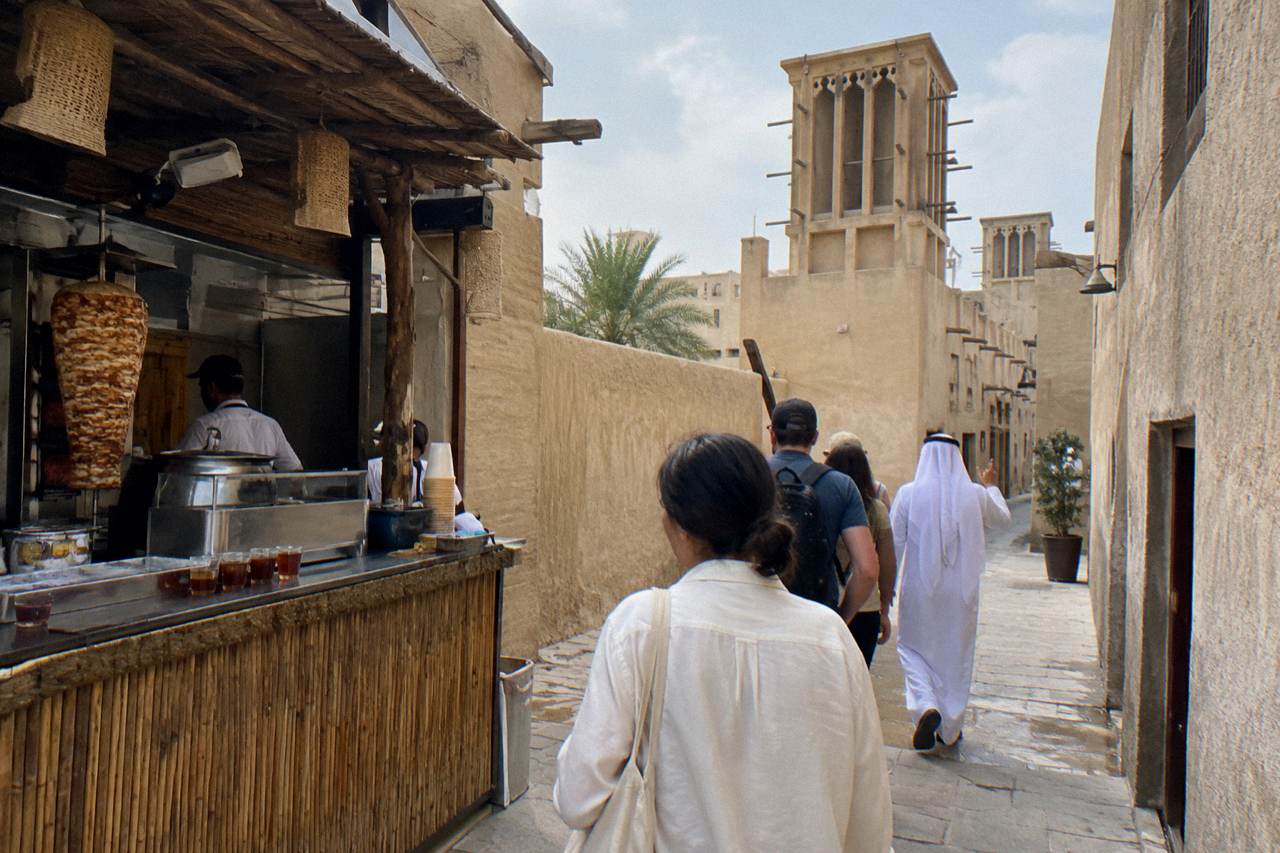
The street layer needs less introduction. Shawarma, falafel, samboosa and karak are the daily currency of Deira and Bur Dubai cafeterias, and recent local guides report them at pocket-money prices: shawarma at around 8 to 15 AED at local spots, falafel wraps from around 4 AED, karak chai from around 1 to 3 AED at local stalls.
Luqaimat bridges the two layers. These are crisp fried dough dumplings drizzled with date syrup and sesame seeds, served warm and eaten immediately, as common a dessert in Ramadan as they are a street sweet the rest of the year. For a fuller background on the traditional dishes, the Emirati dishes worth knowing guide covers each one in detail.
The Dishes Locals Actually Order
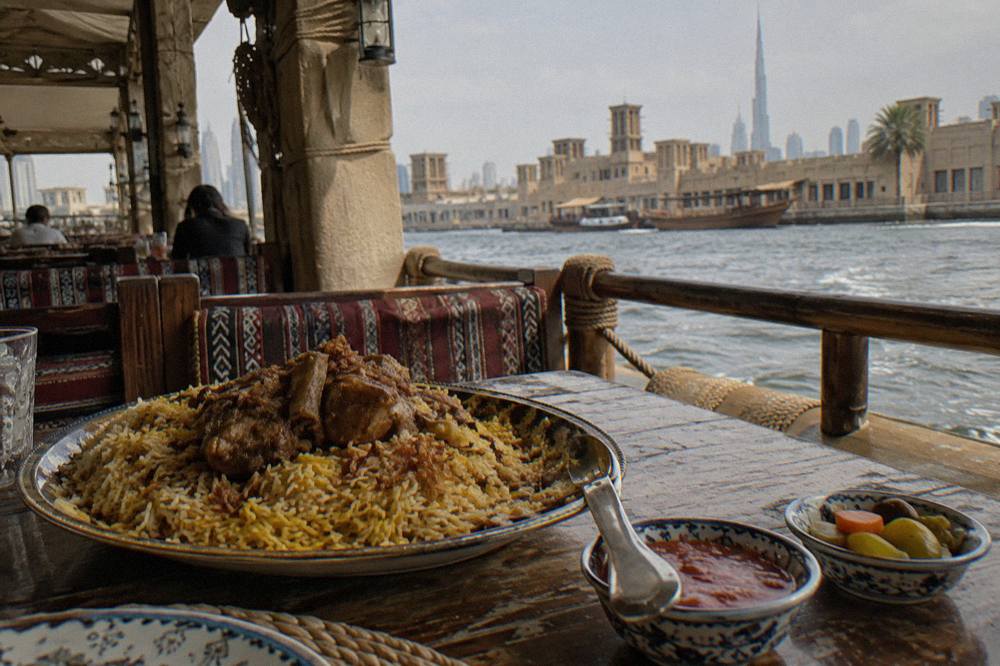
Locals in Dubai order machboos, harees and thareed at Emirati restaurants, luqaimat as dessert, and shawarma, falafel or a biryani plate at neighborhood cafeterias, with karak chai or gahwa alongside. Reported restaurant prices put Emirati mains such as machboos at around 58 to 65 AED and harees at around 42 AED in heritage settings in Deira, while a casual cafeteria meal runs a reported 15 to 40 AED per person.
The pattern is practical. A family dinner gravitates to the platters: machboos with lamb, fish or chicken, thareed or margoog, and harees in cooler months. A workday lunch is more likely to be a shawarma wrap, a falafel sandwich or a biryani plate from a cafeteria near the souks. Breakfast belongs to balaleet, chebab, regag bread with egg or cheese, dates and Arabic coffee.
Reported figures from Deira heritage restaurants give a sense of the sit-down layer: machboos with lamb or fish at around 58 to 65 AED, harees at around 42 AED, and thareed or margoog at around 55 to 58 AED. These are reported street-level figures, not promises; individual venues vary and it pays to check the menu before sitting down. On the breakfast side, an Emirati breakfast spread with balaleet and regag is reported at around 52 AED at one Al Fahidi institution.
The table below gathers the famous dishes in one view, with what each one is and what locals pair it with.
| Dish | What it is | When locals order it |
|---|---|---|
| Machboos | Long-grain rice slow-cooked with meat, dried limes and baharat spices, served family-style | Family meals and gatherings |
| Harees | Wheat and meat slow-cooked six to eight hours to a smooth porridge, finished with ghee | Gatherings, cooler months, Ramadan |
| Luqaimat | Crisp fried dough dumplings with date syrup and sesame, eaten warm | Dessert and Ramadan evenings |
| Balaleet | Sweet saffron and cardamom vermicelli with a thin omelette on top | Breakfast |
| Chebab | Saffron, cardamom and turmeric pancakes with cream cheese and date syrup | Breakfast |
| Thareed | Meat and vegetable stew ladled over thin regag bread | Family meals, Ramadan |
| Shawarma | Spit-roasted meat wrap with garlic sauce or pickles | Lunch or late dinner from a cafeteria |
| Karak chai | Strong spiced milky tea | Morning and evening, any day |
The practical problem for a visitor is that the sit-down Emirati layer and the street layer sit in different places, and finding both in one afternoon takes route planning.
Where To Eat The Famous Dishes In Old Dubai
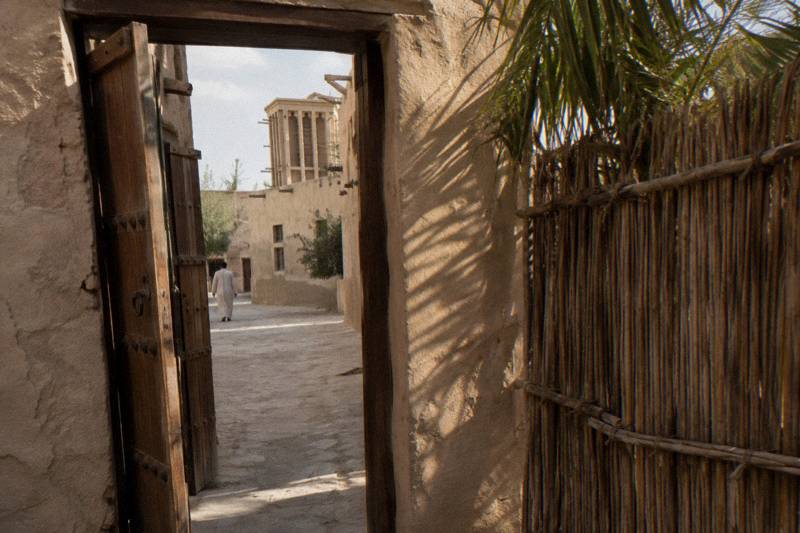
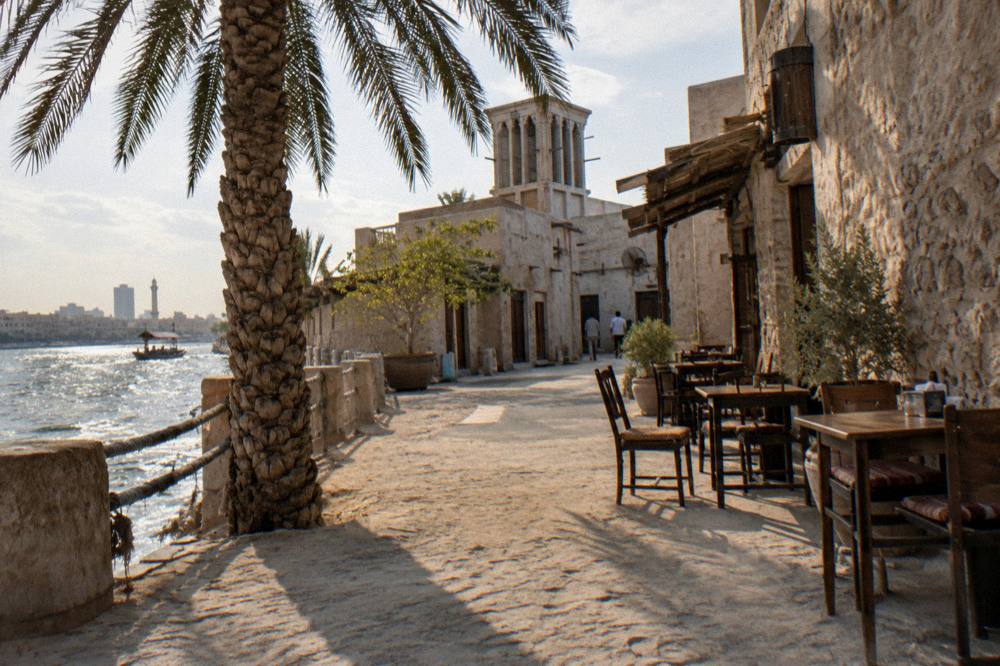
The famous dishes cluster in Old Dubai: Al Fahidi Historical Neighbourhood for Emirati breakfasts and cultural meals, the Deira souks for street staples, and the Creek promenades between them for the walk itself. Al Fahidi's lanes and courtyards are free to walk, open daily from 7am to 8pm per Dubai Culture, and the Al Seef promenade stretches about 1.8 km along the Bur Dubai side of the Creek.
Al Fahidi is the natural first stop for the Emirati layer. The neighbourhood's wind-tower houses hold courtyard cafes serving balaleet, regag and Arabic coffee, and the Sheikh Mohammed Centre for Cultural Understanding runs 1.5-hour cultural meals with Emirati hosts, Arabic coffee and dates, with reported prices of AED 130 for breakfast or brunch, AED 145 for lunch, AED 150 for fuala tea time and AED 160 for dinner, booking required. The centre's programme is described on its official cultural meals page.
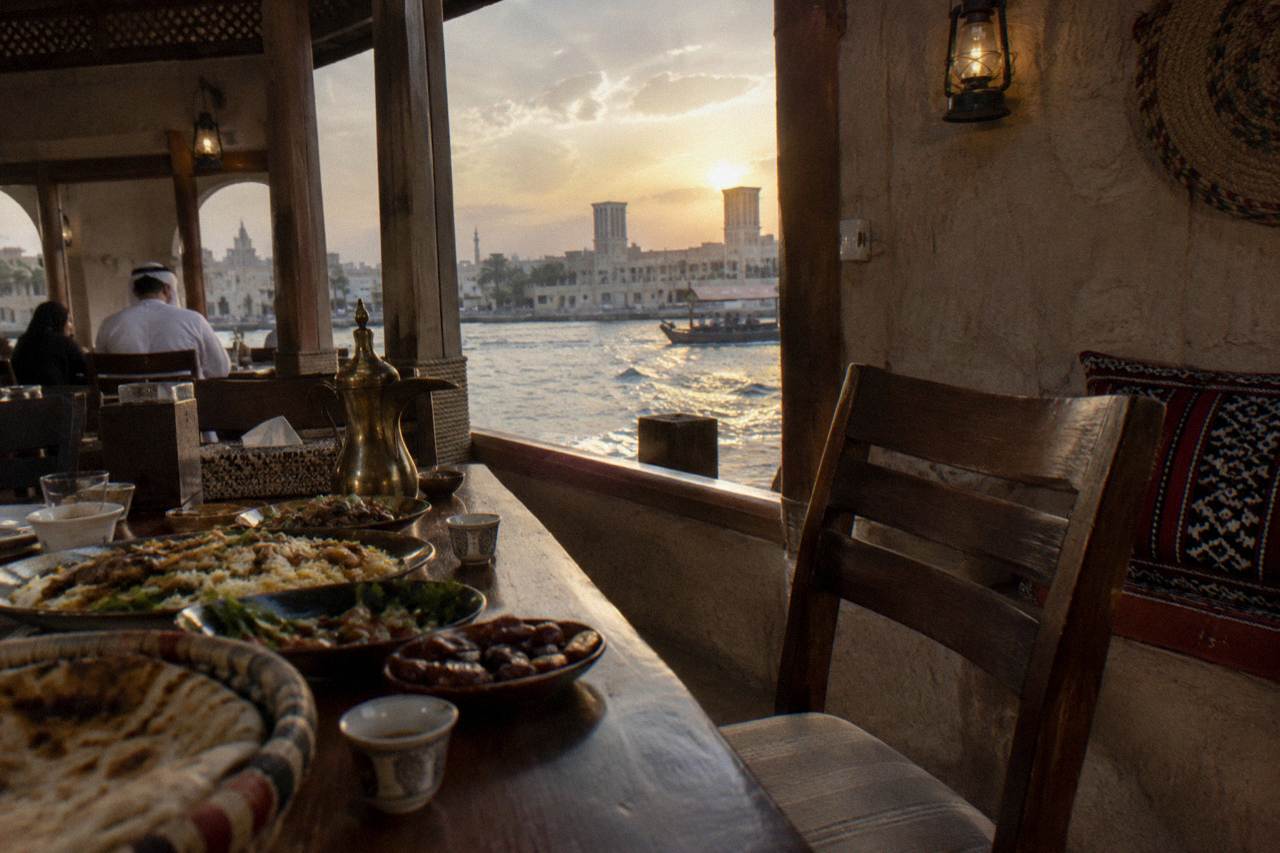
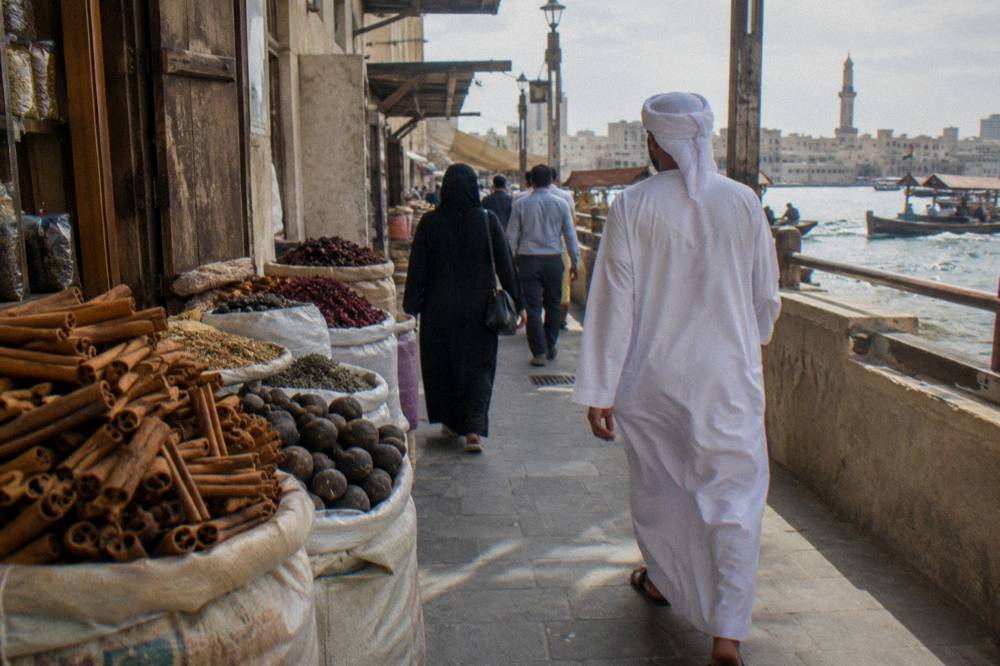
Cross the Creek and the picture changes. Deira's lanes around the Spice Souk and Gold Souk are where the shawarma, falafel and karak layer lives, in Iranian, Afghan, Indian, Pakistani and Lebanese cafes that have fed the souk trade for decades. The souks keep their own rhythms: reported descriptive hours put most Gold Souk shops around 10am to 10pm, and Spice Souk shops from before 8am to past 9pm, with Friday daytime closures reported for the Spice Souk. Individual shops vary, so treat those as patterns rather than timetables.
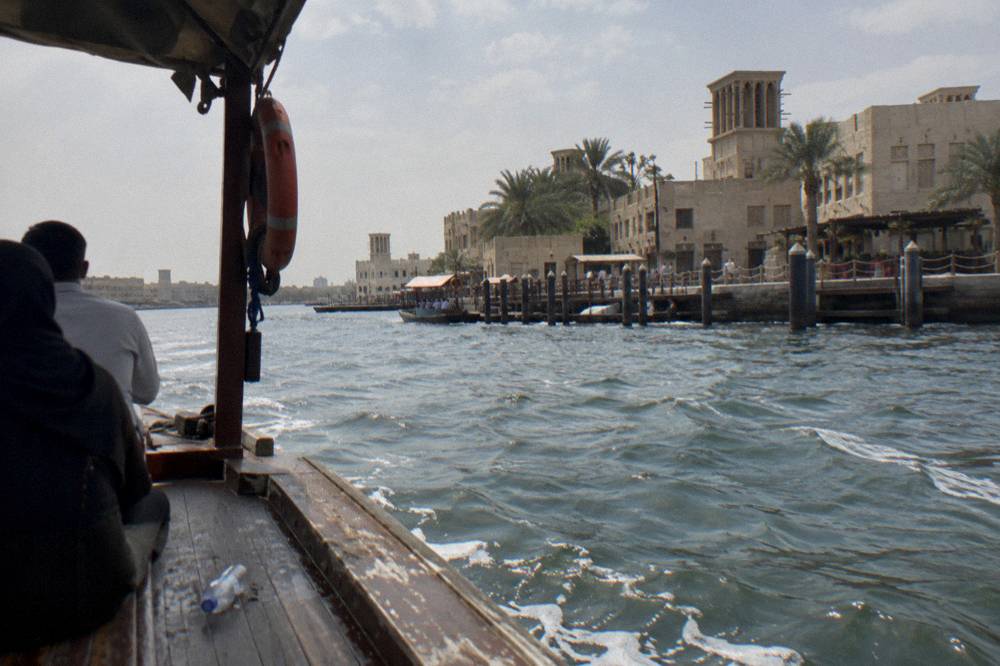
The Creek itself ties the two halves together. The Roads and Transport Authority runs traditional commuter abra routes across the water, including CR1 between Bur Dubai and Deira Old Souq, and the walking connections between Al Fahidi, Al Seef, the Textile Souk and the Deira souks are standard and reported open. The Creek abra ride and waterfront eating guide covers the crossing in detail. For a guided version of this exact geography, the Al Fahidi Old Town, Souks, Street Food and Abra Cruise tour links the neighbourhood, the souks and a Creek crossing into one 2.5 to 4 hour route; the current price is on the operator's live listing.
What The Famous Food Costs In Dubai
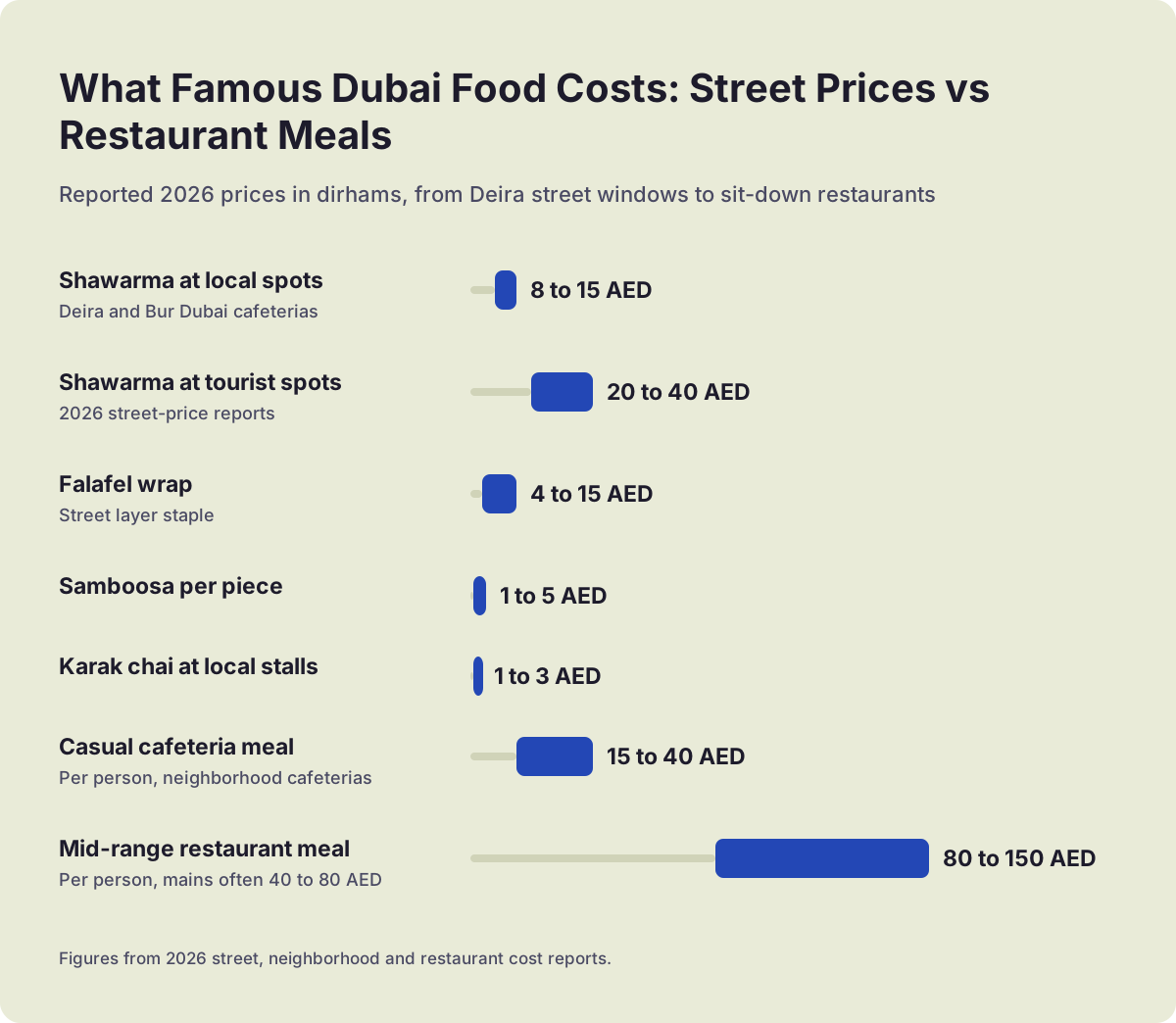
Street-level prices are low: reported figures put a shawarma at 8 to 15 AED at local spots, a falafel wrap at 4 to 15 AED, karak chai at 1 to 3 AED and samboosa at 1 to 5 AED per piece. A casual Emirati, Levantine or cafeteria meal runs a reported 15 to 40 AED per person, while a mid-range restaurant meal costs around 80 to 150 AED per person with mains often 40 to 80 AED.
The gap between the street layer and the restaurant layer is wide, and it is worth knowing before you budget a day. A walker eating shawarma, karak and luqaimat from Deira windows spends very little. The same appetite in a mid-range restaurant multiplies several times over, especially once the bill extras land: restaurants commonly add a 10 per cent service charge, which is venue-retained rather than a mandatory government fee, plus 5 per cent VAT, and some hotel-affiliated venues add a 7 per cent municipality fee.
Two practical notes on top of the menu prices. First, bottled water runs about 1 to 2 AED per litre in supermarket multipacks but 6 to 12 AED per bottle in restaurants, so carrying a bottle changes the day's arithmetic. Second, tipping is personal preference rather than obligation; Visit Dubai's own tipping guide suggests 10 to 15 per cent in restaurants and AED 5 to 10 in cafes. The Dubai food prices guide breaks the full budget picture down.
| Item | Reported price | Where the figure comes from |
|---|---|---|
| Shawarma at local spots | 8 to 15 AED | 2026 street-price reports |
| Shawarma at tourist spots | 20 to 40 AED | 2026 street-price reports |
| Falafel wrap | 4 to 15 AED | 2026 street-price reports |
| Karak chai at local stalls | 1 to 3 AED | 2026 street-price reports |
| Samboosa per piece | 1 to 5 AED | 2026 street-price reports |
| Casual cafeteria meal | 15 to 40 AED per person | 2026 neighborhood cost reports |
| Mid-range restaurant meal | 80 to 150 AED per person | 2026 restaurant cost reports |
| Emirati mains, heritage settings | harees around 42 AED, machboos around 58 to 65 AED | 2026 Deira restaurant reports |
Karak, Gahwa And The Coffee Ritual
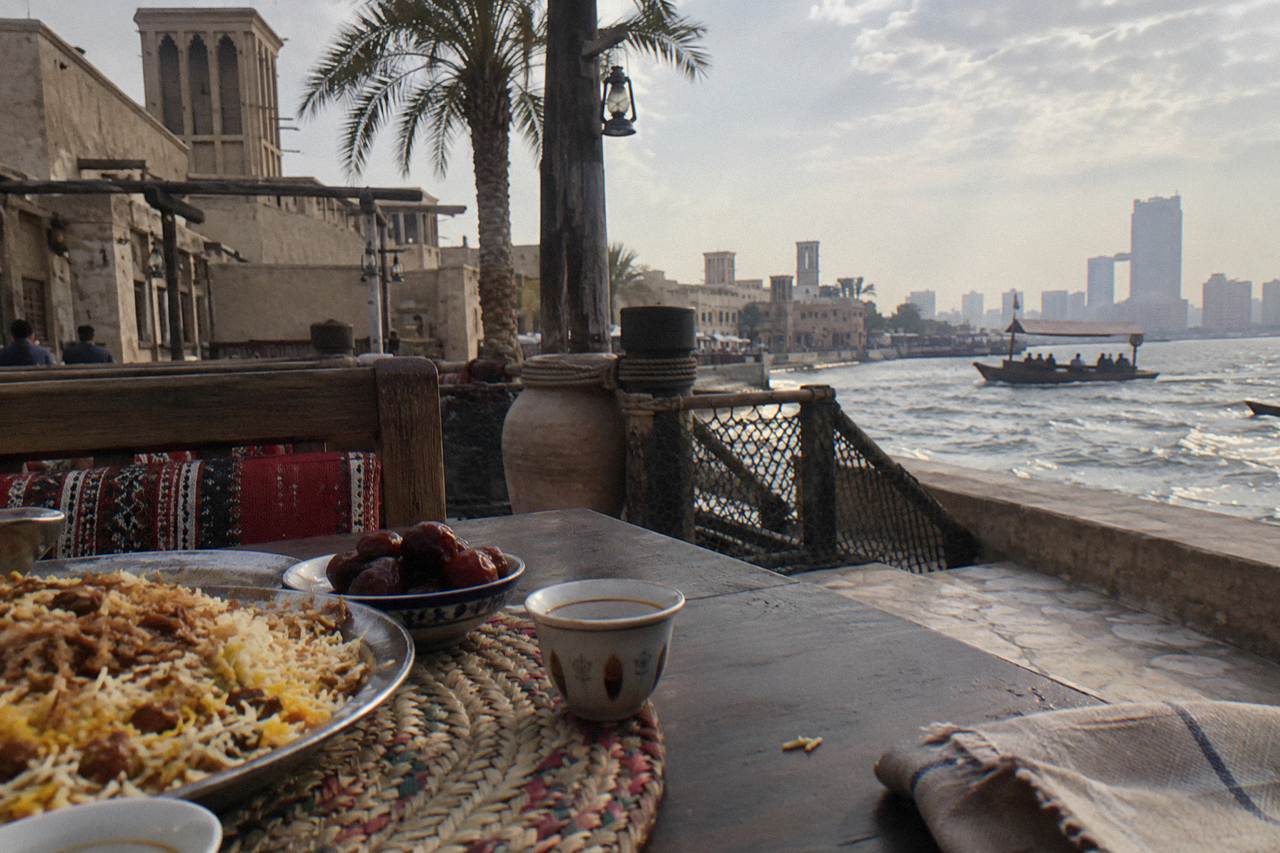
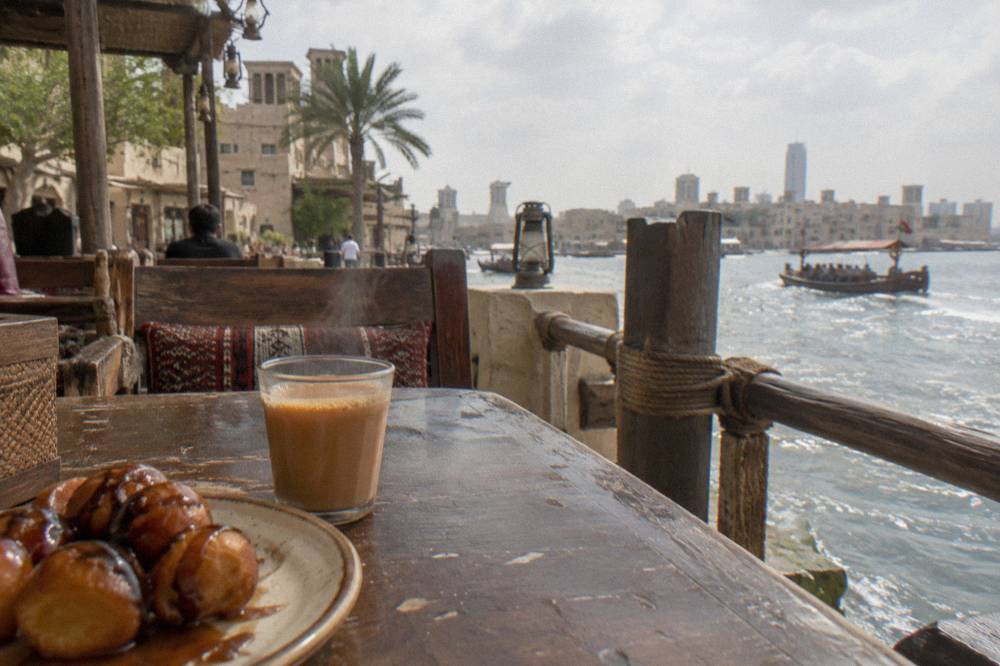
Karak chai is the drink locals order most often, a strong spiced milky tea reported at 1 to 3 AED at local cafeterias, while gahwa is the traditional Arabic coffee served unsweetened with cardamom in small finjan cups alongside dates. The etiquette around gahwa is specific: receive the cup with the right hand and shake the empty cup gently side to side to signal you are finished.
Karak is Dubai's daily ritual, drunk morning and evening, from car windows at drive-through cafeterias and standing at counters. The cafe versions cost more, with one reported example at 14 AED, but the stall version is the one locals queue for. It pairs naturally with the breakfast dishes: balaleet and karak is a classic combination. More of these guides are collected on Dubai Food Tours.
Gahwa belongs to the older layer of hospitality. It is lightly spiced with cardamom, unsweetened, poured in small amounts and always offered with dates. The etiquette is part of the welcome: the cup is received and held in the right hand, refills arrive until you signal, and the signal is a gentle side-to-side shake of the empty cup. Learning it before a cultural meal or a majlis visit marks you as a guest who did the homework.
Dates deserve their own sentence. The UAE's fresh date harvest, the rutab season, runs primarily through summer with a peak from June to September, and around 150 varieties are grown, with fresh dates reported from around 15 AED per kilogram at festivals and markets. Dried dates are available year-round, so a visitor in any month can taste them, but the fresh season is the one locals watch. The Arabic coffee, karak and dates guide goes deeper on all three.
Tourist Menu Dishes Versus Local Orders
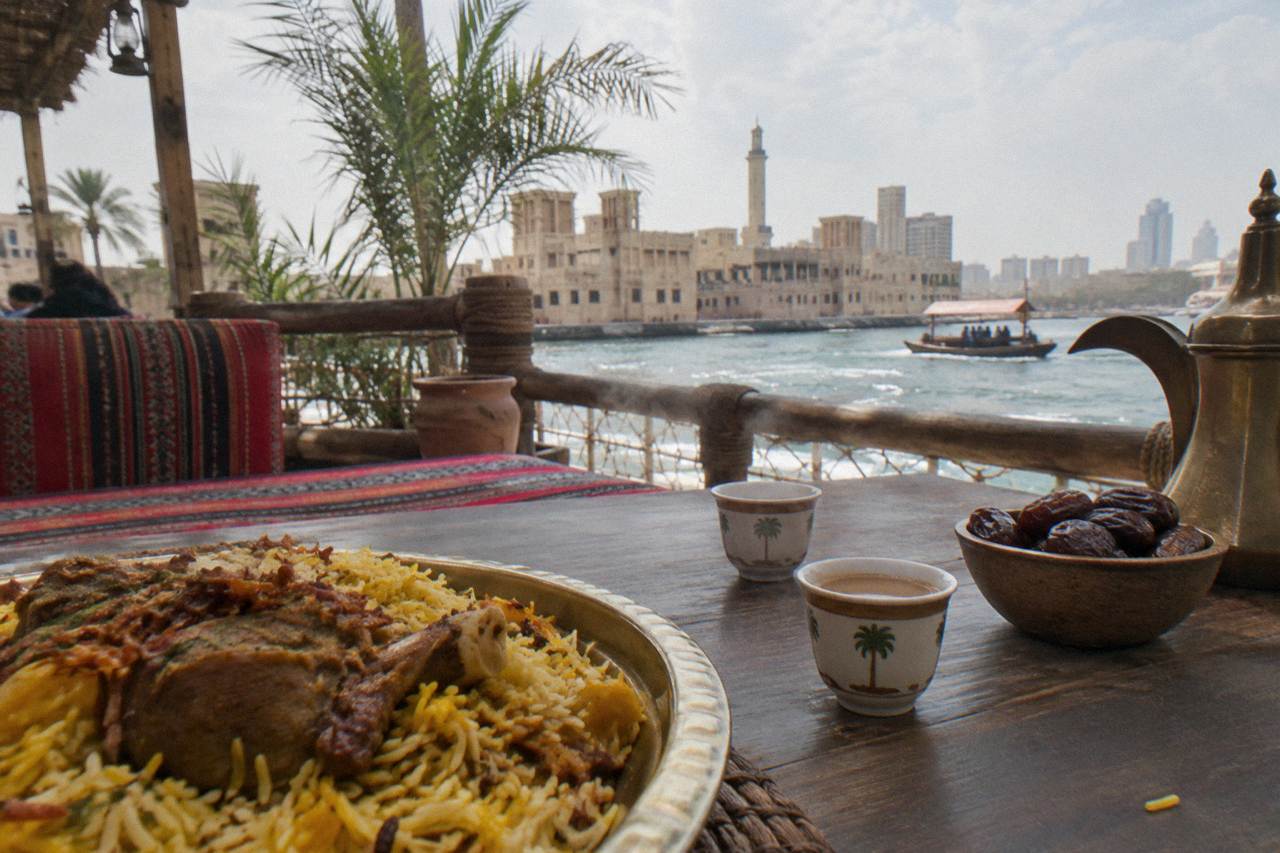
The tourist menu leans on the street layer, shawarma, falafel and luqaimat, because those dishes are visible, fast and cheap, while local orders add the platter dishes, machboos, harees and thareed, that need a table and time. Neither list is wrong. But a visitor who only eats the street layer leaves Dubai having tried half its famous food, and the Emirati half is the half that defines the cuisine.
The street layer travels well. A shawarma wrap is the same experience for a visitor and a resident, which is why it anchors so many visitor itineraries and tasting walks. The Emirati layer is different: machboos and harees rarely appear on a tourist street, they appear in homes, at cultural meals and in a handful of heritage restaurants, and a first-time visitor has to be taken to them or told where they are.
That asymmetry shapes what a good food day looks like. The strongest days pair one street crawl through Deira with one sit-down Emirati meal, either at a heritage restaurant or at a cultural meal with hosts who explain the dishes. The Emirati food experience at a local table guide describes what that meal actually involves, from the welcome coffee to the family-style platters.
One honest gap to flag: a shawarma-and-karak crawl, however good, is a snack tour, not a meal tour. The famous platter dishes need either a restaurant booking or a guided walk whose tastings include them, so plan at least one table meal into the itinerary rather than grazing all day.
How A Guided Walk Fits The Famous Dishes Into One Day
A guided food walk through Old Dubai bundles the famous dishes into a single route: Emirati tastings and heritage lanes in Al Fahidi, street staples around the Deira souks, and an abra crossing of the Creek between them. The walks compared here run from about 2 hours to 4 hours, with prices on each operator's live listing, and the tastings are listed on the booking page rather than left to chance.
The value of a guide in this district is not just translation. It is sequencing. The premium guided tour with street food and an abra ride runs 3 to 4 hours and its listing describes tastings of shawarma, falafel, karak, samboza, regag and luqaimat, a list that spans both layers of the famous-food table above. That breadth is hard to assemble alone in one afternoon, especially the Emirati items, which is why the format earns its price for first-time visitors.
The historic guided tour format covers similar ground with a Creek and souks emphasis, also 3 to 4 hours, and suits visitors who want the market history and the street food weighted equally. For a different angle, the 4 Cuisines walk frames the tasting route around four culinary traditions rather than one, which matches how Deira actually eats: Iranian, Afghan, Indian, Pakistani and Lebanese kitchens sit within blocks of each other.
The walks below give the shape of the choice: format, length and what each listing says it covers. Prices vary by date and group size, so the operator's live listing is the place to check the current figure before booking.
| Walk | Length | What the listing describes |
|---|---|---|
| Al Fahidi Old Town, Souks, Street Food and Abra Cruise | 2.5 to 4 hours | Old town, souks, street food and a Creek cruise |
| Premium Guided Tour with Street Food and Abra Ride | 3 to 4 hours | Guided route with tastings of shawarma, falafel, karak, samboza, regag and luqaimat |
| Historic Guided Tour: Creek, Street Food and Souks | 3 to 4 hours | Creek, street food and souk history in one route |
| Food Tour: 4 Cuisines, Souks and Street Bites | 3 to 4 hours | Tastings across four culinary traditions with souk stops |
Meeting points across these walks cluster in the same small set of Old Dubai landmarks, among them a heritage restaurant in Al Fahidi, a metro station exit in Deira and a hotel entrance at Al Seef, so whichever format you pick, the day starts inside the district you came to eat in. If you would rather move at your own pace, the food walking tour pace and stops guide covers what to expect on foot.
Practical Notes For Ordering Like A Local
Order like a local in Dubai by eating breakfast where karak is served, ordering platters to share rather than single plates at Emirati restaurants, and checking dietary questions with the operator or venue before you order. All meat in restaurants and markets is halal, pork appears only in designated licensed sections, and visitors over 21 can drink only at licensed venues, never in public places.
A few habits carry most of the weight. Eat breakfast late enough to want it. Order karak with anything sweet. At an Emirati table, expect food to arrive shared and family-style, and pace yourself accordingly. In the souks, ask before photographing people, especially women and families in traditional attire; photographing individuals without consent can violate privacy rules, and asking costs nothing.
Dietary needs deserve a direct note. All meat sold in restaurants and markets follows halal rules, and pork is sold only in designated licensed sections. No tour should be assumed vegetarian, vegan, gluten-free or kosher unless its listing says so: the honest move is to message the operator before booking and ask. The vegetarian and dietary needs guide covers this in full.
Dress and season matter for the walking part. Cover shoulders and knees in heritage areas and souks, which is respect rather than law but avoids attention in traditional districts. December through February brings the lowest average daytime highs, a reported 24 to 26 °C, the comfortable window for a long route on foot. The dress code for walking tours and souks guide has the details, and the official RTA metro map covers the Green Line stations, Sharaf DG for Al Fahidi and Al Ras for the Deira souks, that frame the whole district.
Putting The Day Together
A famous-food day in Dubai works best as one street crawl and one table meal: karak and a breakfast dish in Al Fahidi, shawarma, falafel and luqaimat around the Deira souks, an abra crossing of the Creek in between, and a machboos or harees platter to finish. The guided walks compared here compress that whole sequence into 2 to 4 hours, with every tasting named on the booking page. Before you pick a walk, reading up on the stories behind karak, machboos, and luqaimat adds real context to each stop, and the guide to Dubai's most famous dishes and where they came from covers exactly that.
The sequence matters because the district rewards walkers. Al Fahidi, Al Seef and the Textile Souk sit on the Bur Dubai side, the Spice Souk and Gold Souk on the Deira side, and the Creek crossing between them is a few minutes by abra. Doing all of it independently is entirely possible, and the getting to Old Dubai by metro and abra guide explains the connections. Doing it with a guide simply removes the route-finding and guarantees the dish list in advance.
Whatever the choice, the underlying point of this page stands: the famous food in Dubai is a known, short, orderable list. Locals are not keeping secrets. They are ordering machboos, harees, luqaimat, shawarma and karak, and any visitor with half a day and a route through Old Dubai can be eating exactly the same things by dinner.
Common Questions About Famous Food In Dubai
What Is The Most Famous Food In Dubai?
Machboos is widely described as the UAE national dish, long-grain rice slow-cooked with meat, dried limes and baharat spices, but the street staples, shawarma, falafel, samboosa and karak chai, are what most people eat daily. Luqaimat, crisp fried dumplings with date syrup, is the famous sweet.
What Food Do Locals In Dubai Actually Order?
Locals order platter dishes at Emirati restaurants, machboos, harees and thareed, and street staples at cafeterias, shawarma, falafel, biryani and karak chai. Reported figures put the cafeteria meal at 15 to 40 AED per person and Emirati mains in heritage settings at roughly 42 to 65 AED.
How Much Does Famous Food Cost In Dubai?
At street level, reported prices run from about 1 to 3 AED for karak chai to 8 to 15 AED for a shawarma at local spots. A casual meal runs a reported 15 to 40 AED per person, while a mid-range restaurant meal costs around 80 to 150 AED per person before service charge and VAT.
Where Can I Try Emirati Dishes In Dubai?
Al Fahidi Historical Neighbourhood in Bur Dubai is the natural starting point, with courtyard cafes serving balaleet and regag and a cultural centre offering hosted Emirati meals, reported at AED 130 to 160 depending on the sitting, booking required. Deira's heritage restaurants serve machboos, harees and thareed.
Is All Food In Dubai Halal?
All meat sold in restaurants and markets follows halal rules, and pork is sold only in designated licensed sections. Visitors with vegetarian, vegan or other dietary needs should message the tour operator or venue before booking, since a listing that does not mention an accommodation is not promising one.
Do I Need A Food Tour To Eat The Famous Dishes?
No, but a guided walk compresses the hunt into one route. The walks compared here run 2 to 4 hours through Al Fahidi, the souks and the Creek, with tastings listed on the booking page, which removes the guesswork of finding the Emirati platter dishes independently.