What To Eat In Dubai: A First-Timer List
Dubai's food identity sits at the junction of three kitchens: Emirati, Levantine and South Asian. This list names the ten dishes a first-timer should seek out, what each one is, and what it costs.
Short answer
Start with shawarma, falafel, karak chai and luqaimat from Old Dubai's stalls, where reported prices run from around 1 AED for tea to 15 AED for a wrap. Then seek out Emirati dishes: machboos, harees and balaleet. A guided tasting walk stitches the neighbourhoods together in three hours.
Dubai's food scene is not one cuisine wearing a city's name. It is three kitchens sharing the same streets. The Emirati table gave the city machboos, harees and luqaimat. Levantine grills and wraps supply the shawarma and falafel nearly everyone eats. South Asian cooks, who have shaped Old Dubai's cafeterias for generations, pour the karak chai that locals queue for at all hours. A first visit done well samples all three.
This list names ten dishes worth hunting down, explains what each one actually is, and gives reported prices where trustworthy figures exist. It also shows where each dish sits on the map of Bur Dubai and Deira, the two historic districts where most of the eating happens, and where a guided tasting walk earns its fee. For the broader neighbourhood picture, the Dubai street food guide covers stalls and ordering customs in more depth.
What To Eat In Dubai: The Short Answer
Eat five things from the street and five from the Emirati table. On the street: shawarma, falafel, samosas, karak chai and luqaimat, with reported prices from around 1 AED for tea to 15 AED for a wrap. At the table: machboos, harees, balaleet, chebab and thareed. Both halves sit within walking distance in Old Dubai, and a three-hour guided walk can cover most of them. For a wider look at how these Dubai staples fit into eating habits across all seven emirates, the guide to everyday food across the UAE covers what each dish is and what it typically costs.
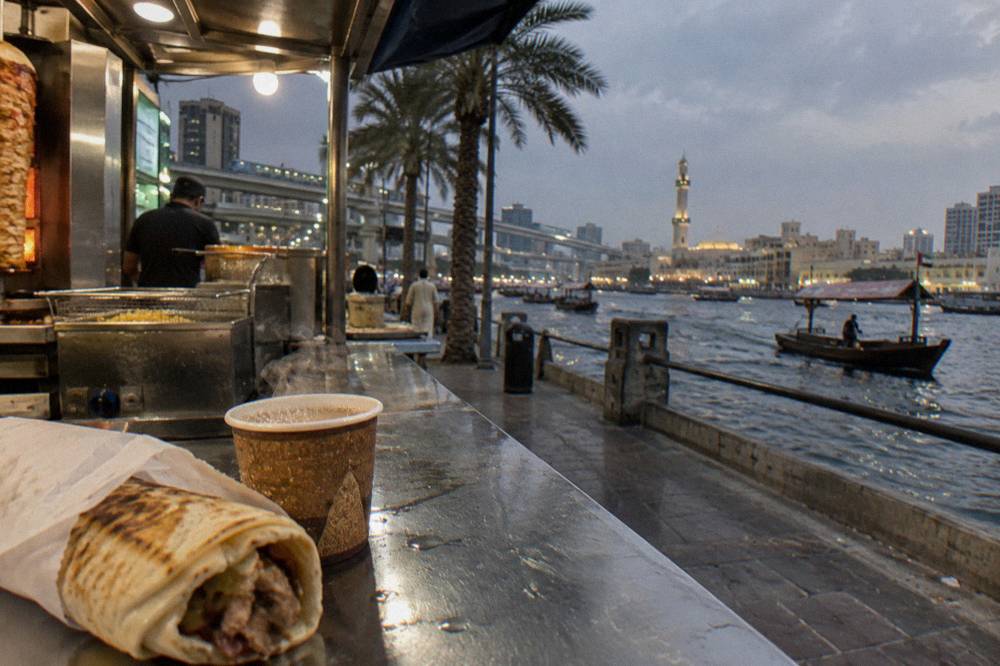
The split matters because the two halves of the list live in different places. The street half comes from cafeteria counters and stall windows, mostly in Deira and along the Bur Dubai creek side, and it costs very little: reported figures put falafel wraps at 4 to 15 AED and samosas at 1 to 5 AED each. The Emirati half is a sit-down affair, served in heritage restaurants in Al Fahidi and Deira, where reported mains run from around 42 AED for harees to about 65 AED for machboos.
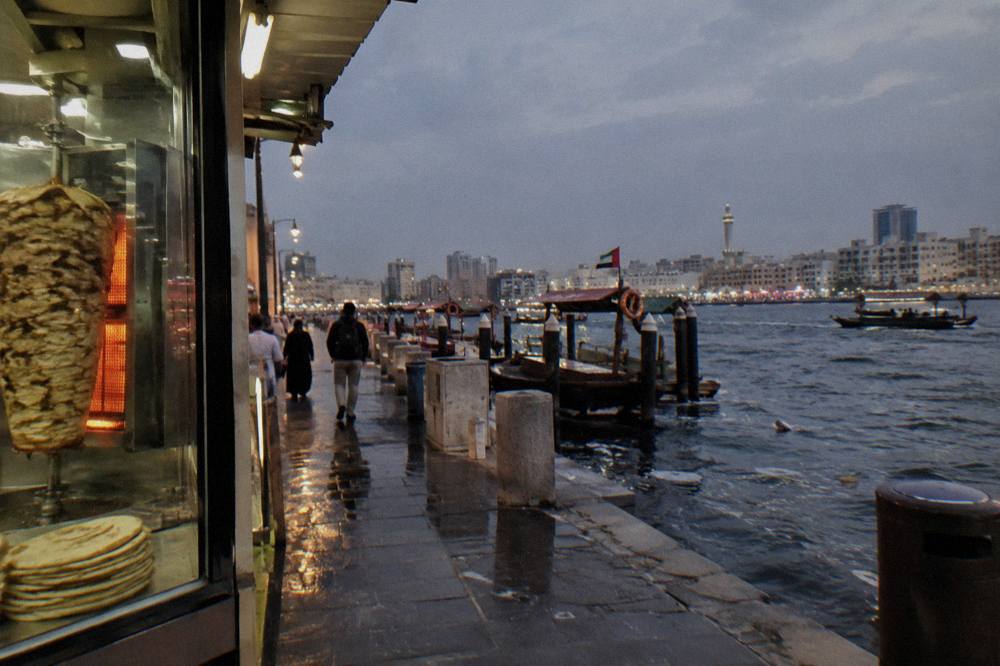
Neither half is hard to reach. The Green Line metro stops at Baniyas Square, Gold Souq and Al Ras on the Deira side, and Sharaf DG serves the Al Fahidi area, per the official transport authority's station map. Between them run the abra boats that cross the Creek, so a day of eating can loop from one bank to the other without a taxi. The guide to getting to Old Dubai by metro and abra explains the connections stop by stop.
If you would rather have the route, the stalls and the dish explanations handled for you, the three walks below cover exactly this territory.
The Ten Dishes, Explained One By One
The list runs from the familiar to the specific: shawarma and falafel first, then karak chai and samosas, then luqaimat for dessert, and finally the Emirati table dishes machboos, harees, balaleet, chebab and thareed. Each one is described here exactly as the sources report it, with reported prices where clusters state them and no invented figures anywhere.
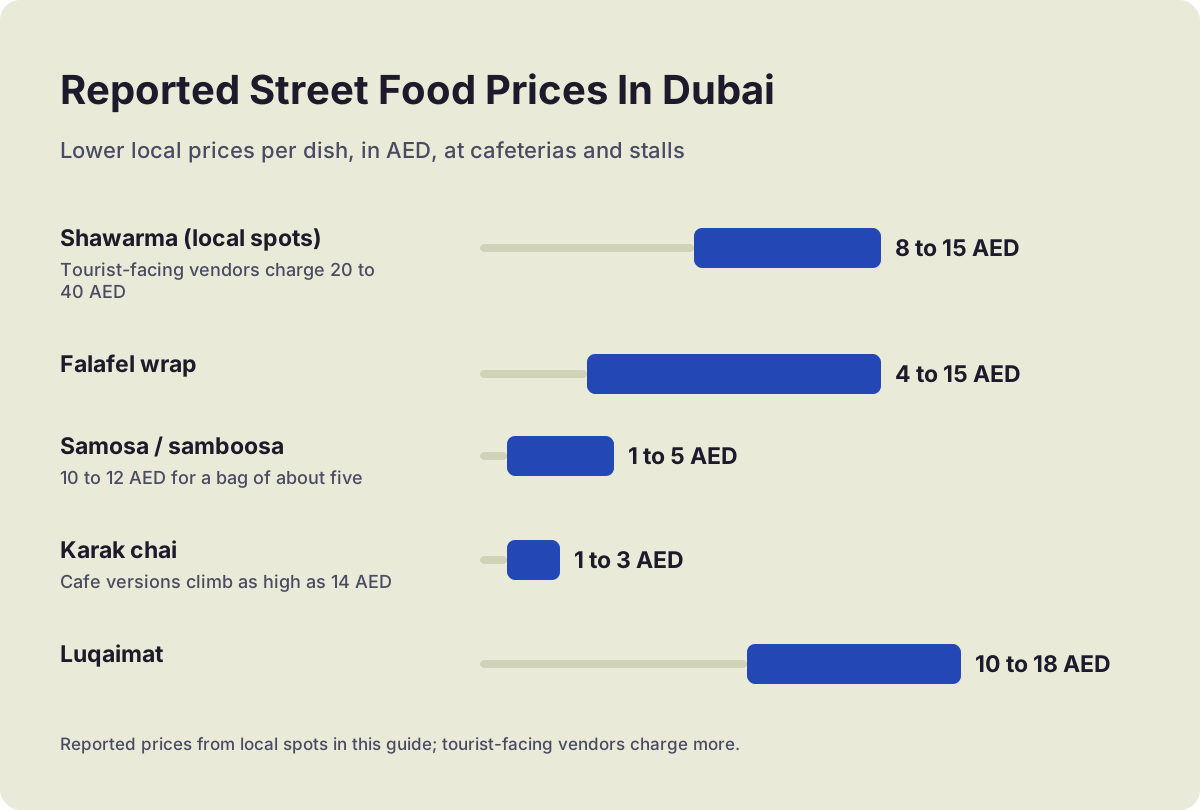
Shawarma needs little introduction but benefits from ordering advice. It is meat, usually chicken or lamb, shaved from a vertical spit into a wrap with garlic sauce and pickles. Reported prices at local spots run 8 to 15 AED, while tourist-facing vendors charge 20 to 40 AED, so the same item can cost three times more two streets apart. A chicken shawarma wrap runs 12 to 18 AED at example spots.
Falafel is the reliable vegetarian anchor of the list, fried chickpea balls tucked into bread with hummus and salad. Reported wraps cost 4 to 15 AED. Samosas, called samboosa locally, are fried pastry triangles; reported prices run 1 to 5 AED each or 10 to 12 AED for a bag of about five.
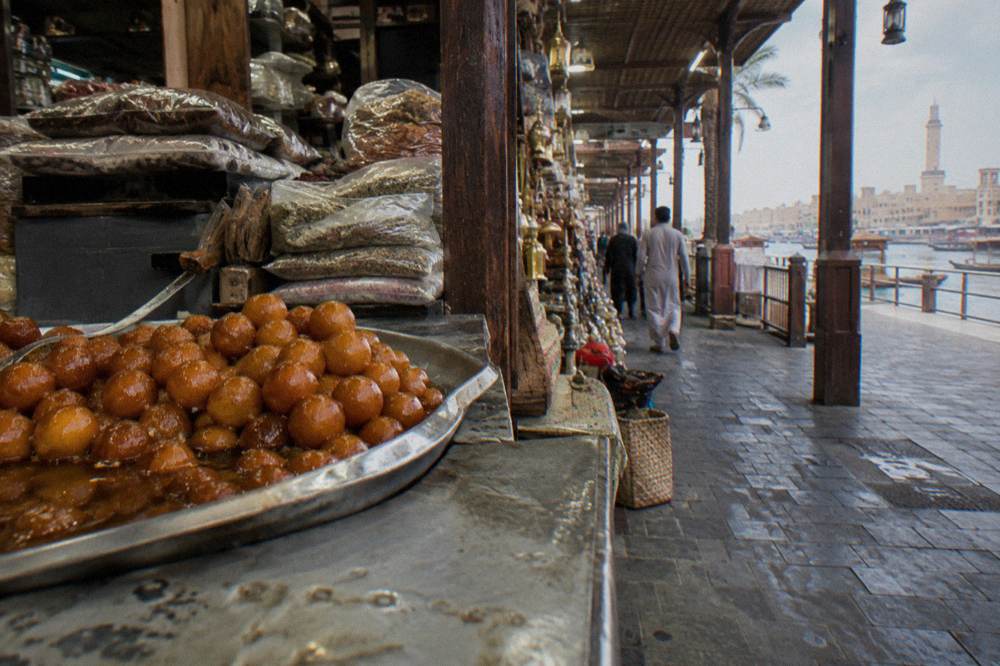
Karak chai is the drink that holds the whole list together: strong black tea boiled with milk, sugar and cardamom. Reported prices at local cafeterias run 1 to 3 AED, with cafe versions climbing as high as 14 AED. Luqaimat are the dessert: crisp fried dough dumplings drizzled with date syrup and sesame seeds, served warm, reported at 10 to 18 AED.
| Dish | What it is | Reported price | Where to look |
|---|---|---|---|
| Shawarma | Meat shaved from a spit, wrapped with sauce and pickles | 8 to 15 AED local, 20 to 40 AED tourist spots | Cafeterias in Deira and Bur Dubai |
| Falafel wrap | Fried chickpea balls with hummus in bread | 4 to 15 AED | Cafeterias and Levantine counters |
| Samosa / samboosa | Fried pastry triangle, spiced filling | 1 to 5 AED each, 10 to 12 AED per bag | Deira stalls |
| Karak chai | Milky cardamom tea | 1 to 3 AED at local stalls | Cafeterias citywide |
| Luqaimat | Fried dumplings with date syrup and sesame | 10 to 18 AED | Sweet stalls and heritage restaurants |
| Machboos | Spiced rice with meat, dried limes and saffron | Around 58 to 65 AED at example restaurants | Emirati restaurants, Deira and Al Fahidi |
| Harees | Wheat and meat slow-cooked to a porridge | Around 42 AED at example restaurants | Emirati restaurants |
| Balaleet | Sweet saffron noodles topped with egg | Around 52 AED at an example Al Fahidi cafe | Al Fahidi breakfast spots |
| Chebab | Saffron and cardamom pancakes with date syrup | Varies, check the venue | Emirati breakfast menus |
| Thareed | Meat and vegetable stew over thin regag bread | Around 55 to 58 AED at example restaurants | Emirati restaurants |
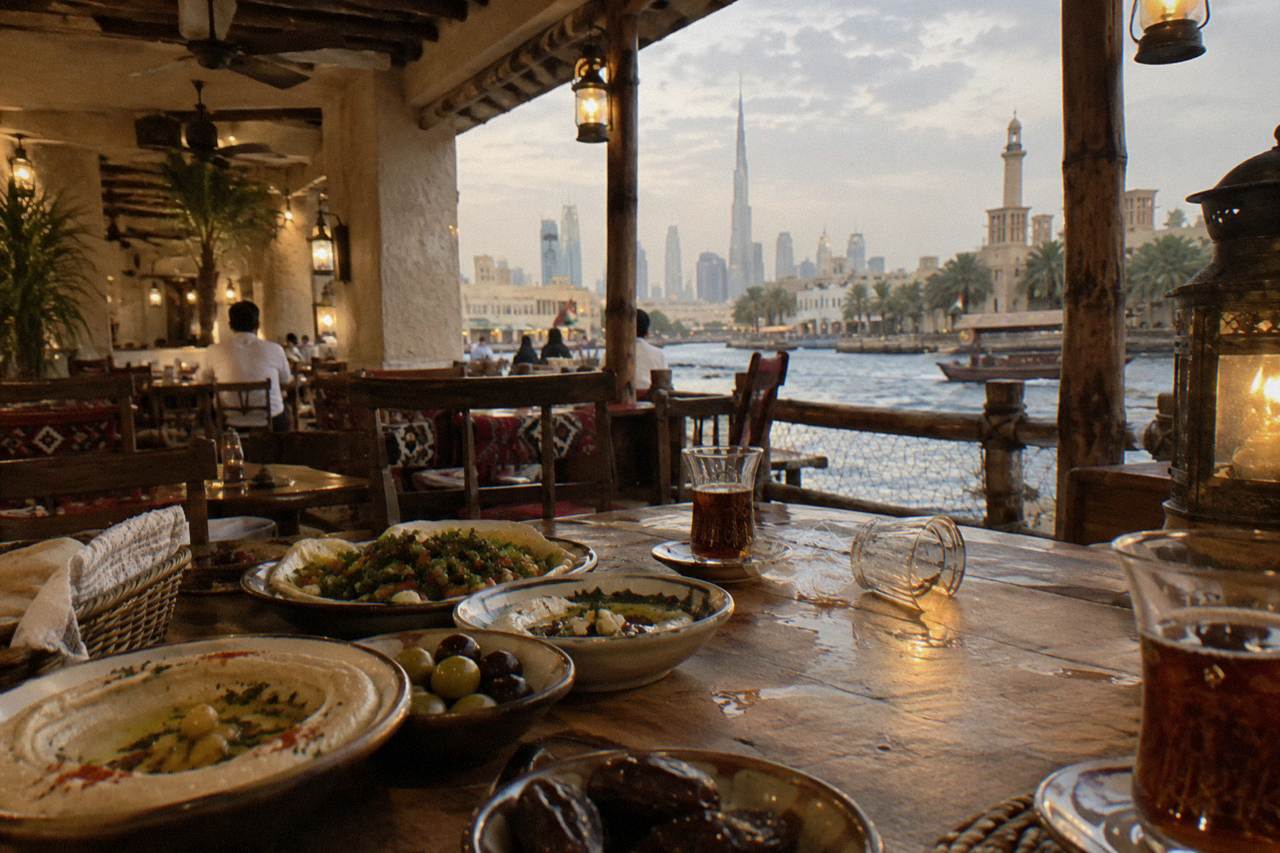
The Emirati dishes deserve their own words, because they are the ones a first-timer cannot guess at. Machboos is the UAE's national dish: long-grain rice slow-cooked with lamb, chicken or fish, dried limes called loomi, baharat spices, cardamom, saffron and cinnamon, served family-style. Harees is wheat and meat cooked for six to eight hours until smooth, finished with ghee. Balaleet is sweet saffron and cardamom vermicelli topped with a thin omelette, a breakfast dish that surprises people who expect dessert logic. Chebab are saffron, cardamom and turmeric pancakes eaten with cream cheese and date syrup. Thareed is a stew ladled over paper-thin regag bread so it drinks up the broth.
For more on each of these, the guide to traditional Emirati dishes goes dish by dish through the cooking methods, and the Emirati food guide covers the spice cupboard behind them.
Where To Eat Each Dish In Old Dubai
Bur Dubai's Al Fahidi district holds the Emirati sit-down restaurants and the heritage cafes, while Deira holds the dense street-eating around the Spice Souk and Gold Souk. The Creek sits between them and an abra boat crosses it in minutes. Reported shop hours cluster around 10am to 10pm on the Gold Souk side, with Friday daytime closures on the Spice Souk side.
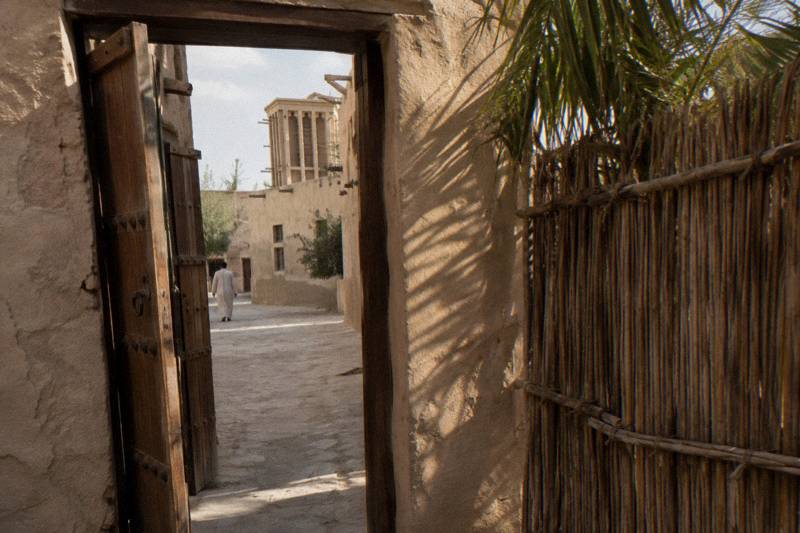
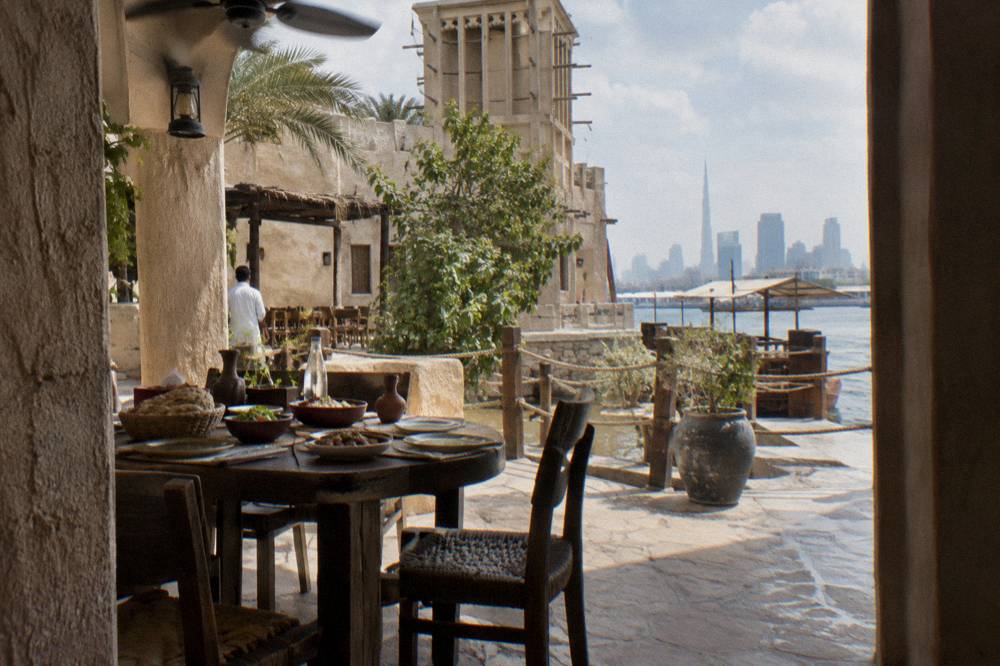
The geography is forgiving. On the Bur Dubai bank, Al Fahidi Historical Neighbourhood is a district of wind-tower houses and courtyards, open for free walking from 7am to 8pm per the culture authority's stated hours. Arabian Tea House there serves balaleet at a reported 52 AED alongside Emirati breakfast boards. On the Deira bank, Local House and Al Bait Al Qadeem serve machboos, harees and thareed at the reported prices in the table above.
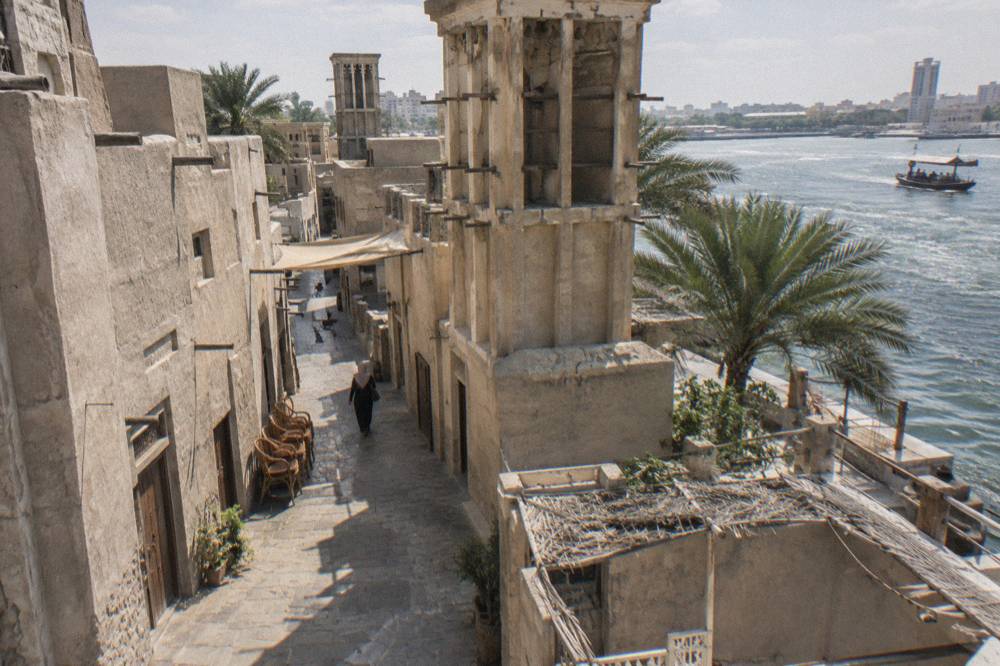
The street half of the list clusters around the Deira souks. The Spice Souk's shops generally open earlier than 8am and run past 9pm, with Friday daytime closures, and many take midday breaks, per the tourism authority's descriptive hours. The Gold Souk's shops mostly open around 10am to 10pm, though individual shops vary and no single official timetable exists. Between the two souks, the cafeteria counters selling shawarma, falafel, samosas and karak sit on the surrounding streets.
| Area | Dishes to eat there | Reported example prices | Getting there |
|---|---|---|---|
| Al Fahidi Historical Neighbourhood | Balaleet, chebab, gahwa and dates | Balaleet around 52 AED at an example cafe | Green Line metro, Sharaf DG station |
| Al Seef waterfront | Karak, luqaimat, heritage cafe food | Varies by venue, check the menu | Walkable from Al Fahidi, roughly 1.8 km stretch |
| Deira Spice Souk streets | Falafel, samosas, karak chai | Falafel 4 to 15 AED, karak 1 to 3 AED | Green Line metro, Al Ras or Baniyas Square |
| Deira Gold Souk area | Shawarma, cafeteria meals | Shawarma 8 to 15 AED local, meals 15 to 40 AED | Green Line metro, Gold Souq station |
| Sheikh Mohammed Centre for Cultural Understanding | Emirati cultural meal with gahwa and dates | Breakfast or brunch 130 AED, lunch 145 AED, tea time 150 AED, dinner 160 AED | Inside Al Fahidi, booking required |
The Sheikh Mohammed Centre for Cultural Understanding in Al Fahidi offers a different route into the Emirati half of the list: 1.5-hour cultural meals with Emirati hosts, Arabic coffee and dates, and a question session on customs and daily life. Reported prices are 130 AED for breakfast or brunch, 145 AED for lunch, 150 AED for tea time and 160 AED for dinner, booking required, per the centre's own programme page. That is a sit-down introduction to the table dishes with someone to explain them, which no stall can offer.
If the idea of walking this loop with a guide appeals, the Old Town street food walk with an abra ride is the format most first-timers pick.
The listing describes tastings across the souks with the Creek crossing included, which maps neatly onto the loop above. Check the booking page for the current price, meeting point and what the tastings cover on your date.
For anyone who would rather have a guide handle the same territory, the Old Town guided route is the natural fit.
Street Food Prices And What They Mean
A full street half of the list costs very little: reported figures put a shawarma at 8 to 15 AED, a falafel wrap at 4 to 15 AED, karak at 1 to 3 AED and samosas at 1 to 5 AED each. A casual cafeteria meal of biryani or mezze runs a reported 15 to 40 AED per person. Mid-range restaurant meals sit far higher, around 80 to 150 AED.
The gap between those two ranges is the whole argument for eating street food in Dubai. The dishes on this list were born as cheap food and remain cheap where locals buy them. The same shawarma that costs 8 to 15 AED at a local counter costs 20 to 40 AED at a tourist-facing spot, so the skill is less about finding the dishes and more about finding the counters.
Restaurant bills carry additions worth knowing before the first sit-down meal. A 5 per cent federal VAT applies to food and beverage, and venues commonly add a service charge of up to 10 per cent, which is discretionary and retained by the venue rather than a government fee. Cash tips of 5 to 10 per cent are common but voluntary. The official tourism authority's tipping guidance suggests 10 to 15 per cent at restaurants and smaller fixed amounts at cafes.
Guided food tours sit in a different bracket again. One long-standing operator's own page lists a 3.5-hour guided walk at 435 AED per person including sampled food and water, which is a useful benchmark for what a full professionally guided tasting route costs in this city. The tours on this site each state their own price on their booking pages, and the guide to food tour costs breaks down what drives the differences.
Karak, Gahwa And The Drinking Culture
Karak chai is the everyday drink, a reported 1 to 3 AED at cafeteria counters, and gahwa, lightly spiced unsweetened cardamom coffee, is the ceremonial one, served in small cups with dates. Etiquette for gahwa is specific: accept and receive the cup with the right hand, and shake the empty cup gently side to side to signal no more.
The two drinks bookend the day in Old Dubai. Karak is the workers' and drivers' fuel, ordered in seconds from cafeteria windows and often taken with a samosa. Gahwa is the welcome drink, poured in majlis settings and at cultural meals, always alongside dates. The pairing of dates and gahwa is the country's basic gesture of hospitality. More of these guides are collected on Dubai Food Tours.
Fresh dates have their own season. The UAE's rutab harvest runs primarily through summer, peaking between June and September, with around 150 varieties including Khalas, Barhi and Fard, reported from about 15 AED per kilogram at festivals and markets. Dried dates are available year-round, so a November visitor is not missing out on the fruit, only the fresh soft version.
Alcohol is the one drink that does not belong on this list. Visitors over 21 may drink at licensed venues such as hotels, restaurants and lounges, and no personal permit is needed for on-site consumption, but alcohol is not allowed in public places outside licensed venues. The food walks through Old Dubai serve no alcohol unless a listing says otherwise, and the guide to alcohol and pork on a food tour covers the rules in full.
Dietary Needs, Halal Rules And Etiquette
All meat sold in Dubai's restaurants and markets is halal, and pork appears only in designated licensed sections, so the default meal is halal throughout. Vegetarians can rely on falafel, hummus and the vegetable Emirati dishes, but no listing is described as vegan, gluten-free or kosher unless it says so: message the operator before booking. Cover shoulders and knees in souks and heritage areas.
The halal rule comes from federal food standards, not from individual restaurant choice, which means a first-timer does not need to ask. It also means pork dishes are rare and clearly segregated where they exist. For vegetarians the street half of the list is friendly: falafel wraps and hummus are everywhere, and dishes like balaleet and luqaimat are meat-free, though anyone with strict requirements should check with the venue or operator directly.
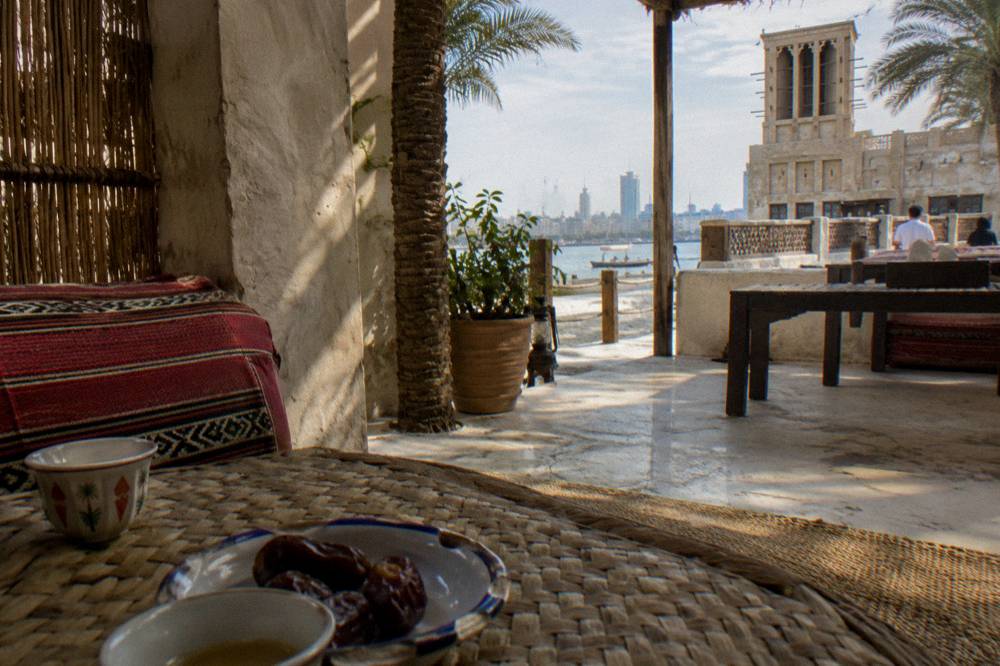
Etiquette around the table is light but real. Gahwa is received with the right hand. Photography in souks should start with a question: ask before photographing individuals, especially women and families in traditional attire, since photographing people without consent can breach privacy expectations. During Ramadan, restaurants operate normally and non-Muslims are not required to fast, though discretion is advised outdoors during daylight hours, per the current rules.
Tipping closes the loop: no set rules exist, personal preference governs, and the common pattern is 5 to 10 per cent cash on top of any service charge, or simply rounding up. The guide to tipping and paying in Old Dubai works through the bill line by line.
How A Guided Tasting Walk Fits Into This List
A guided walk compresses the list into one route: three to four hours, a guide explaining each dish, and tastings already paid for. The trade is money for certainty. Independent eating costs a reported 15 to 40 AED per person in cafeterias, while a guided walk's price is stated on its booking page and typically includes multiple tastings, a boat crossing and a guide's commentary.
The value of a guide is not navigation, since the districts are walkable and the metro reaches them. It is translation. A guide can explain what loomi does to machboos, why harees takes eight hours, which stall's samosas are worth the stop today, and how to order karak like a local. That layer of explanation is what turns ten snacks into a lesson in the city's food history.
The Old Town street food and guided walking tour is built exactly around this list's territory. The listing describes a guided route through Old Town with street food along the way. Check availability on the operator's booking page, where the current price, meeting point and tasting list are shown for each date.
A shorter alternative covers similar ground in two hours with a boat crossing included, which suits a tight schedule.
For first-timers weighing whether the fee is justified at all, the guide to whether food tours in Dubai are worth it sets out both sides honestly.
A Sample First Day Of Eating In Dubai
Start with an Emirati breakfast in Al Fahidi, where balaleet and chebab anchor the menu and a reported 52 AED covers an example dish at a heritage cafe. Walk the creek side, cross by abra, then eat the street half of the list around the Deira souks: shawarma, falafel, samosas and karak at reported prices from 1 to 18 AED. Finish with luqaimat and a sit-down machboos if any room remains.
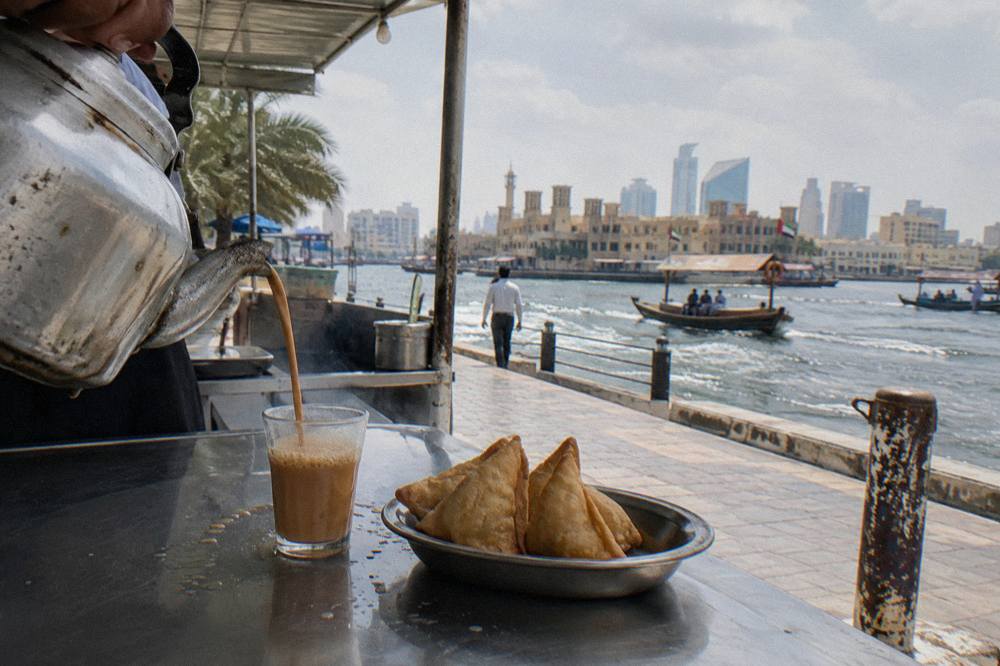
The order is deliberate. Breakfast dishes are the ones that vanish from menus by midday, so they come first. The Al Fahidi lanes open from 7am per the stated neighbourhood hours, and a morning there covers balaleet, chebab, gahwa and dates before the heat builds. Winter helps: December through February bring the lowest average daytime highs, 24 to 26 °C per the compiled climate normals, which is walking weather rather than surviving weather.
| Time of day | Where | What to eat | Reported cost |
|---|---|---|---|
| Morning | Al Fahidi Historical Neighbourhood | Balaleet, chebab, gahwa with dates | Balaleet around 52 AED at an example cafe |
| Late morning | Al Seef waterfront walk | Karak chai stop | Karak 1 to 3 AED at local stalls |
| Midday | Abra crossing to Deira | The crossing itself, then falafel | Falafel wraps 4 to 15 AED |
| Afternoon | Deira souks and cafeterias | Shawarma, samosas, biryani or mezze meal | Shawarma 8 to 15 AED, meals 15 to 40 AED |
| Evening | Deira or back in Bur Dubai | Luqaimat, then machboos if room remains | Luqaimat 10 to 18 AED, machboos around 58 to 65 AED |
The afternoon belongs to Deira. The abra crossing between the banks takes minutes, and the Spice Souk's shops generally open earlier than 8am and past 9pm, so timing is flexible outside Friday daytime closures. A cafeteria meal of biryani or mezze runs a reported 15 to 40 AED per person, and the stalls selling luqaimat appear in the evening. Souk browsing is free, and the guide to free things and budget food in Dubai covers the no-cost half of the day in detail.
Anyone who wants the whole loop handled, tastings counted and history narrated, can book a premium version that adds a guide and a boat ride across the Creek.
Whether you eat it independently or with a guide, the list holds. Ten dishes, three kitchens, two creek banks, and a city that explains itself best through what it puts on the table. Dubai Food Tours exists to make that first table easier to find.
If you are still choosing between formats, these three walks cover the same ground in different styles.
Common Questions About What To Eat In Dubai
What To Eat In Dubai For The First Time?
Start with shawarma, falafel, karak chai and luqaimat from the street stalls of Old Dubai, then sit down for the Emirati table dishes: machboos, harees, balaleet and thareed. Reported street prices run from about 1 AED for tea to 18 AED for luqaimat, while example Emirati mains sit around 42 to 65 AED.
What Is The UAE's National Dish?
Machboos: long-grain rice slow-cooked with lamb, chicken or fish, dried limes, baharat spices, cardamom, saffron and cinnamon, served family-style on a platter. Example restaurants in Deira serve it at a reported 58 to 65 AED.
Is Street Food In Dubai Cheap?
Where locals buy it, yes. Reported prices put falafel wraps at 4 to 15 AED, shawarma at 8 to 15 AED at local spots, karak chai at 1 to 3 AED and samosas at 1 to 5 AED each. Tourist-facing vendors charge more, up to 40 AED for a shawarma, so the counter you choose matters as much as the dish.
What Do Locals Drink With Their Food?
Karak chai, spiced milky tea, is the everyday drink at a reported 1 to 3 AED from cafeteria counters. Gahwa, lightly spiced unsweetened cardamom coffee served in small cups with dates, is the ceremonial welcome drink.
Can Vegetarians Eat Well From This List?
Yes: falafel, hummus, balaleet, chebab and luqaimat are all meat-free. All meat in Dubai's restaurants is halal by federal rule, and pork is limited to designated licensed sections. Anyone with strict dietary requirements should message the restaurant or tour operator before booking, since listings do not always state vegan or gluten-free options.
Do I Need A Food Tour To Eat Well In Dubai?
No, the districts are walkable and the dishes are cheap to find independently. A guided walk adds explanation, a counted set of tastings and a route that connects the banks of the Creek, which many first-timers find worth the fee. The choice is set out in the guide to whether these walks are worth it.