Getting To Old Dubai By Metro And Abra
Old Dubai is the one part of the city where the metro, a wooden boat and a short walk do more work than any taxi, and knowing the stations before you arrive is what keeps a food day simple.
Short answer
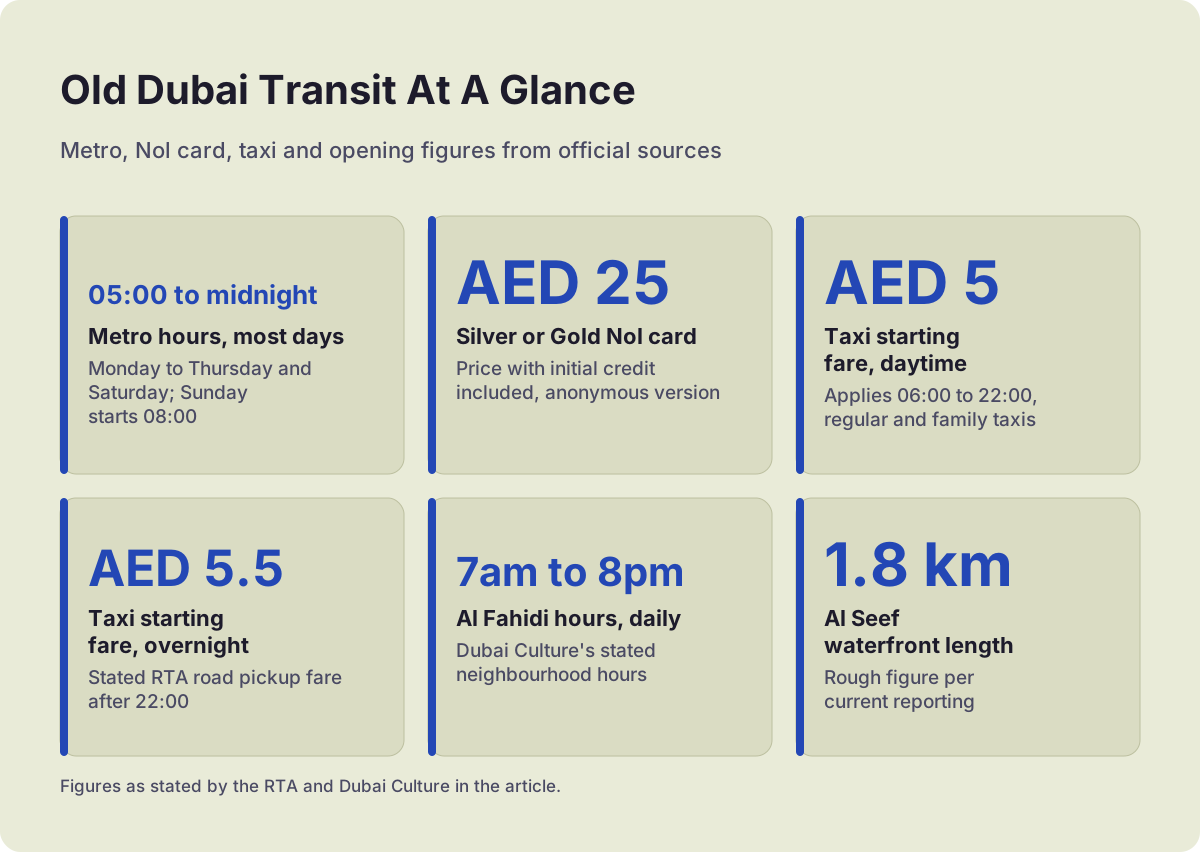
The Green Line serves Old Dubai directly: Al Ras and Gold Souq for the Deira souks, Baniyas Square for the abra side, and Sharaf DG for Al Fahidi and Al Seef. Trains run from 05:00 to midnight most days, a Nol card costs AED 25 with credit included, and the Creek crossing is by abra, with the fare paid at the dock.
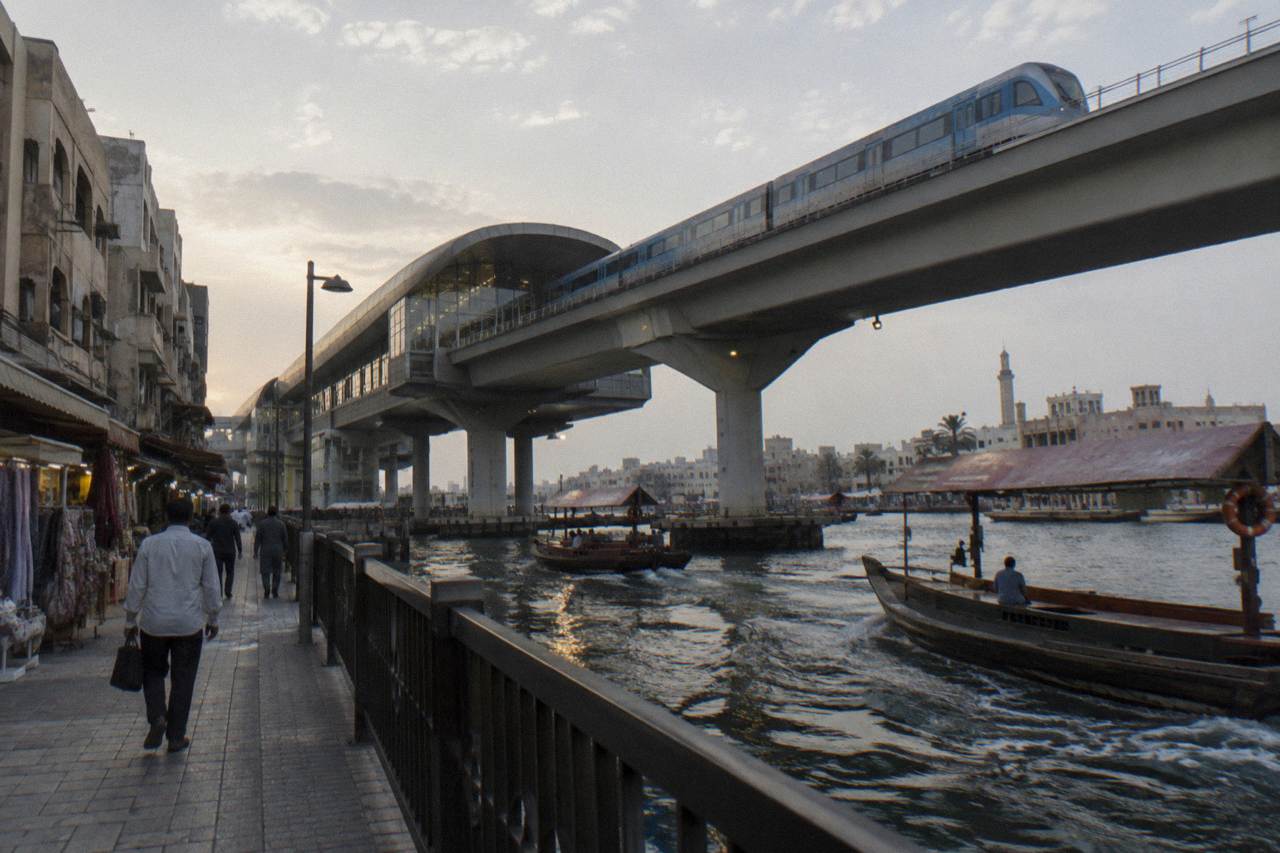
Old Dubai runs on three transport layers stacked on top of each other: an elevated metro line along the Creek's northern edge, a set of wooden abras crossing the water itself, and a dense street grid that is faster on foot than in any car. Visitors who work this out before arrival spend their day eating rather than circling for parking. This page lays out the stations, the crossings, the taxi rules and the timing, using official transport figures and reported souk patterns, so the logistics are settled before you book anything.
The payoff is real. Nearly every guided food walk in the old quarter starts at a fixed meeting point within walking distance of a metro station, from Al Ras exit 2 in Deira to the Sharaf DG stop serving Al Fahidi. Meeting-point logistics decide whether the tour is easy to reach, and a traveler who knows the map can pick a food walk the way a commuter picks a route. Dubai Food Tours covers the eating side of every district this page gets you to.
Which Metro Stations Serve Old Dubai?
The Green Line carries the whole district: Union and Baniyas Square sit at the Deira end, Gold Souq and Al Ras serve the souks, Sharaf DG is the stop for Al Fahidi and Al Seef, and BurJuman links to the Red Line for hotel-side transfers. Every one of these stations sits within roughly a ten to fifteen minute walk of a major food area, and no transfer is needed once you are on the Green Line.
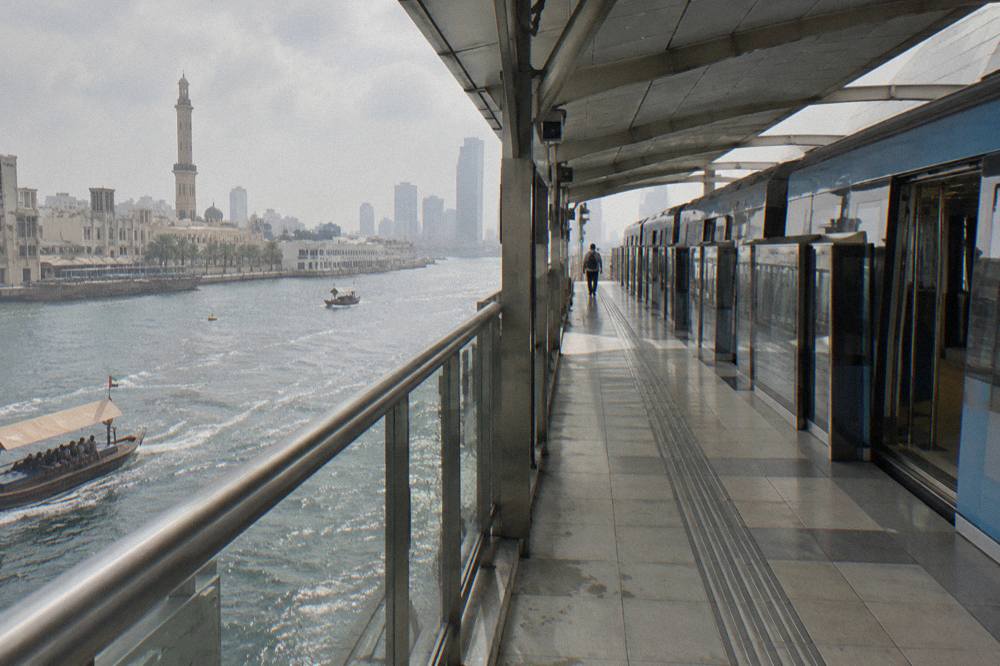
The station naming follows the geography closely. On the Deira side, the official RTA station list runs Union (the interchange with the Red Line), then Baniyas Square, Gold Souq and Al Ras. Gold Souq station is the closest stop to the Gold Souk itself, and Al Ras is the closest to the Spice Souk and the winding lanes around it. On the Bur Dubai side, Sharaf DG serves the Al Fahidi area, and BurJuman, two stops further, is the interchange where Red Line riders coming from the Marina or the airport hotels change trains.
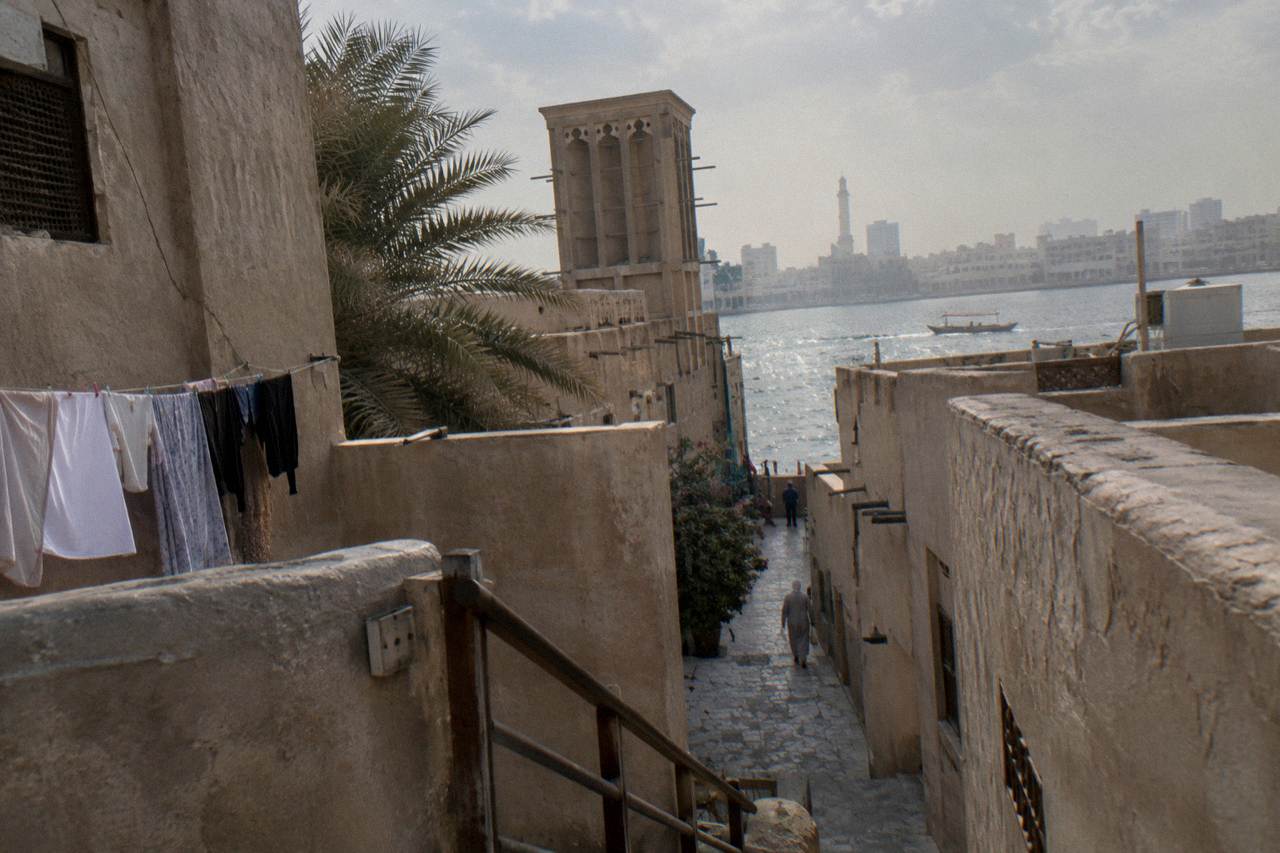
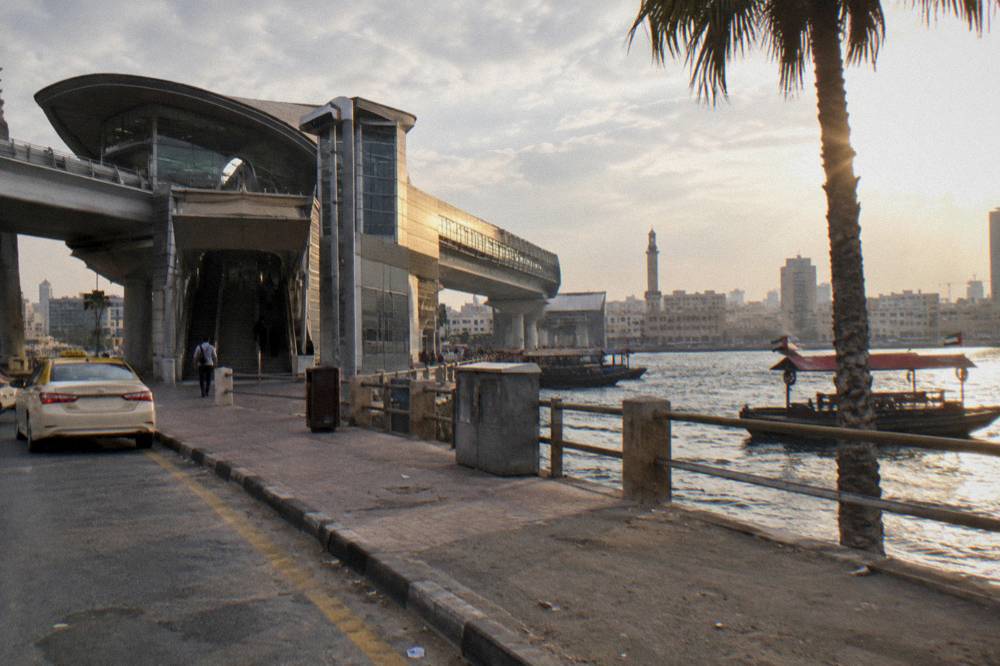
Distances here are short but the streets are old, so a "ten minute walk" can feel longer in midday heat. Al Ras station exit 2 appears on food walk listings as a meeting point in its own right, which tells you how central it is: a guide can stand at the exit and be within a few minutes of the spice lanes. From Sharaf DG exit 4, the walk into the Al Fahidi Historical Neighbourhood is a straight run down to the Creek, and Al Seef's waterfront sits just beyond it.
A few practical notes from the official pages. The RTA metro station map lists the stations and their numbering, and it is worth checking before you ride because the Green Line's Deira stretch is compact: three stops cover the whole souk district. If your hotel is on the Red Line, you change at Union or BurJuman, and both interchanges are signed in English and Arabic.
| Station | Side Of The Creek | What It Serves | Walk To The Food Areas |
|---|---|---|---|
| Union | Deira | Red Line interchange | Northern Deira, Al Rigga side |
| Baniyas Square | Deira | Baniyas Road, abra side of Deira | Old Souq abra dock, riverside cafes |
| Gold Souq | Deira | Gold Souk | A few minutes to the souk entrance |
| Al Ras | Deira | Spice Souk and old lanes | Exit 2 is a listed food walk meeting point |
| Sharaf DG | Bur Dubai | Al Fahidi area | Al Fahidi Historical Neighbourhood, Al Seef |
| BurJuman | Bur Dubai | Red Line interchange | Al Fahidi via a longer walk or one more stop |
How Do You Ride The Metro To Al Fahidi And Al Seef?
Ride the Green Line to Sharaf DG, leave by exit 4, and walk toward the Creek: Al Seef's roughly 1.8 km waterfront stretch and the Al Fahidi lanes both sit on that walking line, with the neighbourhood open daily from 7am to 8pm per Dubai Culture's stated hours. The whole transfer from train to heritage district is on foot, and no bus or taxi leg is needed.
The Bur Dubai side rewards this planning more than the Deira side, because its attractions line up along the water. Al Seef is a promenade district with heritage and modern sections, free to enter and open daily, per current reporting on its roughly 1.8 km length. From there, the walking connections run without interruption to the Al Fahidi Historical Neighbourhood, the Textile Souk and the Bur Dubai abra dock; no route closures were reported for pedestrians in the 2026 checks. You can, in other words, arrive at one station and never think about transport again until you cross the Creek.
Timing shapes the day. The RTA timetable gives metro hours as 05:00 to midnight Monday to Thursday and Saturday, 05:00 to 01:00 on Friday, and 08:00 to midnight on Sunday. The Sunday morning start matters for food walkers: an early brunch plan in Al Fahidi needs a later start or a taxi on Sundays. Winter helps too. December's mean daily maximum is 26.5 C and January's is 24.4 C per the compiled airport normals, with sunrise around 07:07 and sunset around 17:51 in mid-January, so a morning arrival gives you cool air and good light for the heritage lanes.
Payment is by Nol card, the reloadable smart card accepted on the metro, tram and buses. The official RTA page prices anonymous Silver and Gold cards at AED 25 with initial credit included, and the cards top out at a AED 1,000 balance for anonymous versions. Buy one at any station machine before your first ride; there is no single-ride paper ticket to fall back on. The same card works for the tram and buses if your plans stretch past the Green Line.
Food walks cluster on this side too. Several guided tastings meet at Al Seef or inside Al Fahidi, and one listing names the Al Khayma Heritage Restaurant in Al Fahidi as its meeting point, a spot that doubles as a food stop on some routes. The Bur Dubai food walk through Fahidi and the Creek on this site covers the eating side of the district in detail.
The three walks above all work for metro arrivals, but their meeting points differ, and that difference is worth a minute on the booking page before you commit. The Aladdin tour runs three hours across souks, the Creek and Old Dubai with tastings included; the Authentic Old Dubai walk is a shorter two hours with souks, tastings and a local boat ride; and the Local Street Food and Guided Walking Tour of Dubai Old Town runs three hours through the old town's eating lanes. Prices are on each listing rather than quoted here, and the meeting point is stated on the booking page for each.
How Does The Abra Crossing Work?
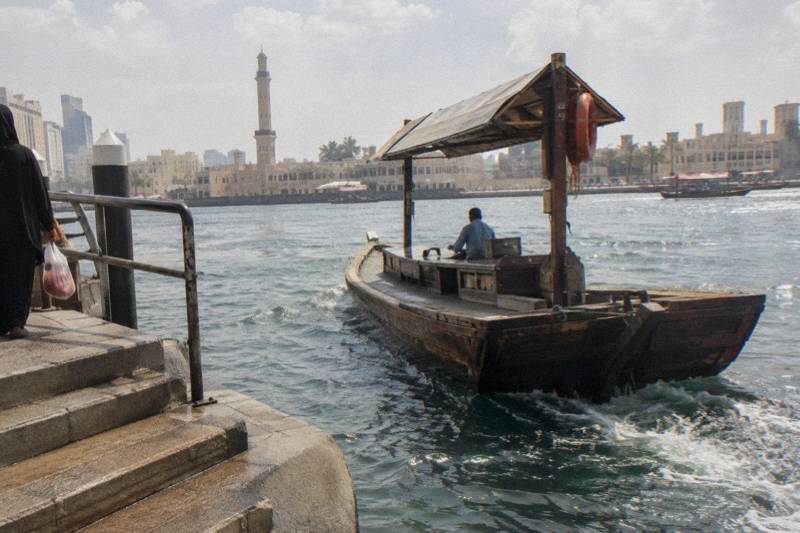
Abras are small wooden boats that shuttle across the Creek between Bur Dubai and Deira, and the RTA lists six traditional routes, including CR1 between Bur Dubai and Deira Old Souq, CR5 between Al Fahidi and Deira Old Souq, and CR6 between Al Seef and Baniyas. The fare is paid at the dock, and the crossing takes minutes rather than the drive it replaces.
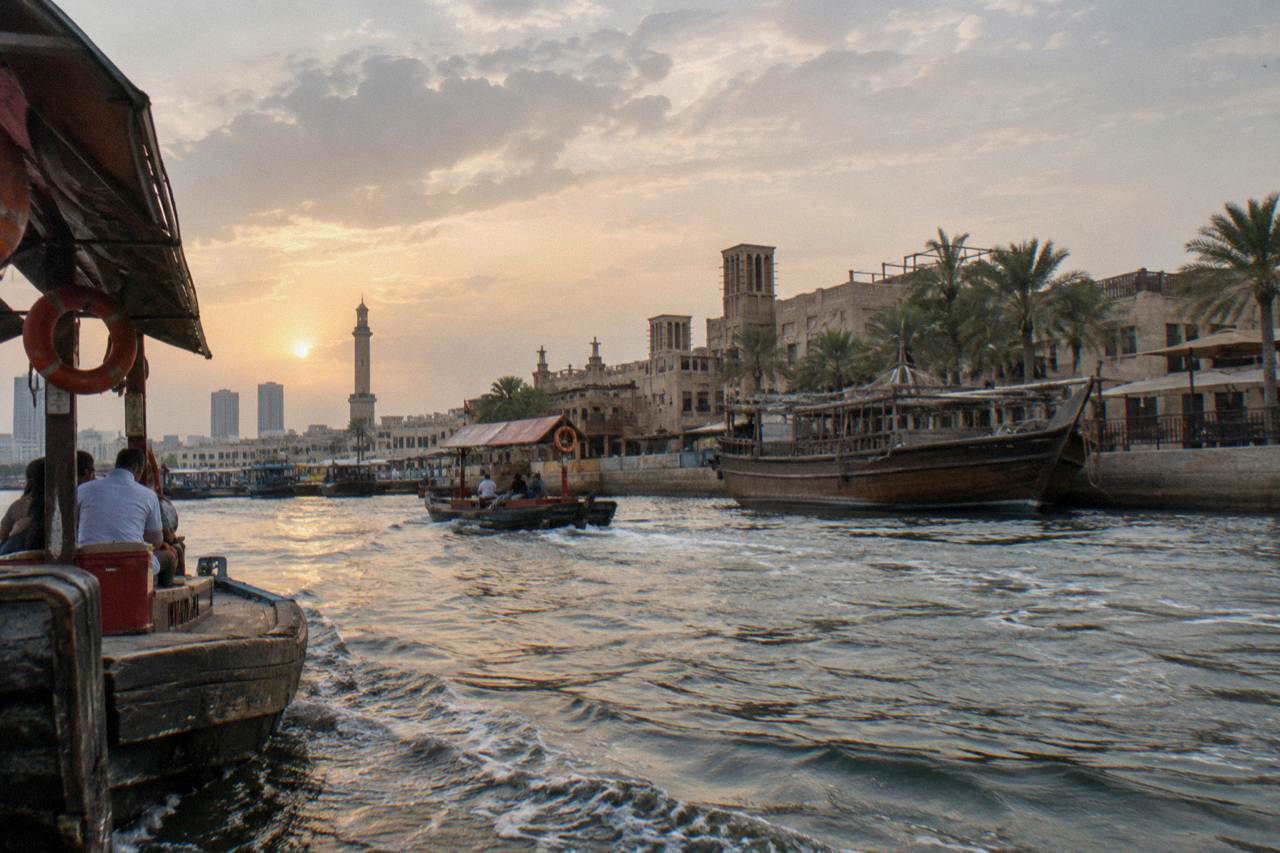
The abra is not a tourist ride dressed up as transport; it is the commuter route that has crossed the Creek for generations, and the food walks use it because it is the fastest line between the two eating districts. The RTA's marine pages list the traditional routes: CR1 runs Bur Dubai to Deira Old Souq, CR2 runs Dubai Old Souq to Al Sabkha, CR3 to Baniyas, CR4 between Al Sabkha and Al Fahidi, CR5 between Al Fahidi and Deira Old Souq, and CR6 between Al Seef and Baniyas. A seventh route, CR7 linking Al Seef, Al Fahidi and Dubai Old Souq, was noted as temporarily on hold in one 2026 flyer, so check the RTA page before counting on it.
| Route | Runs Between | Status Per The RTA Page |
|---|---|---|
| CR1 | Bur Dubai and Deira Old Souq | Traditional route, listed |
| CR2 | Dubai Old Souq and Al Sabkha | Traditional route, listed |
| CR3 | Dubai Old Souq and Baniyas | Traditional route, listed |
| CR4 | Al Sabkha and Al Fahidi | Traditional route, listed |
| CR5 | Al Fahidi and Deira Old Souq | Traditional route, listed |
| CR6 | Al Seef and Baniyas | Traditional route, listed |
| CR7 | Al Seef, Al Fahidi and Dubai Old Souq | Noted temporarily on hold in a 2026 flyer |
What does the fare cost? It is paid at the dock, and the RTA's Creek abra page has the current figures. The crossing itself is short, a few hundred metres of water, and it lands you inside the souk districts rather than at their edge. For the practicalities of the ride and the waterfront eating on both banks, see the Creek abra ride and waterfront eating guide on this site.
Several guided walks build the crossing into their route. The listings describe abra rides as part of the tour on multiple Old Dubai walks, meaning the boat leg is arranged by the guide rather than left to you, and the metro planning on this page pairs naturally with any of them. If a tour listing shows an abra ride in its inclusions, you do not need to work the dock logistics yourself; the guide handles the crossing and the group stays together.
The Aladdin tour is the featured walk here because its three hour route ties the whole district together: souks, the Creek crossing, Old Dubai lanes and tastings, all in one guided line. For a traveler staying anywhere on the metro network, it is the sort of tour where the transport question answers itself, since the route crosses the water the way the district intends.
What Do Taxis Add To Getting Around Old Dubai?
Taxis are best for the first and last legs, not the middle: the RTA's stated road pickup starting fares are AED 5 between 06:00 and 22:00 and AED 5.5 overnight for regular and family taxis, and a cab can reach Al Seef or Deira from most hotel districts in one ride. Inside the old quarter itself, walking beats the meter.
The starting fares come from the RTA's own fare page, and they are the only taxi figures worth planning around, since trip totals depend entirely on distance and traffic. Where taxis earn their keep is the airport run and the hotel districts far from a metro line: a cab from Dubai International Airport to the Al Seef area is a single ride with no transfers, while the metro version means a Red Line train and a change at Union or BurJuman. Late at night, after the metro's midnight close, the taxi is the only scheduled option.
Inside Old Dubai the calculus flips. The lanes around the Spice Souk and Al Fahidi are narrow, the parking is scarce, and the walks between sights are minutes long. A driver who cannot stop at the door of a heritage courtyard is less use than your own feet. The pattern worth copying from locals is simple: taxi or metro in, walk everywhere, abra across, metro or taxi home.
One caution on ride timing: Friday and Sunday schedules shift the ground under a taxi plan. The metro opens at 08:00 on Sundays, and souk shops follow their own patterns, with the Gold Souk area's shops mostly reported open around 10:00 to 22:00 and the Spice Souk shops reported opening earlier than 08:00 and running past 21:00, closed during the daytime on Fridays, with many taking midday breaks. Individual shops vary, so treat those as reported patterns and check the official pages for anything time-critical.
| Leg | Best Option | Why | Official Figure |
|---|---|---|---|
| Airport to Old Dubai | Taxi or Red Line plus change | One ride versus one transfer | Starting fare AED 5 daytime, AED 5.5 at night |
| Hotel to Al Fahidi | Green Line to Sharaf DG | Exit 4 walks straight to the district | Metro from 05:00 most days |
| Bur Dubai to Deira souks | Abra | The crossing is the route itself | Fare paid at the dock, see the RTA page |
| Between souk lanes | On foot | Lanes are narrow, distances short | No fare |
| Late night return | Taxi | Metro closes at midnight most days | Starting fare AED 5.5 overnight |
Where Do Food Tours Actually Meet?
Listing meeting points cluster at a handful of landmarks: Al Ras Metro Station exit 2 in Deira, the Al Khayma Heritage Restaurant in Al Fahidi, the Al Seef Heritage Hotel entrance, and Sharaf DG Metro exit 4 all appear on tour listings, which means almost every guided food walk starts within a short walk of a Green Line station. Check the exact point on the booking page before you ride.
This is the quiet advantage of the district's layout. Tour operators pick meeting points that are easy to find and easy to reach, and in Old Dubai that almost always means a metro exit or a named heritage landmark. The Al Ras exit 2 meeting point puts a Deira walk at the mouth of the old lanes; the Al Khayma meeting point sits inside Al Fahidi; the Al Seef Heritage Hotel entrance works for waterfront starts; and one listing even names the Armani Hotel Dubai hall, a Downtown option for walks that begin with a hotel pickup style arrangement.
The meeting point should shape which tour you book, not the other way round. If you are staying in Deira, a walk meeting at Al Ras saves you a crossing; if you are in Bur Dubai or on the Red Line, an Al Fahidi or Al Seef start is the simpler morning. A tour that includes transfers, like some private food walks do, removes the question entirely, at a higher price on the listing.
Durations matter for the return leg too. The three walks compared here run two to three hours, which fits comfortably inside a morning: arrive by 09:30, finish by lunch, and the metro is still running a full afternoon of service. Longer private options, at four hours on some listings, push toward an early afternoon finish and a busier train. The walking tour pace, stops and what to wear guide covers the on-foot side of that planning.
The Authentic Old Dubai walk suits a metro-first plan well: at two hours, it is the shortest of the three, it meets in the old district, and its local boat leg means you do not arrange the Creek crossing yourself. Tastings are included per the listing, and the price is on the booking page.
When Is The Best Time To Travel?
December to February is the strongest window: mean daily highs run 24.4 to 26.5 C in the core winter months per the compiled airport normals, against 28.9 C in March, and the metro's 05:00 start means you can beat both the heat and the souk crowds by riding early. Friday and Sunday are the two days whose schedules need checking in advance.
The weather numbers come from the 1991 to 2020 monthly normals compiled for the airport station: December averages a 26.5 C daily maximum against a 17.3 C minimum, January 24.4 C against 15.3 C, February 26.1 C against 16.4 C, and March 28.9 C against 18.6 C. For walking tours those winter figures are the whole argument: a three hour food walk in January is a pleasure, and the same route in summer is a different kind of undertaking. The site's summer heat and timing guide covers the hot-month version.
Daylight frames the plan. Mid-winter sunrise runs around 06:57 in December and 07:07 in January, with sunset near 17:32 and 17:51 respectively, so the usable walking day is roughly ten hours. An early metro ride lands you in the souks as shops open, and the mid-afternoon light is still good for the Creek crossing. Souk hours follow their own patterns rather than the sun: the reported shop times for the Gold Souk area run to about 22:00, the Spice Souk closes in the daytime on Fridays, and the Textile Souk's vendor hours vary with some Friday afternoon closures noted.
One more timing layer is worth knowing even though it changes nothing today. The Dubai Creek Lights project, a Municipality scheme running along roughly 8 km of the Creek including the Gold Souq promenade, Bur Dubai Souq and Al Seef areas, is scheduled for completion in Q1 2027, with more than 5,000 lighting units and promenade upgrades. Until then, expect works along parts of the waterfront rather than closures of the walking routes.
What Should A First Visit Look Like Hour By Hour?
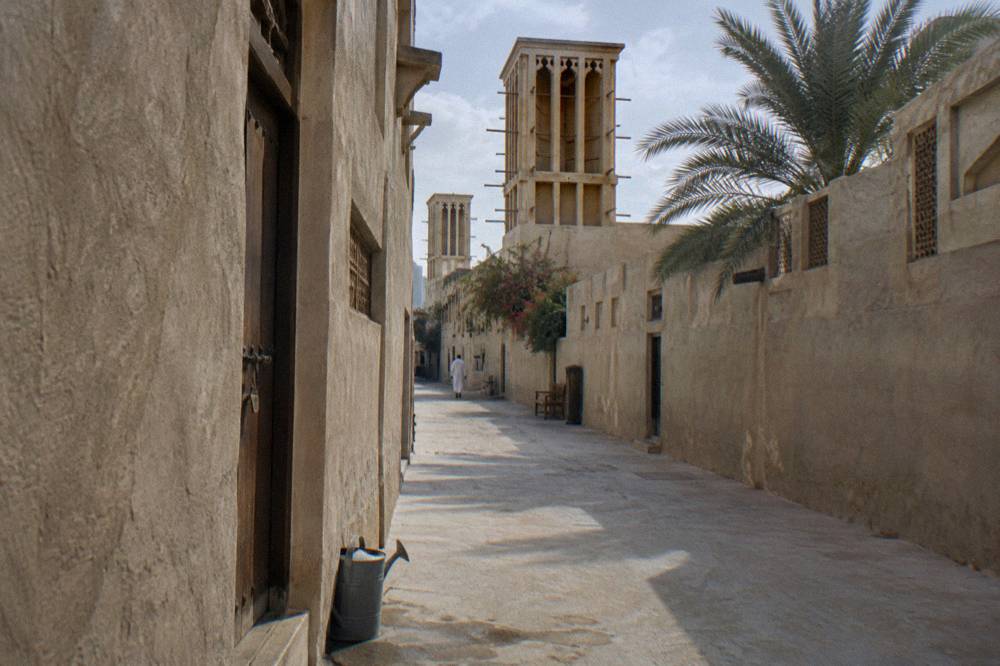
Start on the first Green Line train, walk Al Seef and Al Fahidi while the air is cool, cross the Creek by abra from the Bur Dubai side, eat through the Deira souks from late morning, and ride home from Al Ras or Gold Souq station before the midnight close. That single line uses every transport layer once and repeats nothing.
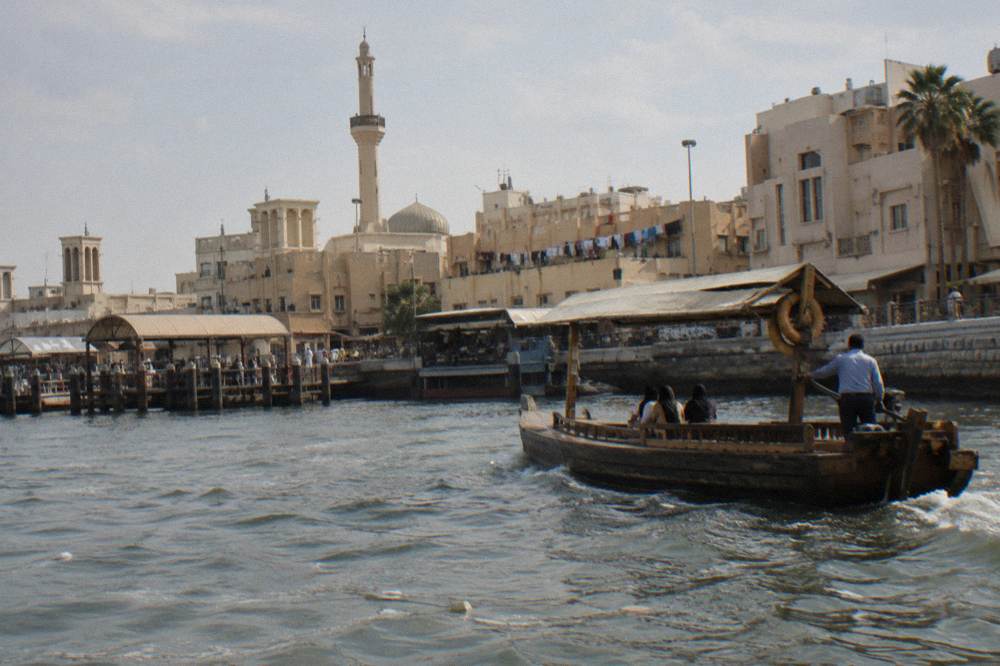
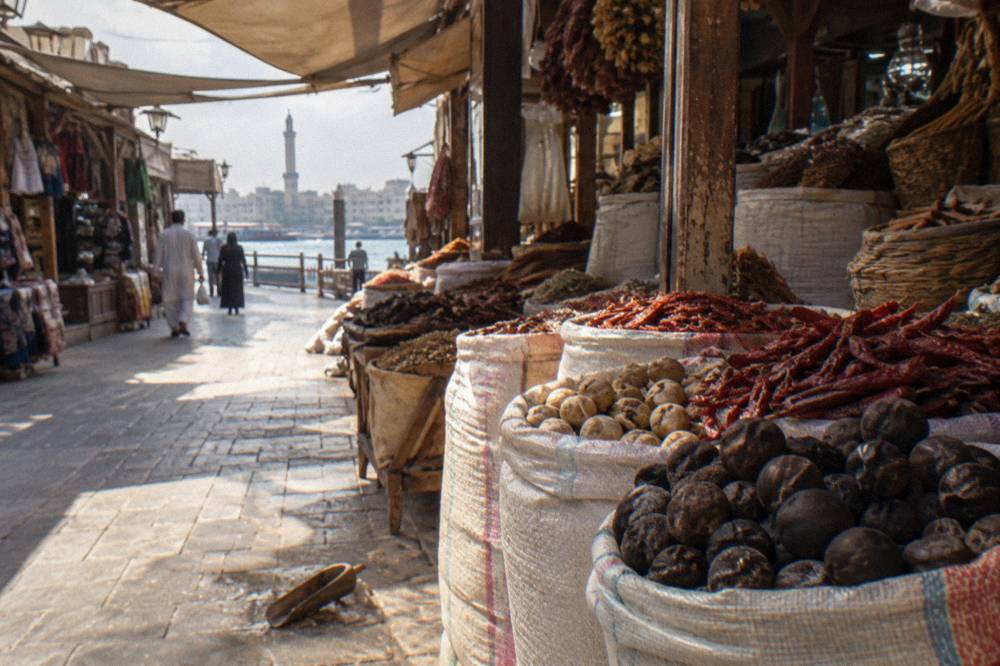
The shape of the day follows the geography. The Bur Dubai side is the calm half: Al Seef's waterfront, the Al Fahidi lanes, the Textile Souk. The Deira side is the loud half: the Spice Souk's sacks and smells, the Gold Souk's windows, the street food stalls between them. Crossing from calm to loud by water, then returning by train, gives the day a natural arc that a loop by car never manages.
A guided walk compresses the decisions. The featured Aladdin tour runs its three hours across souks, Creek, Old Dubai and tastings in exactly this arc, and the meeting point on the booking page tells you which end of the district to arrive at. Booking it for your first morning means the rest of the trip has a working mental map of the old quarter, plus a guide's answer to the question every visitor asks next: where to come back and eat on their own.
For travelers who want the same arc without a guide, the independent version is straightforward: Sharaf DG to Al Fahidi, walk to the water, abra across, eat through Deira, metro home from Al Ras. The difference is that a guide counts and lists the tastings, arranges the crossings and knows which stall serves what, which is precisely the gap between a walk and a food walk. The Deira Spice Souk tasting and buying guide covers the Deira end of that independent route.
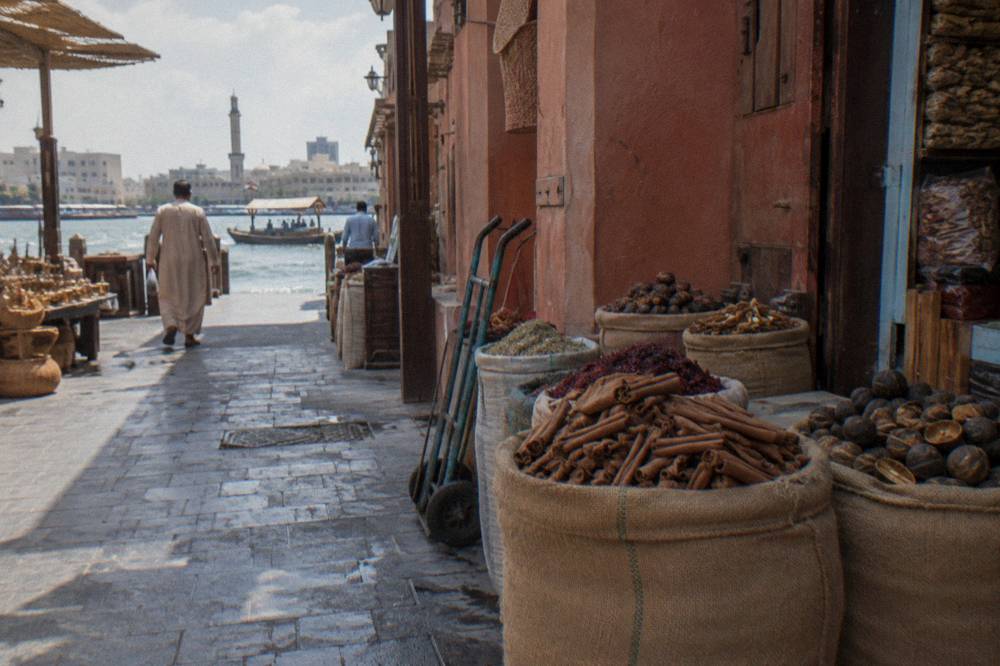
Dress for the district rather than the beach. The reported guidance for heritage areas and souks is to cover shoulders and knees, not because of a fine but out of respect in traditional districts, and flat shoes because the lanes are old. Photography etiquette follows the same spirit: ask before photographing individuals, especially in the souks. These small adjustments cost nothing and change how the old quarter receives you.
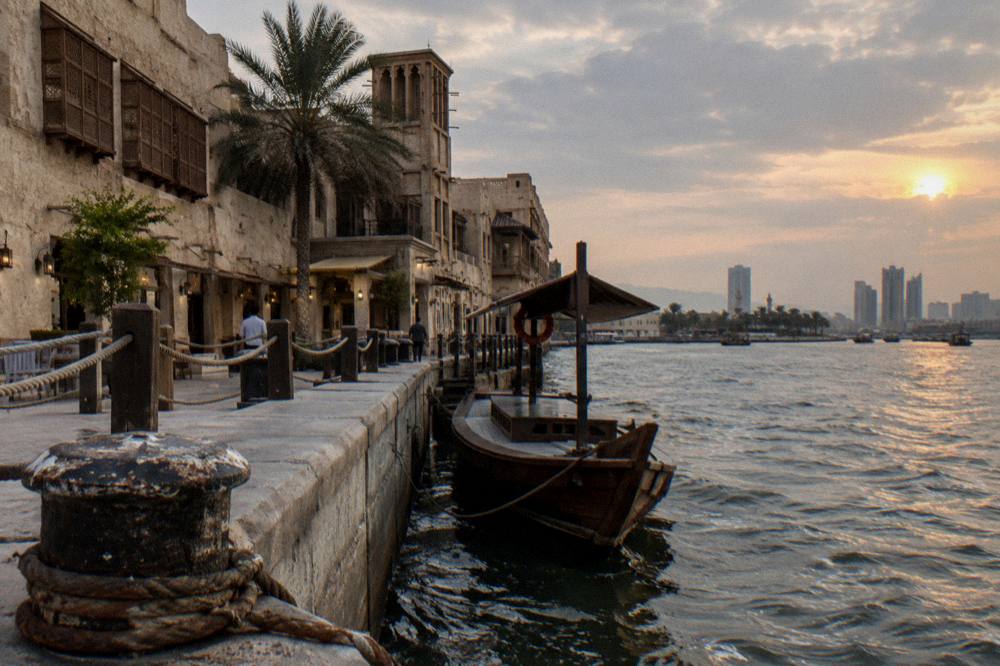
The Local Street Food and Guided Walking Tour of Dubai Old Town is the third metro-friendly option, a three hour guided walk through the old town's eating streets. Its meeting point and price are on the booking page, and like the others it keeps the whole route inside the walkable district.
For anyone weighing the choice between the three, the honest summary is this: all three cover souks and street food with tastings included, they differ in length, from two hours to three, and in the exact route and meeting point, and the price on each listing is the final tiebreaker. Free cancellation terms are shown on the booking page, so a change of plans costs nothing if you check before the cutoff.
Common Questions About Getting To Old Dubai
Which Metro Station Is Closest To The Spice Souk?
Al Ras is the closest Green Line station to the Spice Souk and the lanes around it, and exit 2 is itself used as a food walk meeting point on tour listings. Gold Souq station, one stop away, is the closest to the Gold Souk.
How Do I Get To Al Fahidi And Al Seef By Metro?
Ride the Green Line to Sharaf DG and leave by exit 4, then walk toward the Creek. Al Seef's waterfront and the Al Fahidi Historical Neighbourhood both sit on that walking line, with the neighbourhood's stated hours running 7am to 8pm daily.
What Time Does The Dubai Metro Close?
Per the RTA timetable, trains run 05:00 to midnight Monday to Thursday and Saturday, 05:00 to 01:00 on Friday, and 08:00 to midnight on Sunday. Late nights after midnight need a taxi, whose reported road pickup starting fare is AED 5.5 overnight.
How Much Does The Abra Across The Creek Cost?
The fare is paid at the dock. Check the RTA's Creek abra page for the current figures before you ride, since the crossing itself is arranged by the guide on tours that include an abra ride.
Do I Need A Nol Card For The Metro?
Yes, the Nol card is the payment method for the metro, tram and buses. Anonymous Silver and Gold cards cost AED 25 with initial credit included and can be bought at station machines.
Is Old Dubai Walkable From The Metro Stations?
Yes. Every Green Line station serving the district sits within roughly a ten to fifteen minute walk of a major food area, and no route closures affecting pedestrian access between Al Fahidi, Al Seef, the abra docks and the Deira souks were reported in 2026 checks.