Old Dubai Food Walk: What A Guided Route Covers
A guided food walk through Old Dubai usually threads Al Fahidi and Al Seef on the Bur Dubai side, crosses the Creek by abra, and works through the Deira souks with tastings along the way. Here is what the route, the pace and the tastings actually look like before you book.
Short answer
A guided Old Dubai food walk typically covers Al Fahidi Historical Neighbourhood, the Al Seef waterfront and the Bur Dubai souk, an abra crossing of the Creek, then the Deira Spice and Gold Souks, with street-food tastings between stops. Walks run 2 to 4 hours. Tasting counts and inclusions vary by listing, so check the booking page for each.
What Does An Old Dubai Food Walk Actually Cover?
A guided Old Dubai food walk covers the historic districts on both sides of Dubai Creek: the Al Fahidi Historical Neighbourhood and Al Seef waterfront in Bur Dubai, an abra crossing of the Creek, and the Spice Souk and Gold Souk in Deira, with street-food tastings woven between the sightseeing stops. Most walks run 2 to 4 hours and include several tastings plus a guide.
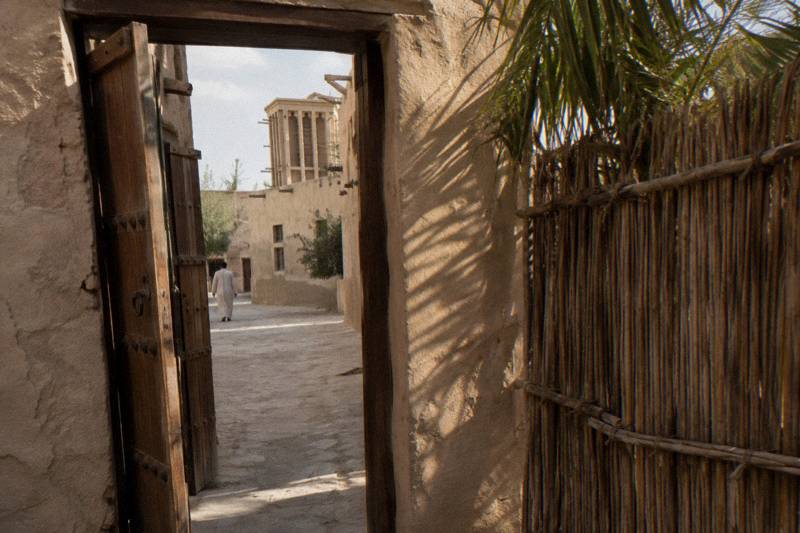
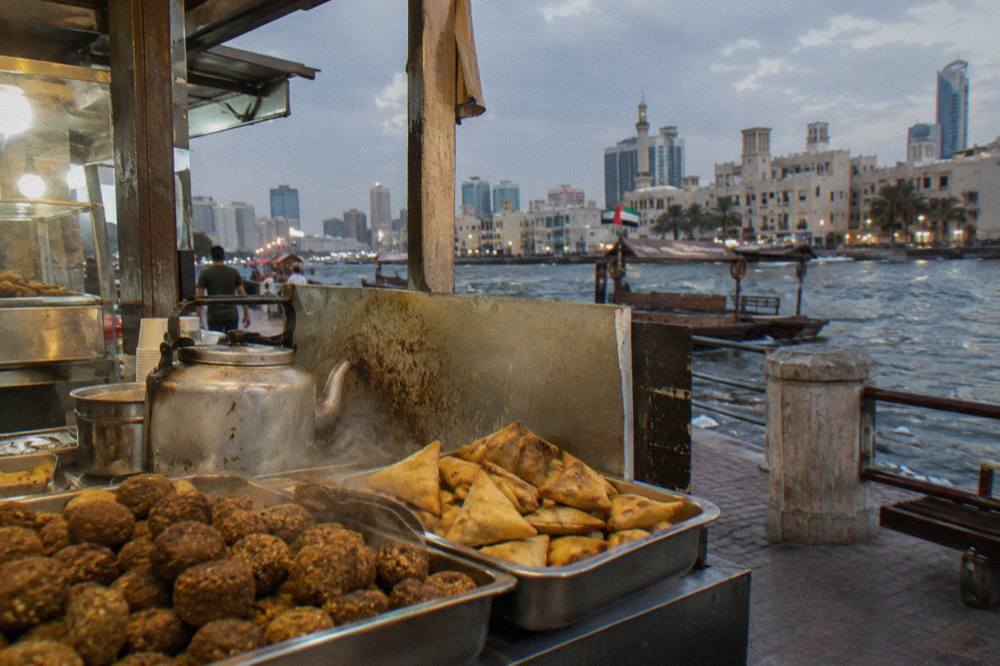
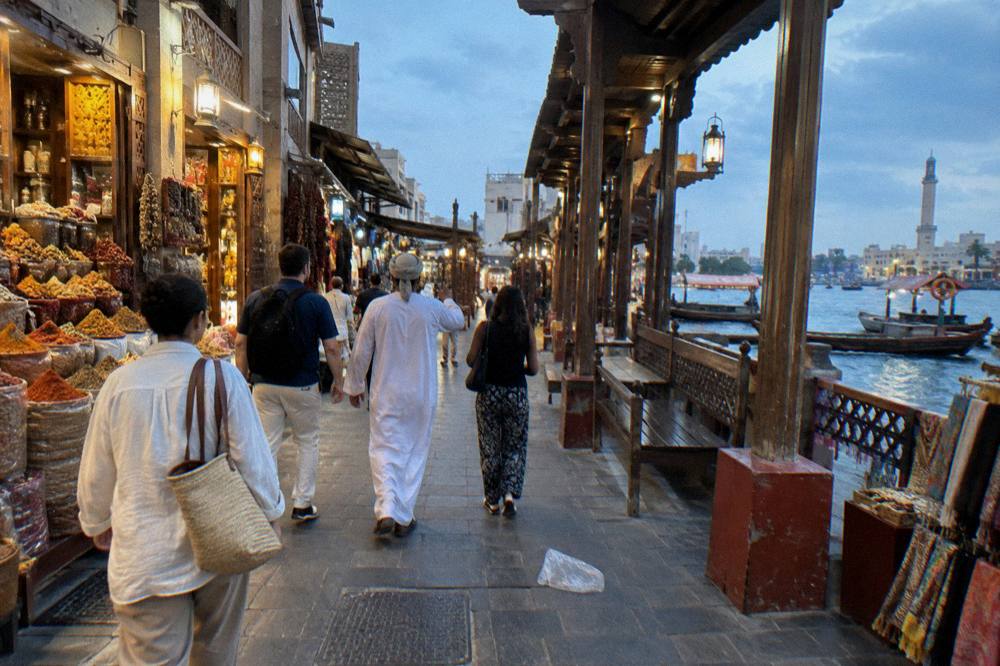
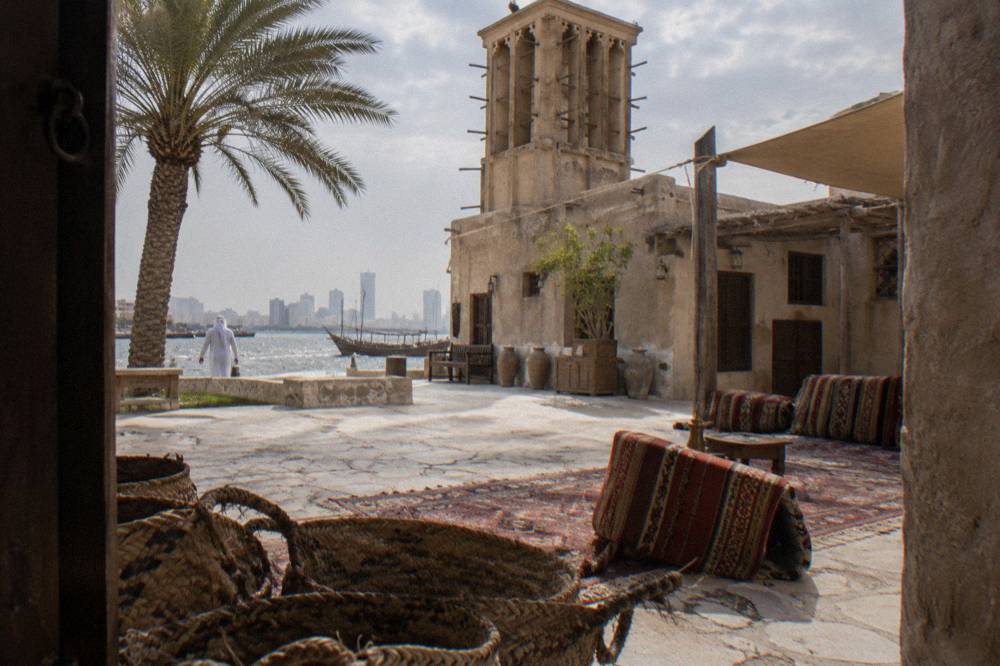
The format is part walking tour, part progressive snack. A guide leads a small group through lanes that are easy to walk but hard to read on your own, pointing out the coral-stone houses of Al Fahidi, the textile merchants of the Bur Dubai souk, and the spice sacks stacked in Deira, while stopping at cafeterias and stalls for shawarma, falafel, karak chai and luqaimat. The listings describe tastings rather than a sit-down meal, though a few walks add a restaurant stop or an Emirati house visit.
What varies between walks is emphasis. Some lean toward history and cover more ground per hour. Others spend longer at the food stops and treat the heritage lanes as connective tissue. The featured walk on this page, the Old Town, Souks, Street Food guided tour with abra ride, runs 3 to 4 hours and combines the souks, the street food and the Creek crossing, which makes it a good yardstick for comparing the rest.
One thing worth knowing before you compare options: the Al Fahidi Fort, home of Dubai Museum, has been closed for a major restoration since 2021, and reports from late 2026 indicate preparations for reopening with new galleries. Some older walking routes mention the museum as a stop, so if a full fort visit matters to you, check the booking page for what the current route includes.
Where Does The Route Go: Bur Dubai, The Creek And Deira?
Nearly every guided food walk follows the same skeleton: start in Bur Dubai at Al Fahidi or Al Seef, walk the Textile Souk to the abra dock, cross the Creek by boat, then work through the Deira Spice Souk and Gold Souk before finishing near Al Ras. The skeleton is fixed; how long each leg gets, and how many tastings sit along it, is what separates one listing from the next. If you're curious which single table defines the city, the guide to Dubai's most famous restaurant question explains why fame in this city works differently.
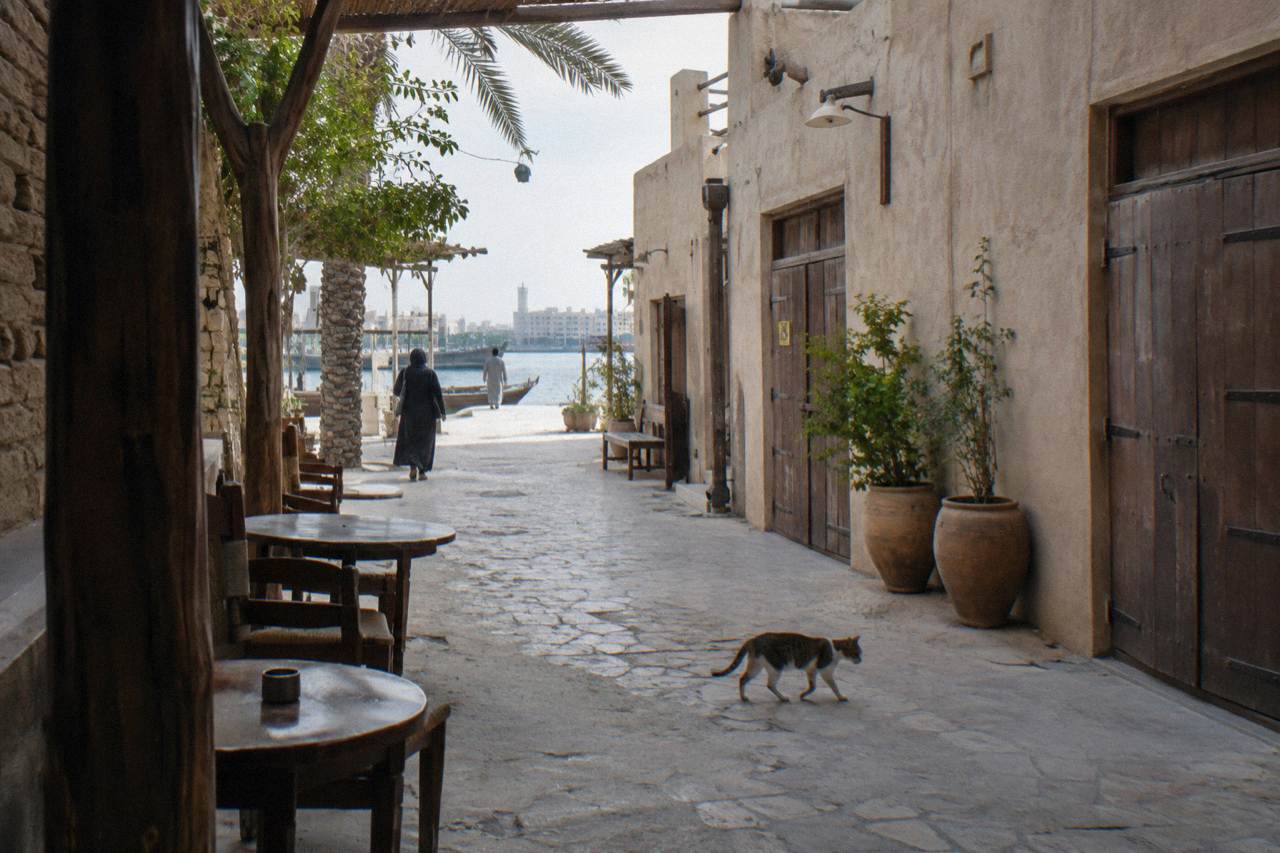
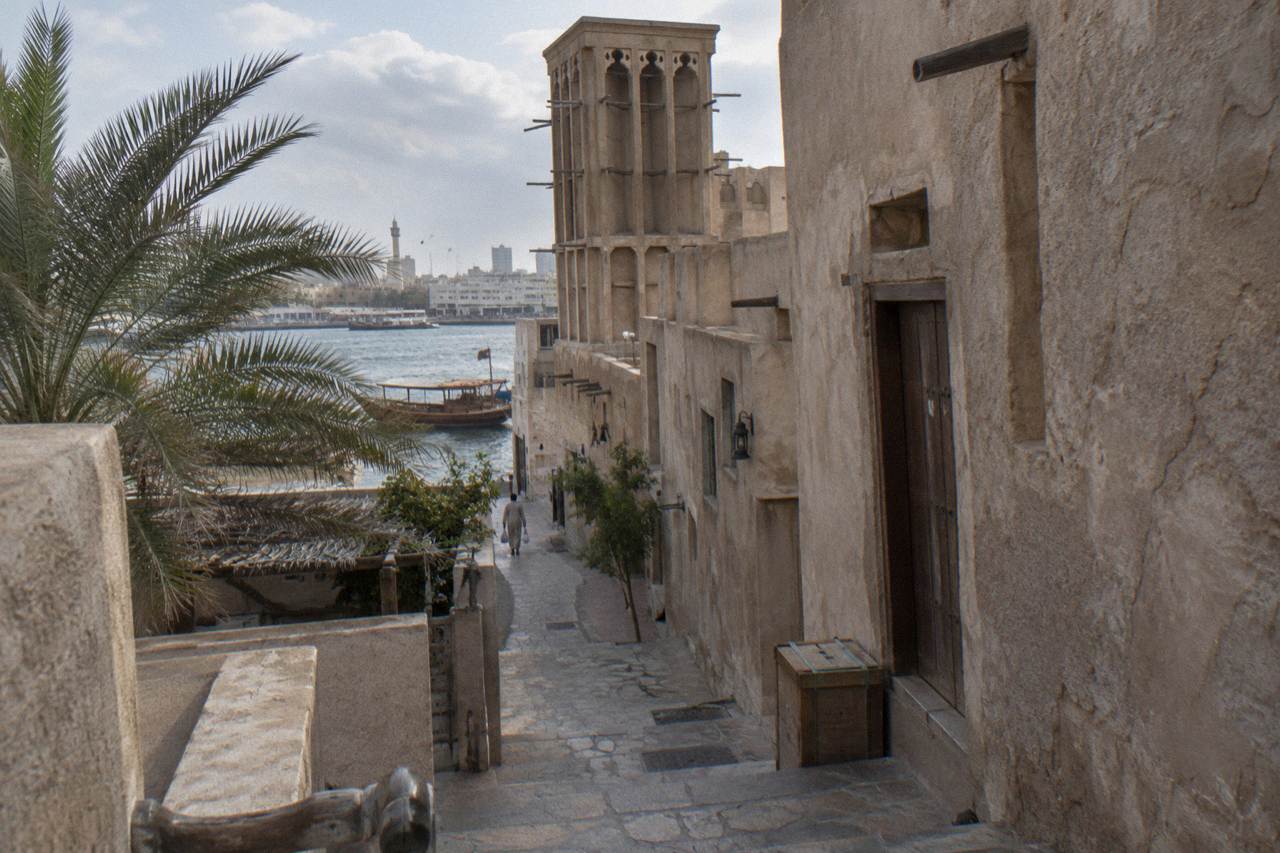
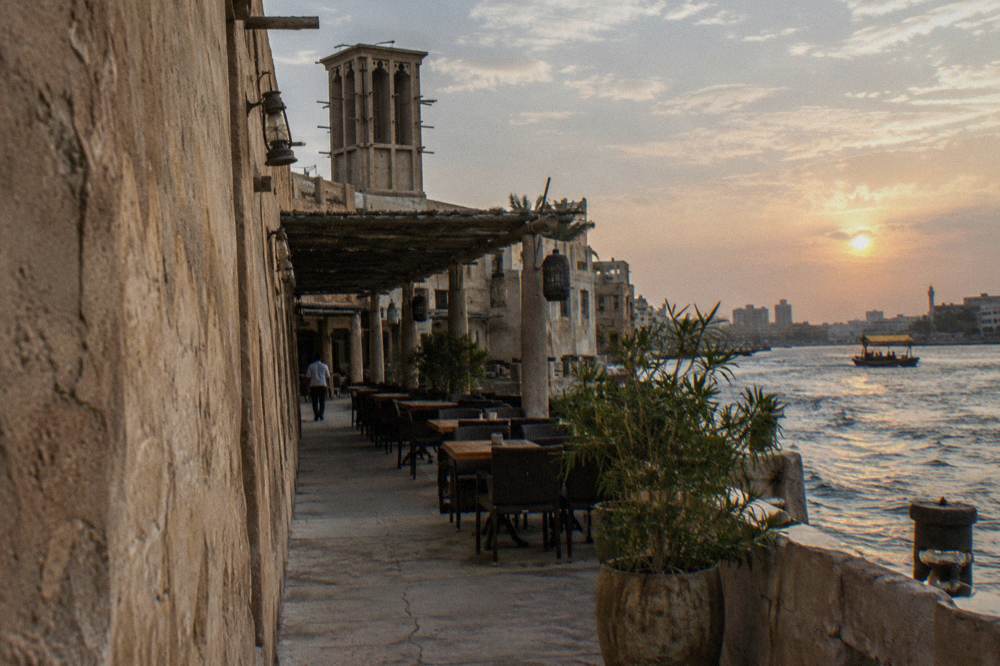
The Bur Dubai side is the heritage half. Al Fahidi Historical Neighbourhood is open for walking with free public access to its lanes, galleries and courtyards, and Dubai Culture states neighbourhood hours of 7am to 8pm daily. Al Seef is a roughly 1.8 km waterfront stretch with heritage and modern sections, free to enter and open daily. Standard walking connections between Al Fahidi, Al Seef, the Textile Souk, the abra stations and the Deira souks are all in place, with no route closures reported in 2026.
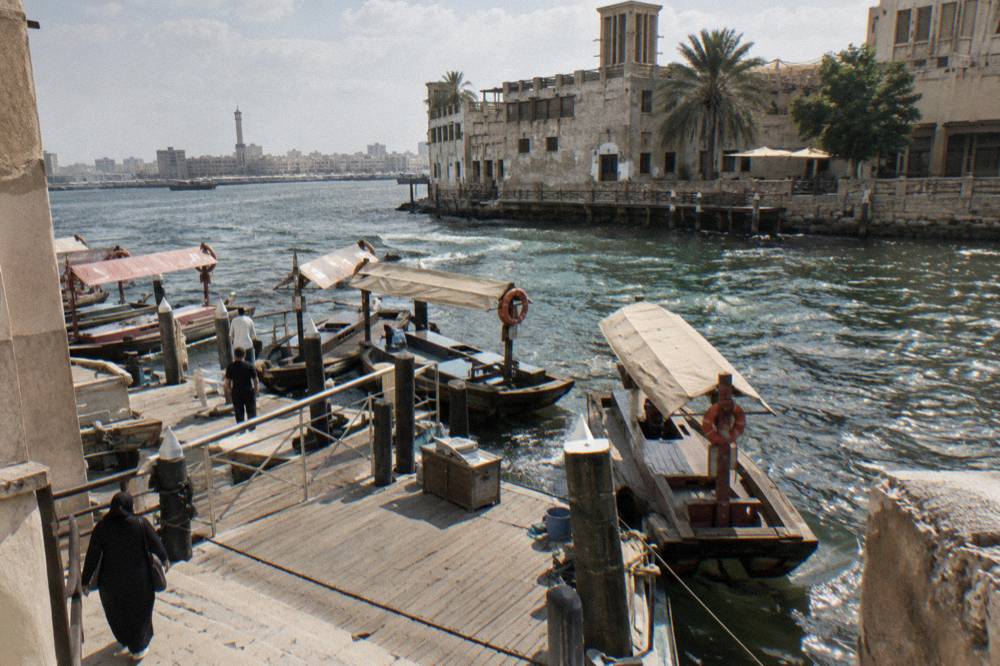
The Creek crossing is the hinge of the route. The Roads and Transport Authority operates traditional commuter abras on several short crossings, including the Bur Dubai to Deira Old Souq route, with routes also linking Al Seef, Al Fahidi, Al Sabkha and Baniyas. A crossing takes minutes and puts you at the mouth of the Deira souk lanes. Timings and routes are on the RTA's Creek abra page.
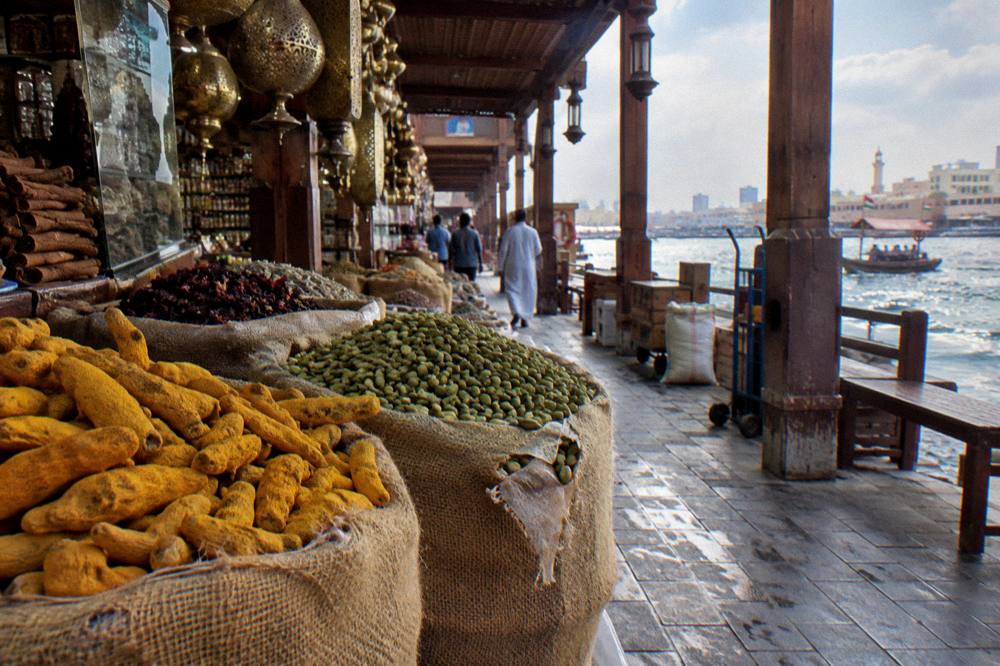
On the Deira side, the Spice Souk and Gold Souk do the heavy lifting. Visit Dubai states most Gold Souk shops open around 10am to 10pm, while Spice Souk shops generally open earlier than 8am and run past 9pm, with many closing during the daytime on Fridays and some taking midday breaks. A guide times the walk around these rhythms rather than gambling on them.
| Route leg | Where | What happens there |
|---|---|---|
| Heritage lanes | Al Fahidi Historical Neighbourhood | Coral-stone houses, wind towers, courtyards, often a coffee or tea stop |
| Waterfront | Al Seef promenade | Creek views, heritage and modern sections, free entry |
| Market lane | Bur Dubai Textile Souk | Fabric merchants between Al Fahidi and the abra dock |
| Creek crossing | Abra, Bur Dubai to Deira | Short boat ride across the Creek |
| Spice stop | Deira Spice Souk | Sacks of spices, dates, tastings at nearby stalls |
| Finish | Gold Souk and Al Ras | Jewellery window shopping, final tastings near the metro |
If that route matches what you are after, these three walks cover it in slightly different packages.
How Many Tastings Fit Into A Guided Walk?
Tasting counts run from a handful of quick street bites to ten or more across a walk, and the count is the single most useful number on a listing. The premium guided walk describes tastings of shawarma, falafel, karak tea, samosa, rogag bread and luqaimat; private listings advertise up to 12 tastings. What each tasting amounts to, a full portion or a few bites, is a fair question to ask the operator before booking.
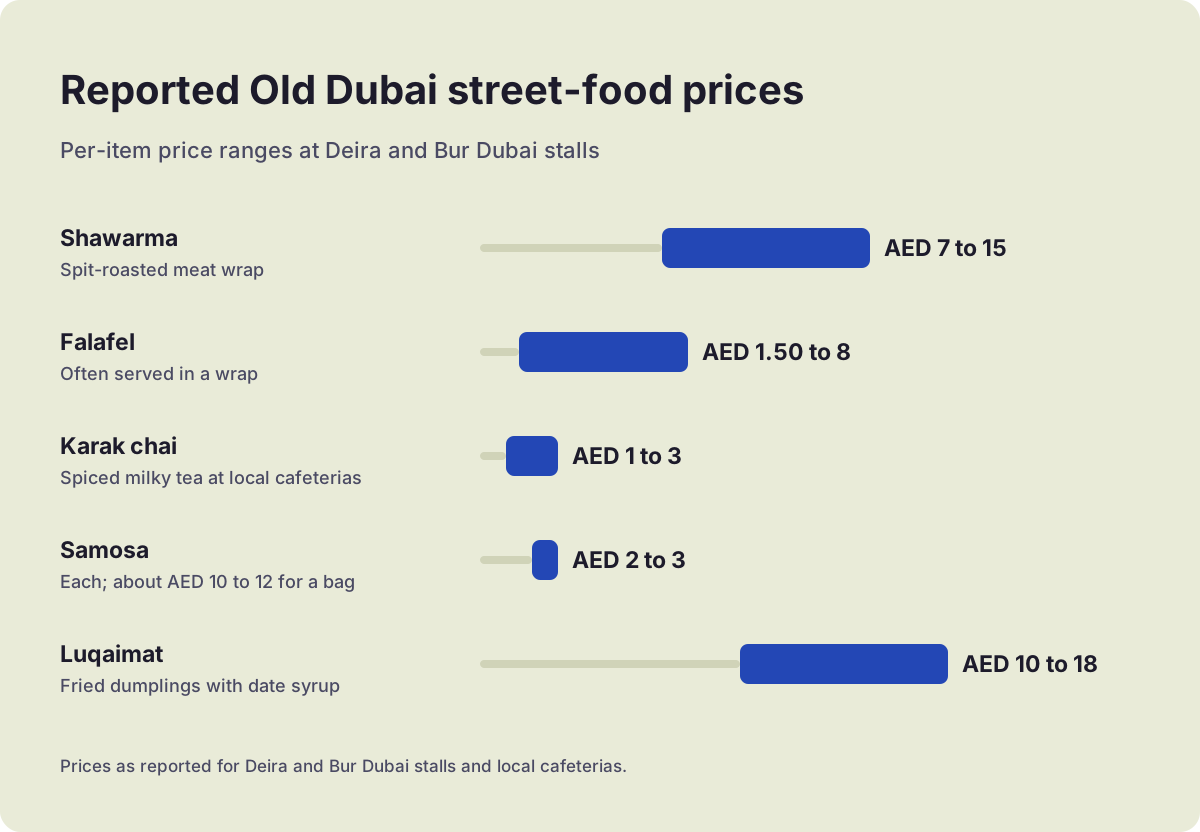
The dishes themselves are the shared vocabulary of Old Dubai street food. Shawarma and falafel are the workhorses: reported prices at Deira and Bur Dubai stalls run around AED 7 to 15 for shawarma and AED 1.50 to 8 for falafel. Karak chai, the spiced milky tea, costs a reported AED 1 to 3 at local cafeterias. Samosas run about AED 2 to 3 each or AED 10 to 12 for a bag, and luqaimat, the crisp fried dumplings drizzled with date syrup, around AED 10 to 18. A guide who buys these for the group is saving you the ordering friction more than the money.
| Tasting | What it is | Reported street price range |
|---|---|---|
| Shawarma | Spit-roasted meat wrap | Around AED 7 to 15 |
| Falafel | Fried chickpea patties, often in a wrap | Around AED 1.50 to 8 |
| Karak chai | Spiced milky tea | Around AED 1 to 3 |
| Samosa | Fried filled pastry | Around AED 2 to 3 each |
| Luqaimat | Fried dumplings with date syrup | Around AED 10 to 18 |
Dietary needs are worth raising before you pay. All meat sold in restaurants and markets in Dubai is halal, and pork is sold only in designated licensed sections. No walk in this comparison is described as vegetarian or gluten-free on its listing, which does not mean it cannot accommodate you, only that the listing does not say so. Message the operator before booking and ask directly.
A walk with counted, listed tastings is where a paid guide earns the price over going alone: the stalls are findable, but which ones to trust, how to order and what to try first is the part that takes local knowledge. For a deeper look at the dishes themselves, the Emirati food guide to the dishes worth knowing breaks down machboos, harees and the sweet side of the cuisine.
What Does The Walk Cost And What Is Included?
Walk prices range from modest group walks to premium private options, and every listing prices differently: some charge per person while private listings charge per group, with from-prices that vary by date and group size. The figure is on each listing, and the basis matters as much as the number, so read the price basis before comparing, since a per-group price and a per-person price are not the same comparison at all.
What you can compare without a calculator is inclusions. The listings in this family include the guide, the street-food tastings, and the abra ride or Creek cruise; some add an Emirati house visit or a museum stop. Water is mentioned on some listings, alcohol on none of them, which tracks the rules anyway: visitors over 21 may drink at licensed venues only, and alcohol is not allowed in public places outside them, so a souk walk is a dry affair by design.
| Walk | Duration | What the listing includes |
|---|---|---|
| Old Town, Souks, Street Food & Abra Ride | 3 to 4 hours | Guided route, street-food tastings, abra ride |
| Al Fahidi Old Town, Souks & Abra Cruise | 2.5 to 4 hours | Guided route, tastings, Creek cruise |
| Old Town, Street Food, Creek & Emirati House | 3 hours | Guided route, tastings, Emirati house stop |
| Half-Day Street Food Tour | 4 hours | Longer guided route with tastings |
| Private Food Tour, 12 Tastings with Locals | 3 hours | Private guide, 12 tastings |
For context on the independent alternative: casual Emirati, Levantine and neighbourhood cafeteria meals run a reported AED 15 to 40 per person, and a mid-range restaurant meal around AED 80 to 150. A guided walk is therefore not a money-saving device; it is a curation device. If budget is the whole question, the guide to what a meal costs in Dubai works through the numbers in detail.
Where Do The Walks Start And How Do You Get There?
Meeting points cluster in a handful of well-known spots: the Al Khayma Heritage Restaurant in Al Fahidi, Al Ras Metro Station exit 2 in Deira, the Al Seef Heritage Hotel entrance, and metro exits at Sharaf DG and Baniyas Square. Green Line stations make the whole area car-optional: Sharaf DG serves Al Fahidi, Al Ras and Baniyas Square sit beside the Deira souks, and Union connects to the Red Line.
The metro timings are worth checking against your walk's start time. Trains run 5am to midnight Monday to Thursday and Saturday, from 5am to 1am the next day on Fridays, and from 8am to midnight on Sundays, per the RTA timetable. The Nol card that gets you onto the metro is a reloadable smart card, with anonymous Silver and Gold cards costing AED 25 including initial credit. Taxis start at a reported AED 5 between 6am and 10pm and AED 5.5 overnight.
| Meeting point | District | Nearest transport |
|---|---|---|
| Al Khayma Heritage Restaurant | Al Fahidi, Bur Dubai | Sharaf DG metro, Green Line |
| Al Seef Heritage Hotel entrance | Al Seef, Bur Dubai | Sharaf DG metro, Green Line |
| Al Ras Metro Station exit 2 | Deira | Al Ras metro, Green Line |
| Sharaf DG Metro exit 4 | Bur Dubai | Green Line |
Confirm the exact meeting point on your booking confirmation rather than assuming, because operators sometimes shift start points with the season or the route. The getting to Old Dubai by metro and abra guide covers every station and crossing in more detail.
The 3-hour walk that adds an Emirati house stop is a good pick if you want the route anchored at a fixed meeting point with a cultural interior in the middle rather than pure street eating.
What Is The Pace Of A Guided Route Really Like?
Expect 3 hours of mostly gentle walking with frequent short stops, roughly a tasting or a sight every 20 to 30 minutes, and a total distance that rarely exceeds a few kilometres of flat lanes. The pace is set for conversation and eating, not exercise. Walks that promise 4 hours usually spend the extra time on more stops, not more distance.
The walking surface is flat and shaded in stretches, but December through February is the comfortable window: airport weather normals show mean daily highs of 24.4 to 26.5 °C across December, January and February, against 28.9 °C in March. Winter daylight runs roughly 7am to 5.30pm, so an afternoon walk finishes near sunset, which is when the souks are at their liveliest anyway.
The premium guided walk, at 3 to 4 hours, is the one to look at if you want the unhurried end of the range: the same souks and street food with more time at each stop, and the tasting list of shawarma, falafel, karak, samosa, rogag and luqaimat described on its listing.
Group size shapes the pace as much as the route does. Small groups move faster between stalls and get more of the guide's attention at each one; larger groups spend longer regrouping. Private listings price per group on some bookings, so read the basis. The private or group food tour comparison works through that trade-off fully.
Who Is A Guided Food Walk Right For?
A guided walk suits first-time visitors, anyone who does not want to navigate the souks alone, and travellers who want counted tastings without the trial and error of finding stalls themselves. It suits confident solo eaters less well: if you already know your karak from your gahwa and you like wandering, the independent version of this route costs a fraction of the price and loses only the commentary.
The cultural upside is real. The Sheikh Mohammed Centre for Cultural Understanding in Al Fahidi runs 1.5-hour cultural meals with Emirati hosts, with Arabic coffee, dates and question time on customs and daily life, priced at a reported AED 130 to 160 depending on the meal, booking required. A walk that includes an Emirati house visit gives you a slice of that experience inside the route. Details are on the centre's cultural meals page.
Photography etiquette is worth a word here: ask permission before photographing individuals, especially Emirati women, families or anyone in traditional attire, including in the souks. A guide handles these introductions better than a stranger with a camera does, which is a quiet argument for the guided format in the heritage lanes.
If you are leaning toward the longer, private end of the range, the premium 4-hour walk with a boat ride covers the same route with the most generous time budget in this family.
What Should You Wear And Know Before You Go?
Cover shoulders and knees in the souks and heritage areas; there is no single dress-code law for tourists, but it avoids attention in traditional districts. Wear closed walking shoes you have already broken in, bring water, and carry small notes for anything you buy independently. Tipping guides is by personal preference, with no set rules.
The rest of the practical picture is short. Ramadan changes the texture of a walk but not its legality: non-Muslims are not required to fast, restaurants operate as normal, and etiquette advises discretion outdoors during daylight fasting hours. Smoking, including shisha, is banned in enclosed public spaces and permitted only in licensed outdoor zones. Restaurant bills commonly carry a 10 per cent service charge plus 5 per cent VAT, with cash tips voluntary on top, per Visit Dubai's tipping guide.
| Practical point | The reported rule | What it means on a walk |
|---|---|---|
| Dress | Cover shoulders and knees in souks and heritage areas | Light layers, no swimwear away from the beach |
| Alcohol | Licensed venues only, none in public places | Souk walks serve no alcohol |
| Food | All meat is halal; pork only in licensed sections | Ask the operator about dietary needs before booking |
| Ramadan | Dining operates as normal, discretion advised outdoors | Walks run; check timing with the operator |
| Tips | Personal preference, service charge up to 10 per cent common | Tip the guide what the walk was worth |
For the full etiquette picture, including the gahwa etiquette of receiving Arabic coffee with the right hand and shaking the empty cup side to side to decline a refill, the dress code guide for walking tours and souks covers it. This site, Dubai Food Tours, keeps the planning pages and the walk comparisons in one place.
Which Walk Should You Actually Book?
Book the 3 to 4 hour Old Town walk if you want the full route with the abra ride and the most standard stop list; book the Al Fahidi walk with the Creek cruise if you want the water time stretched; book the Emirati house walk if the cultural interior matters more than the market lanes. If the decision is budget-driven, take the shortest walk that still lists counted tastings rather than the longest one that lists sights.
The decision usually comes down to time of day and appetite. A morning walk gets cooler air and fresher souks, an evening one gets the lights and the after-work crowds. Whichever you pick, read the cancellation terms on the listing before paying, confirm the meeting point, and message the operator about any dietary needs. The rest of the route takes care of itself.
Common Questions About Old Dubai Food Walks
What Does An Old Dubai Food Walk Cover?
Most walks cover the Al Fahidi Historical Neighbourhood and Al Seef waterfront in Bur Dubai, an abra crossing of the Creek, and the Spice Souk and Gold Souk in Deira, with street-food tastings between stops. Durations run 2 to 4 hours depending on the listing.
How Many Tastings Are Included On A Guided Walk?
It varies by listing. The premium guided walk describes tastings of shawarma, falafel, karak tea, samosa, rogag and luqaimat, while private listings advertise up to 12 tastings. Check the tasting count on the specific listing before booking.
Do You Cross Dubai Creek On A Food Walk?
Most Old Dubai walks include a Creek crossing by abra, and some listings upgrade it to a longer Creek cruise. The crossings are short commuter routes operated by the Roads and Transport Authority between Bur Dubai and Deira.
Is An Old Dubai Food Walk Suitable For Vegetarians?
No walk in this comparison is described as vegetarian on its listing, which means the listing does not say either way. All meat in Dubai restaurants is halal. Message the operator before booking to ask what the guide can substitute at the tasting stops.
What Should You Wear On An Old Dubai Food Walk?
Cover shoulders and knees in the souks and heritage areas, and wear comfortable walking shoes. There is no single dress-code law for tourists, but modest dress avoids attention in the traditional districts.
When Is The Best Time Of Day For An Old Dubai Food Walk?
Morning walks get cooler air, and December through February is the most comfortable season, with mean daily highs of 24 to 27 °C. Evening walks get the souks at their liveliest. Souk shops generally open around 10am, with Spice Souk stalls opening earlier and many closing daytime on Fridays.