How To Choose Between Old Dubai Food Walks And Other Tastings
Every Dubai food walk sells a different version of the city: a souk crawl, a Creek crossing, a private tasting trail or a seated Emirati meal. Here is how to weigh neighbourhood, duration, price, reviews and format against each other before you book anything.
Short answer
Choose by five axes: neighbourhood, theme, duration, price and reviews. Most guided walks run 2 to 4 hours through Old Dubai, from Al Fahidi and the souks to Deira, with tastings included. Private tours run around 3 hours with 10 to 12 tastings; cultural meals run about 90 minutes seated.
Old Dubai concentrates more guided food experiences per square kilometre than anywhere else in the city. Within roughly two kilometres of the Creek you can walk the Al Fahidi Historical Neighbourhood, cross the water by abra, browse the Spice and Gold Souks in Deira, and taste your way through shawarma, falafel, karak and luqaimat in between. The walks compared here range from a two-hour souk-and-tasting loop to a four-hour private trail with a dozen tastings, and the differences between them are bigger than the price gaps. To make those walk logistics easier, the guide to picking a hotel near Old Dubai's food scene compares staying in Deira, Bur Dubai, Downtown and Dubai Marina.
That is exactly why choosing is hard. Two tours can sound identical in a search result, "street food, souks, abra", and deliver completely different days. This guide breaks the decision into five axes: neighbourhood, theme, duration, price and reviews, with format as a sixth tiebreaker. Each section stands alone, so you can jump to the axis that matters most for your trip.
What Types Of Food Experience Can You Book In Dubai?
The range falls into four families: guided street-food walks through Old Dubai, private tasting trails with a fixed tasting count, cultural meals where you sit and eat Emirati dishes, and skyline-format tours that pair tastings with an observation deck or a night setting. Durations run from about 90 minutes for a seated cultural meal to 4 hours for the longest walks and private options. Almost all of them start inside Old Dubai, because that is where the souks, the Creek and the oldest kitchens sit. The format you pick shapes everything else: how much you walk, how much you eat standing versus seated, and how much of the city you see between bites.
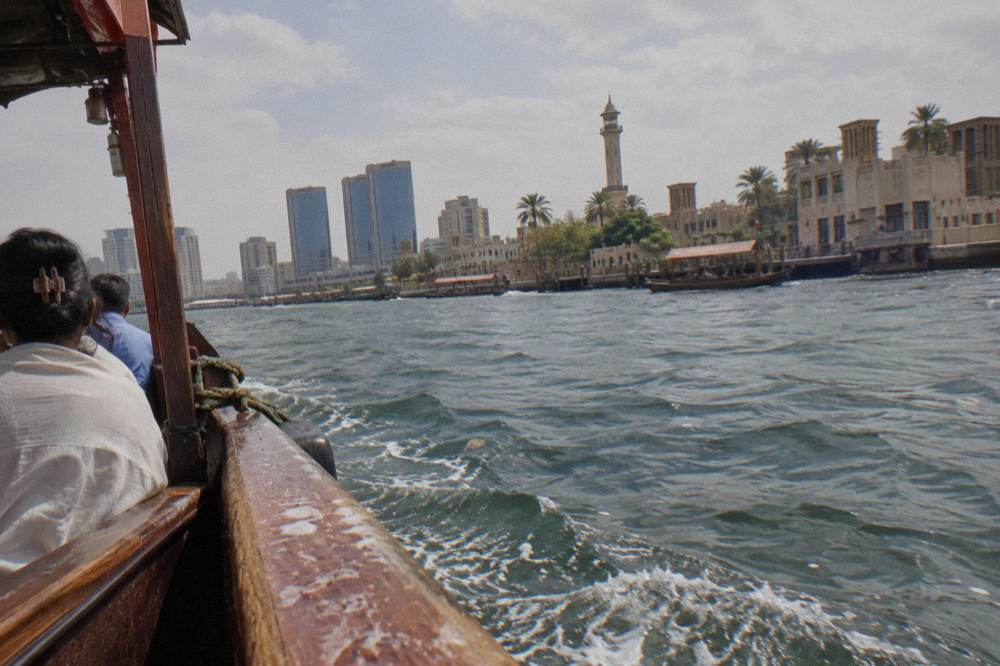
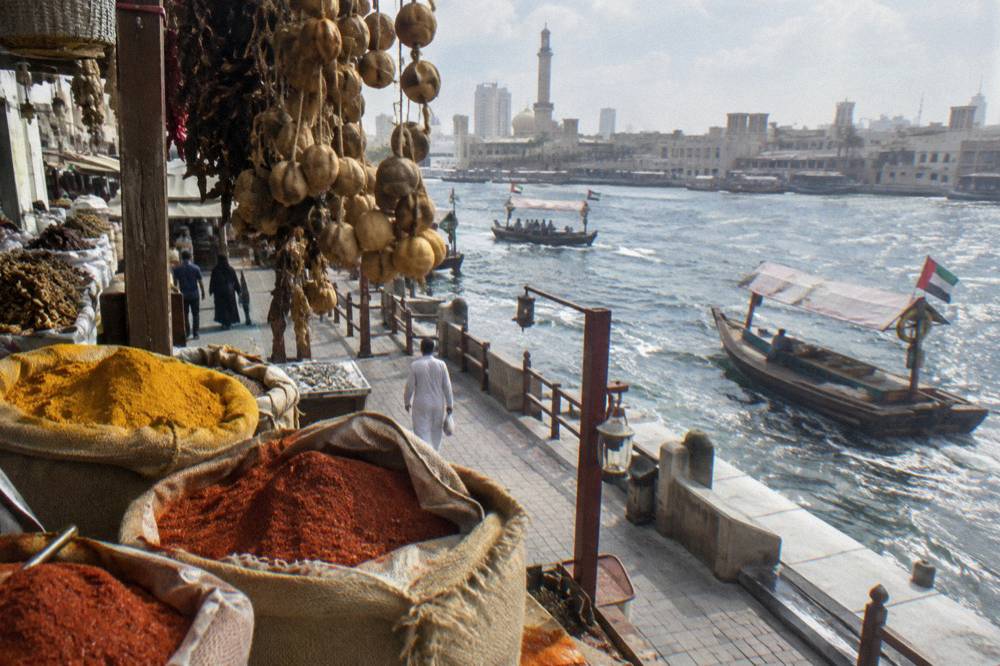
The guided street-food walks are the biggest family. They share a spine: Al Fahidi or Al Seef on the Bur Dubai side, a Creek crossing, then the Deira souks, with tastings distributed along the route. The Al Fahidi Old Town, Souks, Street Food & Abra Cruise option is a good example of the family at its tightest, a 2.5 to 4 hour walk that links the heritage district, the souks and a boat ride on the Creek. Its listing describes tastings along the route and a cruise rather than a plain crossing, which is the kind of detail worth checking on the booking page before you commit.
Private tasting trails trade the group for a fixed menu of stops. The Private Food Tour with 10 Tastings and the 12 Tastings variant both run around 3 hours with a local host, and the count is the promise: you know roughly how many portions you will be handed before you leave. Cultural meals sit at the other extreme, barely any walking, one table, and dishes like machboos and harees explained by the host. The Sheikh Mohammed Centre for Cultural Understanding runs its own version of this in Al Fahidi, with reported session prices of AED 130 to 160 depending on the meal slot, booking required.
Here is the landscape in one view:
| Format | Typical duration | What it centres on | Who it suits |
|---|---|---|---|
| Guided street-food walk | 2 to 4 hours | Souks, heritage lanes, standing tastings | First-time visitors who want sights and food together |
| Private tasting trail | 3 to 4 hours | A fixed count of tastings with a local host | Picky eaters, families, anyone who wants pace control |
| Cultural meal | 1.5 hours | Seated Emirati dishes with explanation | Visitors short on time or on feet |
| Skyline or night format | 3 hours | Tastings plus a deck, bar or after-dark souks | Repeat visitors, photographers |
One honest caveat: the seated cultural meal is not a substitute for a walk, and a walk is not a substitute for a meal. If your main goal is to understand what Emiratis actually cook at home, the seated format answers that better than any street crawl. If your goal is to see the city while eating, no dining room will do it.
Neighbourhood First: Why Old Dubai Carries Most Of The Best Options?
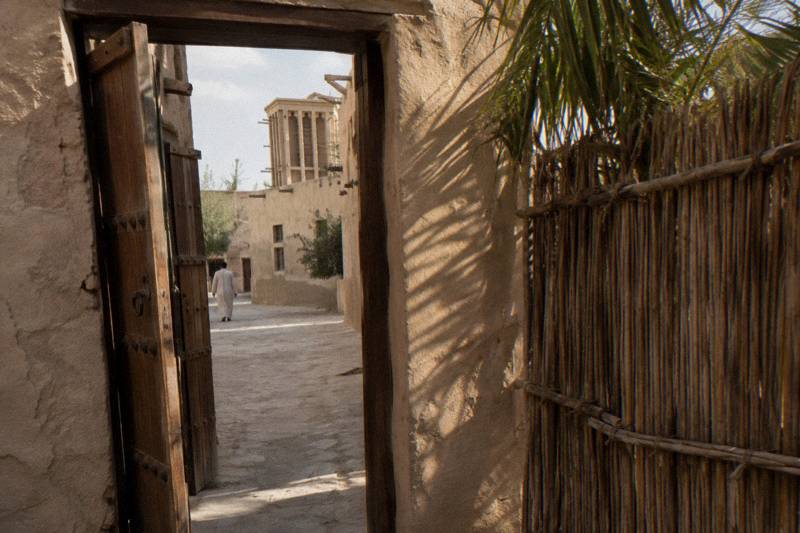
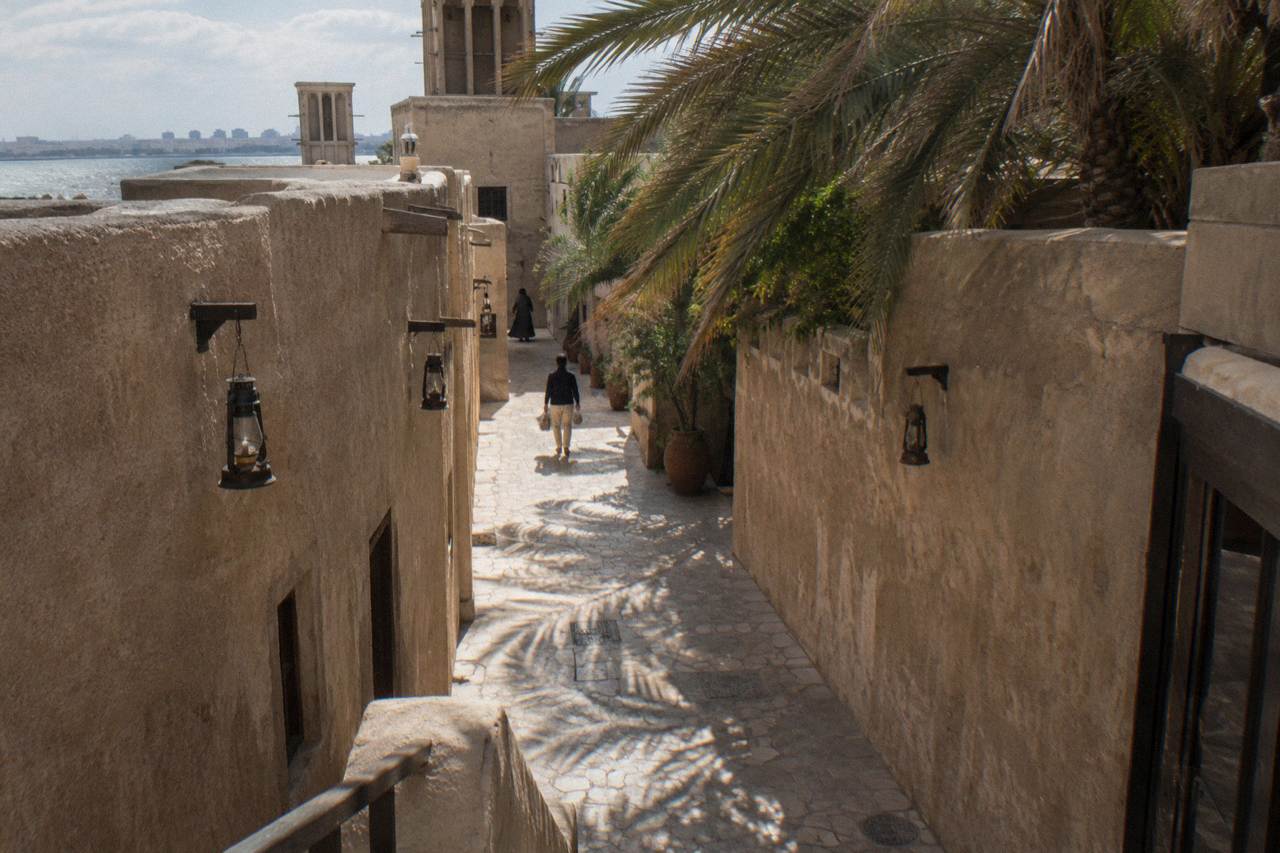
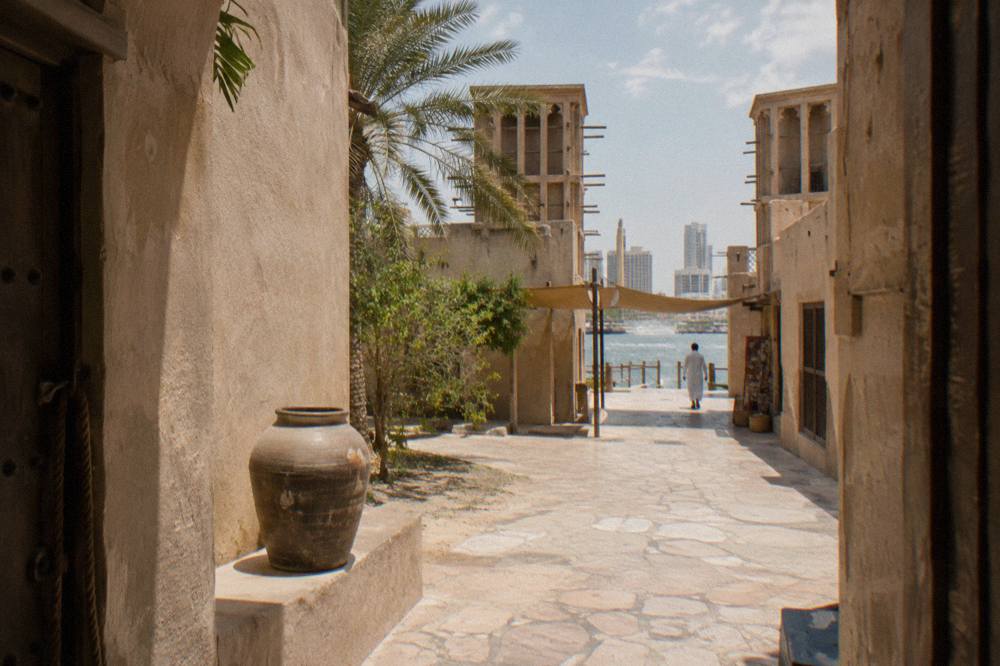
Almost every strong food walk here runs through Old Dubai, meaning Al Fahidi, Al Seef, the Bur Dubai abra docks and the Deira souks, because that is where the Creek, the heritage architecture and the oldest street kitchens sit within walking distance of each other. The Al Fahidi Historical Neighbourhood is open for walking with free public access, and Dubai Culture lists its hours as 7am to 8pm daily. Al Seef's waterfront promenade stretches about 1.8 km and is free to enter. Standard walking connections between Al Fahidi, Al Seef, the Textile Souk, the abra stations and the Deira souks are all intact, with no route closures reported for 2026. For a look at how the newer, resort-style markets stack up against these historic trading streets, the guide to Madinat Jumeirah Souk and other Dubai souks compares what each market does best.
That geography is why tour operators cluster here. A single walk can cover a coral-stone heritage district, a boat ride, a spice market and a gold market without a vehicle, and the metro makes it reachable: the Green Line serves Baniyas Square, Gold Souq, Al Ras and Sharaf DG stations, per the official RTA metro station map. Meeting points seen on listings confirm the pattern: Al Khayma Heritage Restaurant in Al Fahidi, Al Ras Metro Station exit 2 in Deira, the Al Seef Heritage Hotel entrance, Sharaf DG Metro exit 4.
The choice inside Old Dubai is which side you start on. Bur Dubai starts, meaning Al Fahidi and Al Seef, give you heritage lanes first and souks last. Deira starts, meaning Al Ras or the Gold Souk area, reverse the order and put you closer to the Spice Souk's earliest stalls. Neither is better; it depends on whether you want the pretty part fresh or saved for the end, and on where your hotel sits on the metro map.
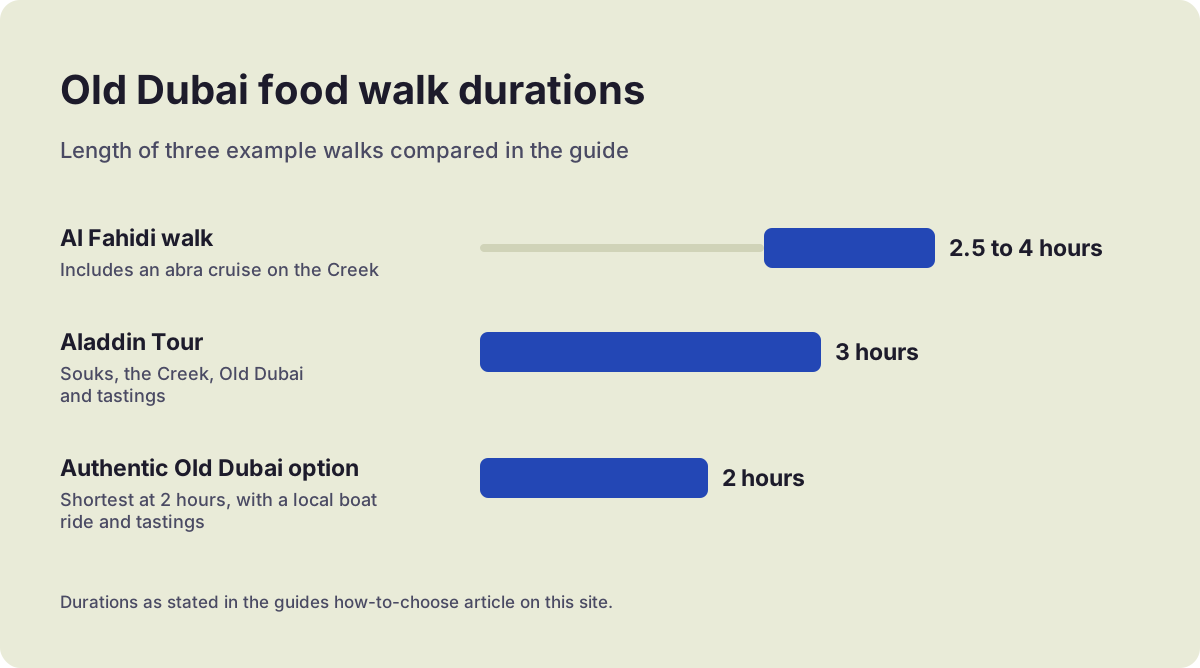
These three walks show how much the same neighbourhood can vary by format. The Al Fahidi walk runs 2.5 to 4 hours and includes an abra cruise on the Creek. The Aladdin Tour runs 3 hours and strings together souks, the Creek, Old Dubai and tastings. The Authentic Old Dubai option is the shortest at 2 hours, with a local boat ride and tastings, which suits anyone who wants the core loop without the full time commitment. Check each listing for the current meeting point and what the tastings cover on your date.
If you are staying elsewhere, note that the newer districts, Downtown and the Marina, host the skyline-format tours rather than street-food walks. Those pair a handful of tastings with a view, and they make sense as a second food experience, not a replacement for the Old Dubai loop. For more on the areas, see the guide to Marina and Downtown restaurants versus Old Dubai.
Duration And Pace: How Long Should A Food Walk Be?
Match the length to your energy and your schedule: 2 hours covers the souks and a boat ride with tastings, 3 hours is the standard that fits the full Old Dubai loop comfortably, and 4 hours suits visitors who want a slower pace, more stops or a private format. The shortest option compared here is the 2-hour Authentic Old Dubai walk; the longest are 4-hour options including the Half-Day Street Food Tour and the Premium Old Town tour. A 3-hour slot is the most common, and it is the one most first-time visitors end up happy with.
Time of day matters as much as total length. Winter helps: December to February bring the lowest average daytime highs of the year, 24 to 26 °C per the NCM-derived monthly normals, which is walking weather from mid-morning to sunset. Winter sunset falls around 17:32 in mid-December, so an afternoon walk ends in daylight and an early-evening one starts at dusk, when the souks switch on their lights. A Dubai Creek lighting project is underway along roughly 8 km of the waterfront including the Gold Souq promenade and Al Seef, scheduled for completion in Q1 2027, so evening walks in this area are only getting brighter.
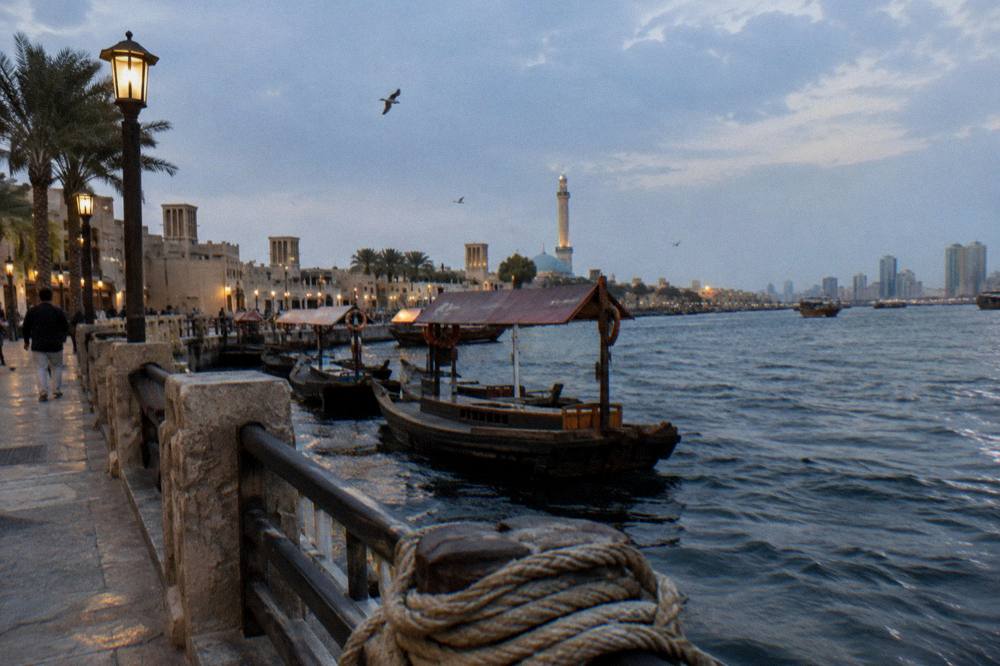
Pace is the hidden variable. A group walk keeps a set route and a set rhythm; if you are the type who wants to linger at a stall, buy dates, or photograph a doorway, the shorter group formats will feel rushed. Private tours solve this directly, since the host adjusts to you. The trade is price, which private listings carry per group on some pages, so read the basis on the booking page before comparing it against a per-person group walk.
| Duration | Tours at that length | What fits |
|---|---|---|
| 2 hours | Authentic Old Dubai, Souks, Tastings & local boat | A quick loop, tight schedules, hot months |
| 2.5 hours | Flavors of Arabia souk tour with dinner | Souk browsing plus a seated finish |
| 3 hours | Aladdin Tour, Emirati House walk, private 10-tasting trails | The standard full loop at a comfortable pace |
| 3 to 4 hours | Al Fahidi walk, Premium Old Town tour, historic guided walks | Repeat visitors, photographers, slow eaters |
| 4 hours | Half-Day Street Food Tour, Premium Old Town & Boat Ride | The whole district without watching the clock |
One planning note: the souks have their own rhythm. The Spice Souk's shops generally open earlier than 8am and run past 9pm, with many closing during daytime on Fridays and taking midday breaks, as reported by Visit Dubai. The Gold Souk's shops mostly open around 10am to 10pm. A morning walk and an evening walk therefore see different versions of the same streets, and neither is wrong.
Price And Inclusions: What Are You Actually Paying For?
Compare what the price includes, not just the number: the walks here differ in whether tastings, a boat ride, a full dinner or a private guide are inside the price, and several listings price per person while private options price per group, so the basis on the booking page is the real comparison. Tasting counts are the clearest signal, with private trails promising 10 or 12 tastings and group walks describing tastings without a fixed count. Where a price is not printed in this comparison, it is on the listing, and per-person from-prices can vary by group size or date.
The inclusions that change value most are these: a boat crossing versus a cruise, standing tastings versus a seated dinner, and a shared group versus a private host. The Flavors of Arabia souk tour, for example, is a 2.5-hour format that includes tastings and dinner, which makes it a different product from a walk that hands you a shawarma and keeps moving. The VIP format goes the other way, pairing 7 or more tastings with Burj Khalifa access in a 3-hour window, which is a food walk bolted onto a sightseeing highlight. The full index of guides sits on Dubai Food Tours.
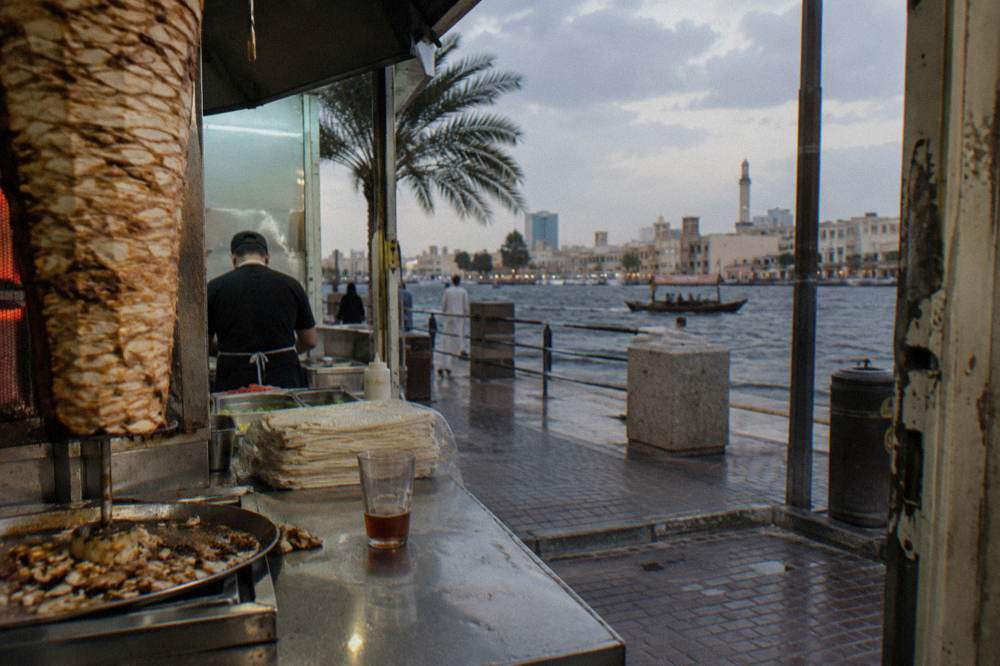
For context, eating independently in Old Dubai is cheap by any tourist standard. Reported local prices put shawarma at 8 to 15 AED, falafel wraps at 4 to 15 AED, karak chai at 1 to 3 AED from local cafeterias, and a bag of samosas at around 10 to 12 AED. A casual neighbourhood meal runs a reported 15 to 40 AED per person. What a guided walk adds is not the food cost, it is the route, the explanation and the confidence to walk into the right places, which is worth weighing honestly before you pay a premium.
| Cost item | Reported figure | Where it appears |
|---|---|---|
| Shawarma at local spots | 8 to 15 AED | Street stalls, Deira and Bur Dubai |
| Falafel wrap | 4 to 15 AED | Street counters |
| Karak chai | 1 to 3 AED | Local cafeterias |
| Casual meal per person | 15 to 40 AED | Neighbourhood cafeterias |
| Mid-range restaurant meal | about 80 to 150 AED | Seated restaurants citywide |
Two payment notes that belong to the planning stage rather than any single tour. Restaurants commonly add a service charge of up to 10 per cent plus 5 per cent VAT, and cash tips of 5 to 10 per cent are common but voluntary, as Visit Dubai's tipping guide explains. And if a tour's price looks too good next to its neighbours, check whether tastings are included or sold as extras on the day; the listing states this, and it is the most common gap between a cheap headline and the real bill.
Reviews And Signals: How Do You Read A Tour's Reputation?
Read the review count before the rating: a listing needs a substantial pool of reviews before its average means anything, and on this range the most reviewed walks are the group Old Dubai formats while newer and private listings carry thinner pools, so treat a high average from a small pool as a weak signal. Ratings printed without counts invite you to imagine a confidence that may not exist. Where this comparison does not print a rating for a specific tour, the figure is on the listing, and you should check the count there.
The second signal is what reviewers actually mention. Look for repeated mentions of the guide's name, the number of stops, whether the group felt crowded, and whether reviewers say they were full at the end. A walk where reviewers consistently report being fed to satisfaction is delivering on the core promise. A listing full of reviews about the sights but not the food is telling you what it actually is.
The third signal is recency. A walk's quality tracks its guides, and guides change. A page of reviews from years ago describes a team that may have moved on. Skim the most recent pages of reviews rather than the average, and look for the tour's current meeting point mentioned by name, which confirms the description matches what you will be sent.
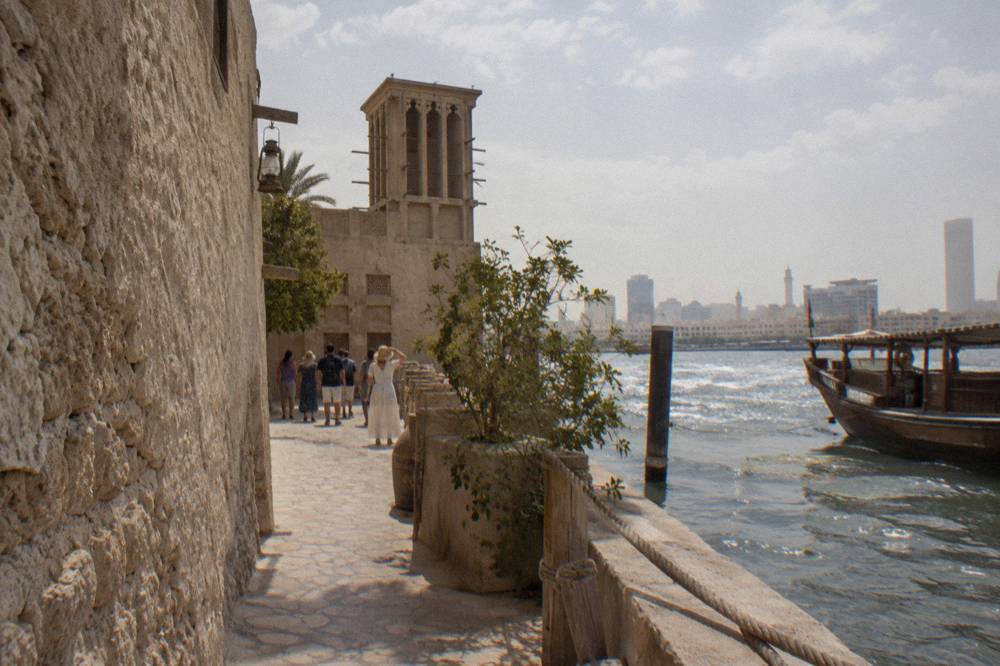
The Dubai Food Tour with 4 Cuisines, Souks & Street Bites runs 3 to 4 hours and frames itself around variety across cuisines, which is a useful test of the format: if reviewers name the dishes, the count is real. Check availability alongside the internal guide to whether food tours in Dubai are worth it, which works through the value question with the same figures.
Format: Group Walk, Private Trail Or Cultural Meal?
Pick group for value and atmosphere, private for control and dietary needs, and a cultural meal for depth over distance: the group walks here share a guide with strangers and cost least per person, the private trails run about 3 hours with a fixed tasting count, and the cultural meals sit you down for around 90 minutes of explained dishes. The decision is mostly about who you are travelling with. Solo travellers and couples do well in groups. Families with children, strict diets or a short window do better private.
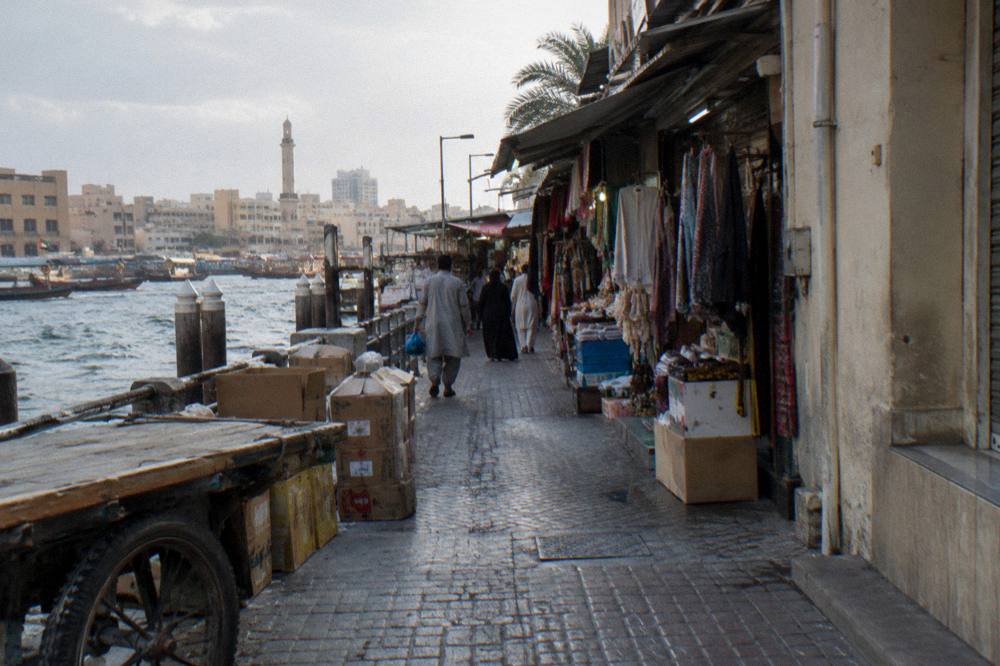
Dietary needs deserve a specific warning. All meat sold in restaurants and markets here is halal, and pork appears only in designated licensed sections, so the default walk is already halal throughout. But no listing should be assumed vegetarian, vegan or gluten-free unless its own description says so. If that matters, message the operator before booking rather than trusting a keyword, and keep the reply. The guide to vegetarian and dietary needs on a Dubai food walk covers this in detail.
The private formats compared here make their promise in the title. The Private Food Tour with 10 Tastings runs 3 hours with locals as hosts, and there is a 12-tasting variant at the same length for bigger appetites. A private Old Dubai walk with transfers adds hotel pickup, which removes the metro question entirely for visitors who would rather not navigate the Green Line on a food day.
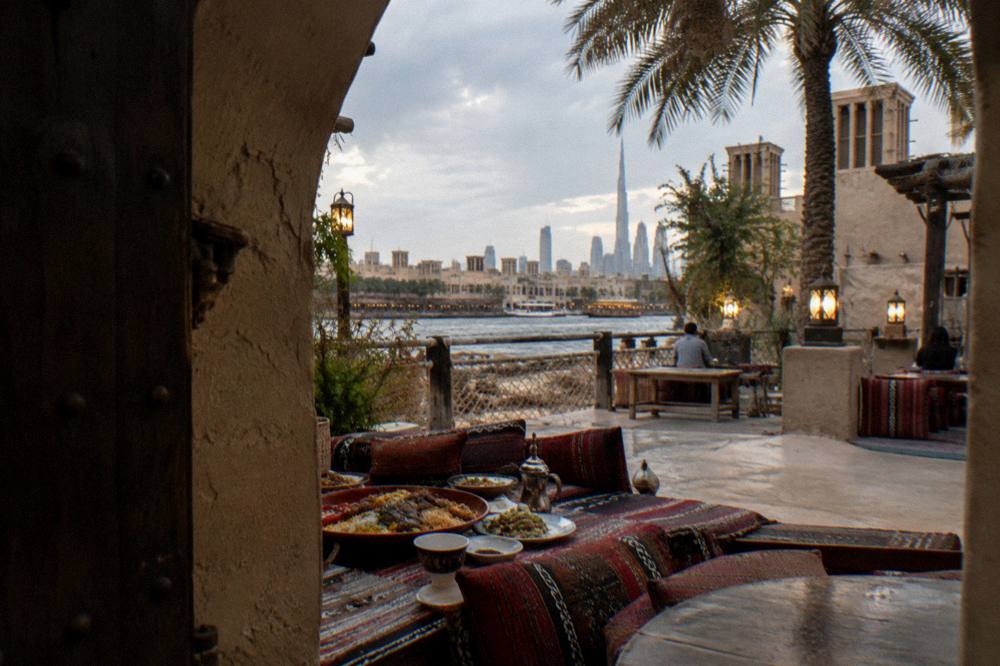
The cultural meal deserves more credit than it usually gets from visitors planning a packed itinerary. The Sheikh Mohammed Centre for Cultural Understanding in Al Fahidi hosts 1.5-hour cultural meals with Emirati hosts, question-and-answer sessions on customs and daily life, and Arabic coffee and dates, at reported prices of AED 130 for breakfast up to AED 160 for dinner, booking required, per its official programme page. A walk shows you the city; a meal like this explains it.
How Do You Match A Tour To The Rest Of Your Trip?
Fit the walk into the trip, not the other way around: on a short visit take one 3-hour Old Dubai walk plus a cultural meal if time allows, on a week-long trip add a private trail or a skyline format as a second experience, and in the hot months book the earliest or evening slots and keep the seated formats as a midday fallback. The mistake to avoid is stacking two long walks on consecutive days, which turns pleasure into homework.
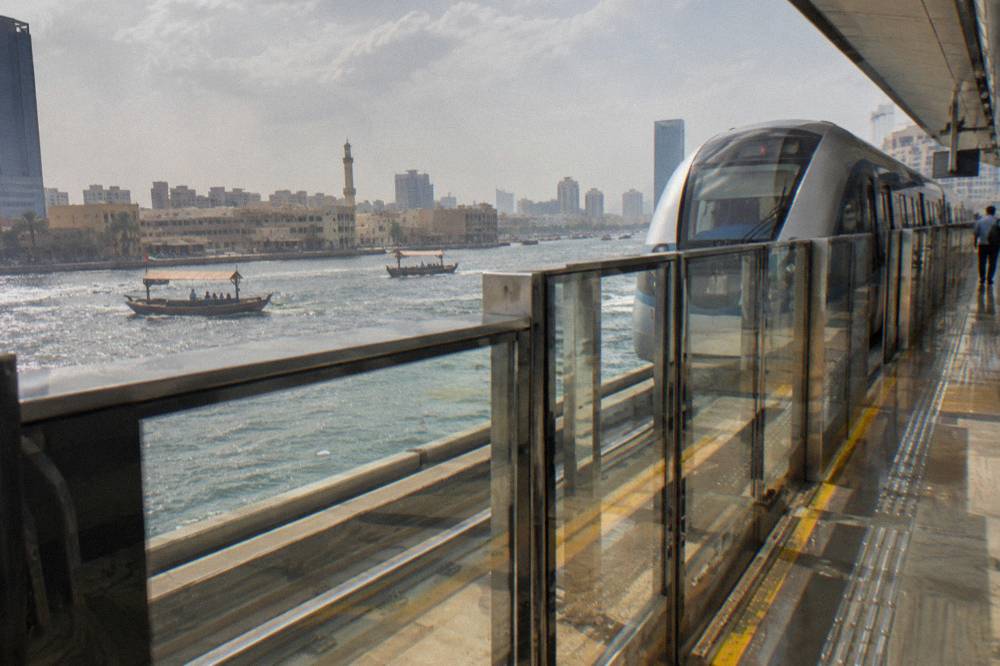
Timing by season is straightforward. December to February is the walking sweet spot, with daytime highs of 24 to 26 °C and sunset near 17:30. Summer reverses the logic: book the earliest slot a tour offers, or take the evening version, and lean on the seated and air-conditioned formats for the middle of the day. The guide to Dubai food walks in summer heat and timing works through the full calendar.
A sensible first-timer's sequence looks like this: the Old Dubai loop walk on day one or two, when jet lag makes a guided structure useful; the souks revisited independently afterwards, since you now know the layout; and a cultural meal or a private trail later in the week if the food has become the trip's theme. Anyone with three days can follow the three-day Dubai itinerary built around a food tour, which sequences exactly this way.
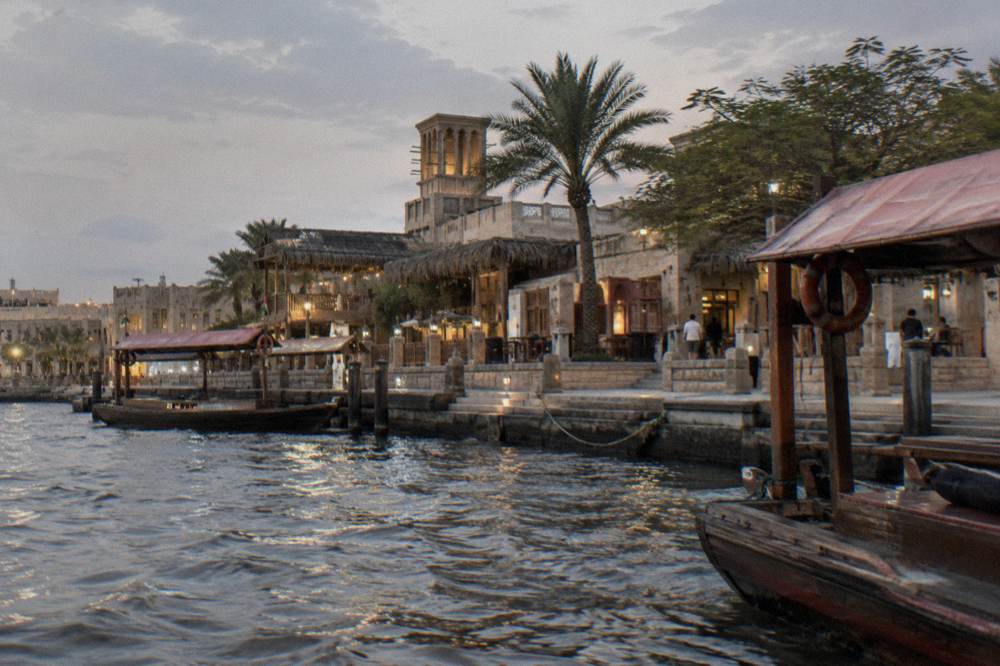
One last practical layer: getting there. The Green Line serves the whole district, and a reloadable Nol card costs AED 25 including initial credit, per the official RTA card page. Taxis start at a reported AED 5 in daytime. The meeting point for each walk is on its booking page, and the listings here use real landmarks, from Al Khayma Heritage Restaurant to the Al Seef Heritage Hotel entrance, which makes a pre-walk coffee easy to plan.
By now the axes should point in one direction. If you want the city and the food in a single morning, take a 3 to 4 hour Old Dubai group walk. If you want control, take a private trail and let the tasting count settle the budget. If you want to understand the cuisine rather than sample it, sit down for a cultural meal. Whatever you pick, book the slot with the best weather window, check the cancellation terms on the listing, and arrive hungry.
Common Questions About Choosing A Dubai Food Walk
What Types Of Food Experience Can You Book In Dubai?
Four families: guided street-food walks through Old Dubai of 2 to 4 hours, private tasting trails of around 3 hours with a fixed count of 10 or 12 tastings, seated cultural meals of about 90 minutes, and skyline formats that pair tastings with a view or a night setting.
How Long Should A Food Walk Be?
Three hours is the standard and fits the full Old Dubai loop comfortably. Two hours covers the souks and a boat ride with tastings for tight schedules, and 4-hour options suit visitors who want a slower pace or a private format.
How Do You Read A Tour's Reviews Before Booking?
Read the review count before the rating, since a high average from a small pool is a weak signal. Then check what recent reviewers say about the guide, the number of stops and whether they were full at the end, rather than relying on the overall average.
Group Walk, Private Tour Or Cultural Meal: Which Should You Pick?
Group walks give value and atmosphere for solo travellers and couples. Private trails suit families, dietary needs and anyone who wants pace control, with 10 or 12 tastings fixed in advance. A cultural meal suits visitors who want the cuisine explained rather than sampled.
What Does A Food Tour Price Actually Include?
It depends on the listing: some include tastings and a boat cruise, some add a seated dinner, and private options may price per group rather than per person. Check the inclusions and the price basis on the booking page before comparing numbers.
When Is The Best Time Of Day For An Old Dubai Walk?
December to February offers daytime highs of 24 to 26 °C, comfortable from mid-morning to sunset. In hotter months take the earliest slot or an evening walk, and note that Spice Souk shops generally open before 8am with many closing during daytime on Fridays.