Madinat Jumeirah Souk And Other Dubai Souks
Dubai has two very different kinds of souk: the purpose-built, air-conditioned retail version at Madinat Jumeirah, and the working markets of Old Dubai where traders have sold textiles, spices and gold for generations. Here is what each one actually offers, and where the food is.
Short answer
Madinat Jumeirah Souk is a modern shopping and dining destination styled like an old Arabian market, while the Deira and Bur Dubai souks are the real trading souks, linked by an abra ride across the Creek. For food, the old souks win: spice stalls, street snacks and karak stops sit right on the walking routes, and guided food walks cover them in two to four hours.
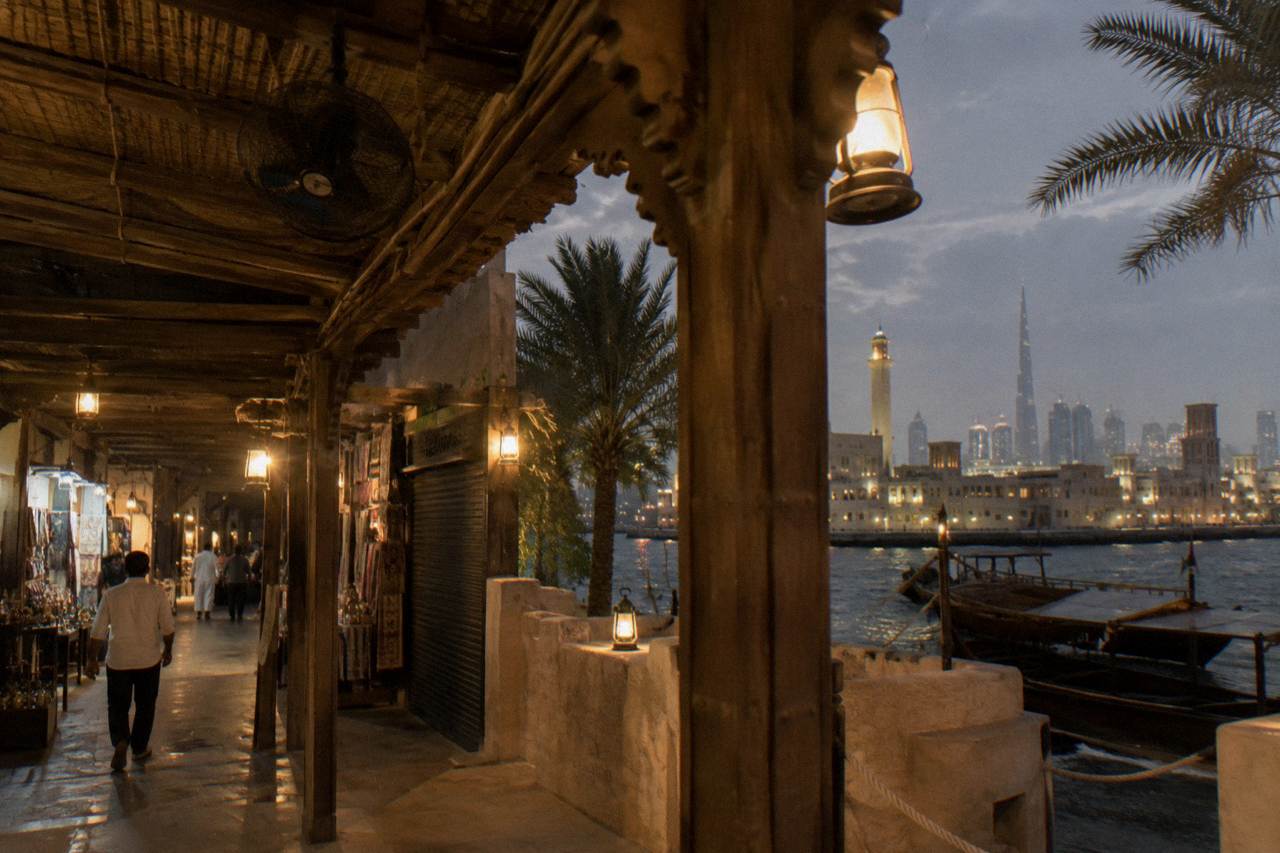
Madinat Jumeirah Souk gets the postcard shots: canals, wooden walkways and lanterns strung across a marketplace built to feel old. The Deira and Bur Dubai souks get the trade. Both are worth a visit, but they serve different trips, and the difference matters most if you are coming for the food. The old souks sit inside one of the most walkable eating districts in the city, while Madinat Jumeirah is a polished retail and dining destination on the beach side of town.
This guide lays out what each souk actually is, what things cost at the street-food end, how the markets connect by metro and abra, and where a guided walk earns its fee. Along the way it points to the Dubai Food Tours guides that go deeper on each neighbourhood.
What Is A Souk In Dubai?
A souk is a traditional market district, and in Dubai the word covers two very different things: the historic trading souks of Deira and Bur Dubai, where spice, textile and gold merchants still run working stalls, and modern destinations like Madinat Jumeirah Souk, built in the style of an old market but designed as a shopping and dining complex. Both trade under the same name.
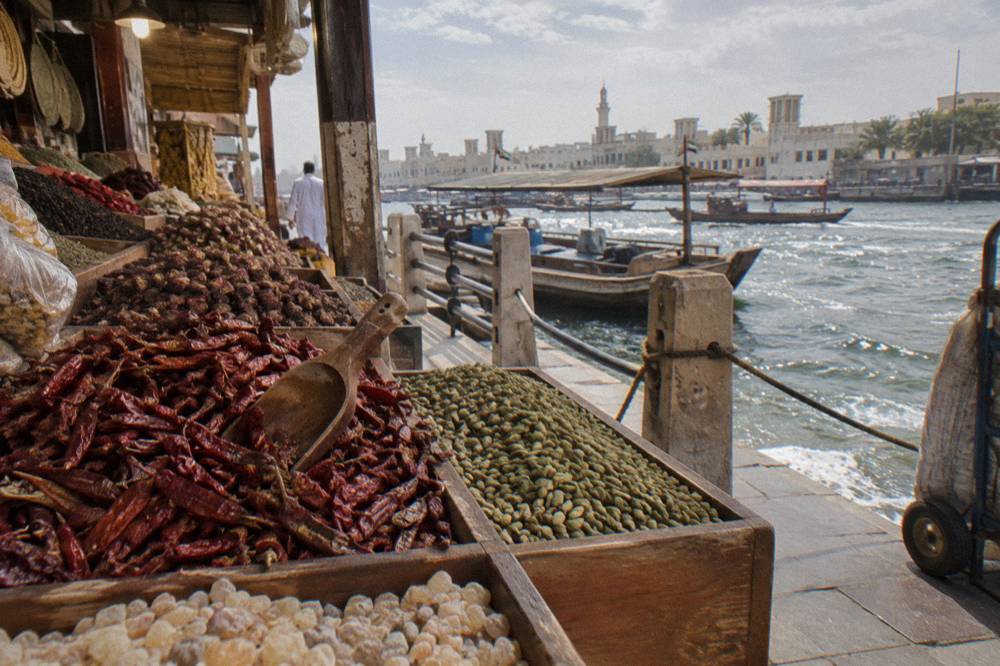
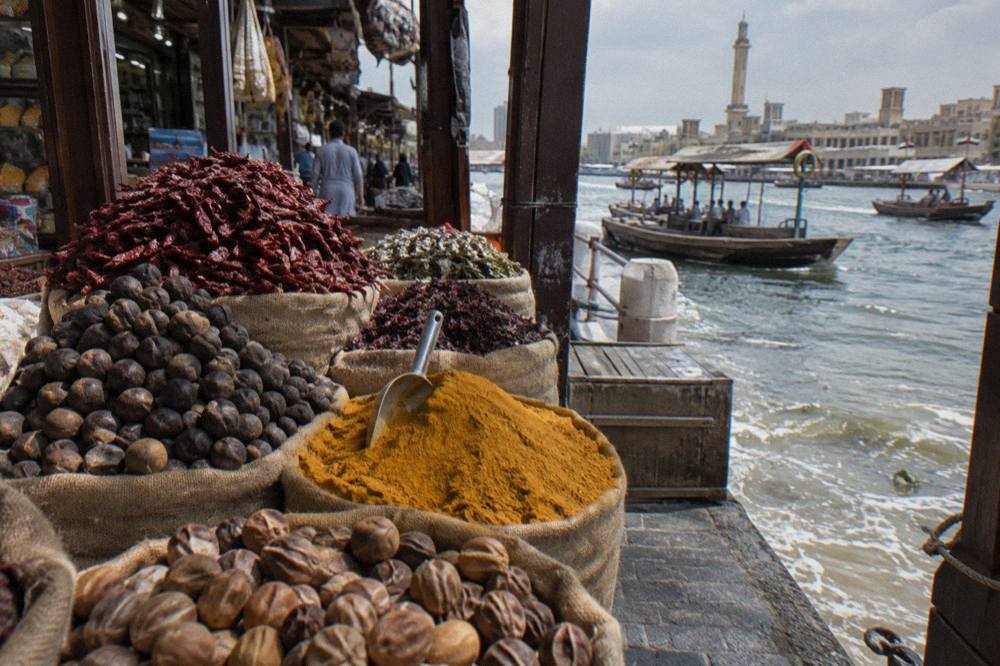
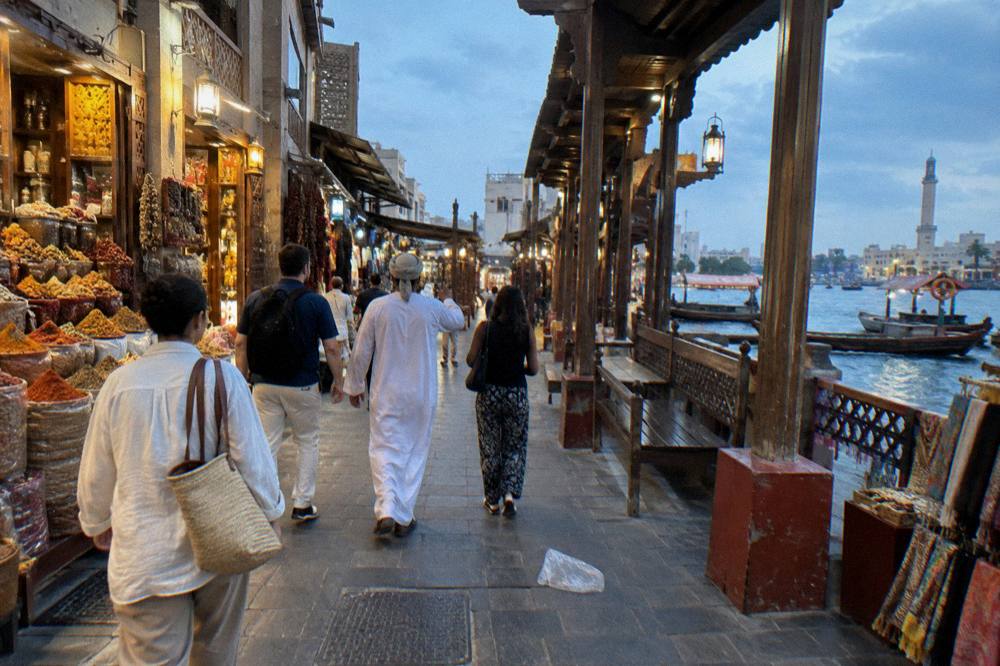
The word itself simply means market. In Old Dubai it means narrow lanes of covered stalls: the Spice Souk's sacks of dried lime, saffron and frankincense, the Gold Souk's windowed storefronts, the Textile Souk's bolts of silk and cotton on the Bur Dubai side. These districts grew around the Creek, the saltwater inlet where the city's pearling and trading economy started, and their layout still follows the logic of a working port rather than a mall.
Madinat Jumeirah Souk is the other thing entirely. It opened as part of a beachfront resort development, and it is beautiful, but nothing there is traded the way spice is traded in Deira. Its stalls sell gifts, fashion, jewellery and art, its cafes and restaurants line waterways crossed by wooden boats, and its air conditioning is a feature rather than an accident. Visitors who expect a bargaining market are sometimes surprised; visitors who want a pleasant evening of shopping and eating love it.
Neither version is the "real" one. They are different products for different evenings, and the practical question is which one fits your trip. If you want a deeper look at the Spice Souk's stalls and what to buy there, the old district is the one to read about first.
Madinat Jumeirah Souk Versus The Old Dubai Souks
Madinat Jumeirah Souk is a modern, resort-side marketplace with boutiques, galleries and canal-side restaurants, reached by taxi or car in the Jumeirah beach area. The old souks are historic trading districts around Dubai Creek, reached by metro and abra, where the shopping is spices, gold and textiles and the eating is street food and small cafes. They are about 20 km apart and feel like different cities.
The comparison is worth making honestly because both are marketed with the same imagery. At Madinat Jumeirah you get architecture that borrows from old Gulf building styles, wooden abras that ferry diners along canals, and a curated, climate-controlled version of a market. It is a good place for an unhurried dinner, a gift hunt, and photographs at golden hour. What you do not get is the trading floor atmosphere, the smells of the spice sacks, or the scale of the historic districts.
The old souks deliver the reverse. The lanes are hot in summer and warm in winter, the stalls are run by working merchants, and the food around them is the food the city actually eats: shawarma, falafel, samosas, karak chai and luqaimat, at prices reported in the single-digit and low-double-digit dirham range. Reported figures from 2026 sources put shawarma at 7 to 15 AED at local spots, karak at 1 to 3 AED at local cafeterias, and falafel wraps at roughly 4 to 15 AED depending on where you buy.
| Feature | Madinat Jumeirah Souk | Old Dubai Souks |
|---|---|---|
| What it is | Modern market-style shopping and dining complex | Historic trading districts around the Creek |
| Location | Jumeirah beach area, about 20 km from the Creek | Deira and Bur Dubai, either side of the Creek |
| Getting there | Taxi or car; not on the metro network | Green Line metro stations and abra crossings |
| Shopping | Boutiques, galleries, gifts, jewellery | Spices, gold by weight, textiles, souvenirs |
| Eating | Canal-side restaurants and cafes | Street stalls, cafeterias, heritage cafes |
| Atmosphere | Curated, climate-controlled, resort-side | Working market lanes, open air, trading floor |
For most visitors the answer is not either or. Madinat Jumeirah makes a relaxed evening; the old souks make a half-day adventure. If food is the point of the trip, the old souks are where the guided walks go, and a guided route saves you the guesswork of finding the best lanes on your own.
The three walks above all work the same historic district with different emphases, so the choice comes down to pace, tasting count and how much structure you want. The solo versus group question is worth a minute before you pick.
Which Dubai Souks Are Best For Food?
For food, the Deira souks win: the Spice Souk and Gold Souk sit in a dense street-food district where shawarma, falafel, samosa and karak stalls line the walking routes. The Bur Dubai side adds the Textile Souk, Al Fahidi Historical Neighbourhood and the Al Seef waterfront, where heritage cafes and Emirati breakfast spots cluster. Madinat Jumeirah Souk is dining, not street food.
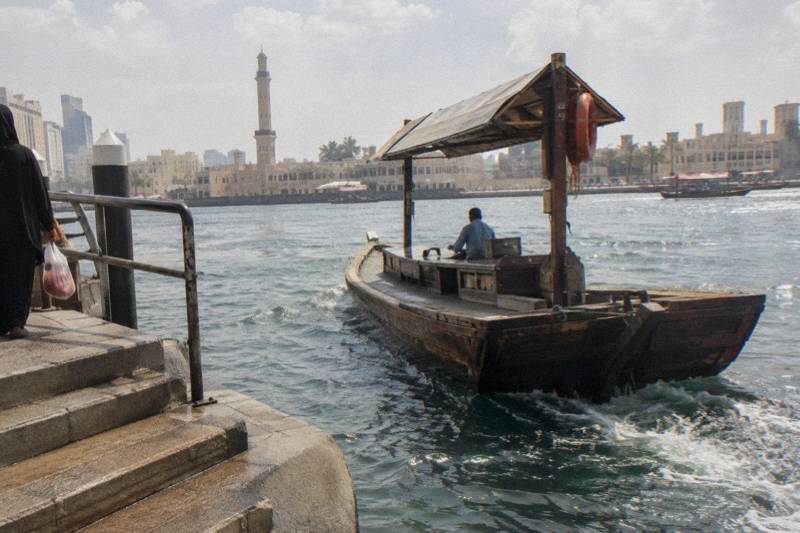
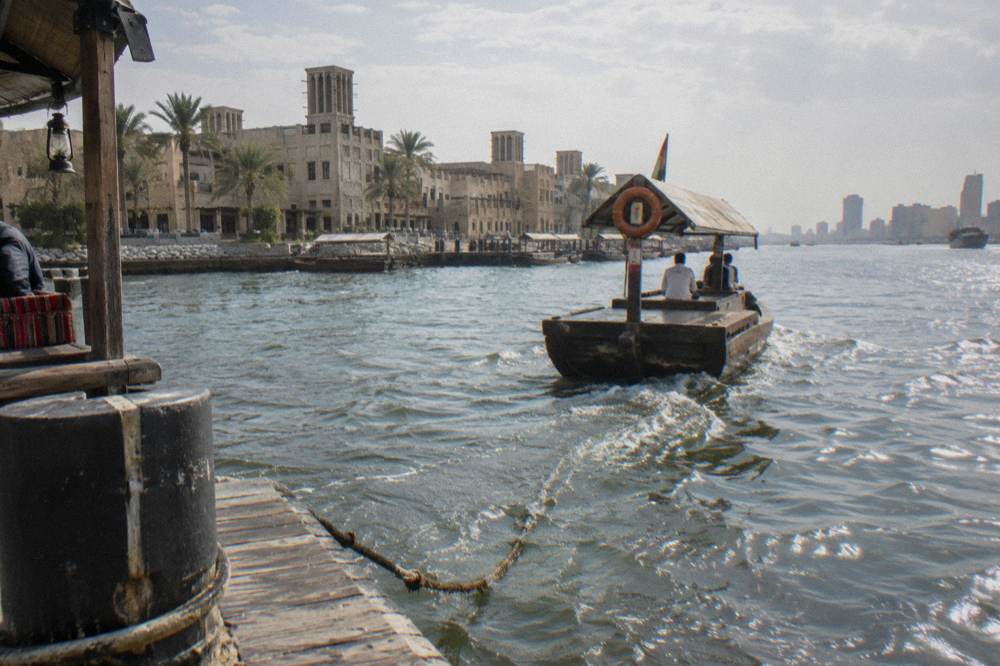
The layout is simpler than it first looks. The Creek splits Old Dubai in two. On the Bur Dubai side you have the Textile Souk, Al Fahidi Historical Neighbourhood with its wind-tower houses and galleries, and the Al Seef waterfront, a roughly 1.8 km promenade with free entry that mixes heritage-style and modern sections. On the Deira side you have the Spice Souk and the Gold Souk, and behind them the cheaper eats of Al Ras and Al Rigga. An abra, the small wooden ferry, crosses between the two sides in minutes.
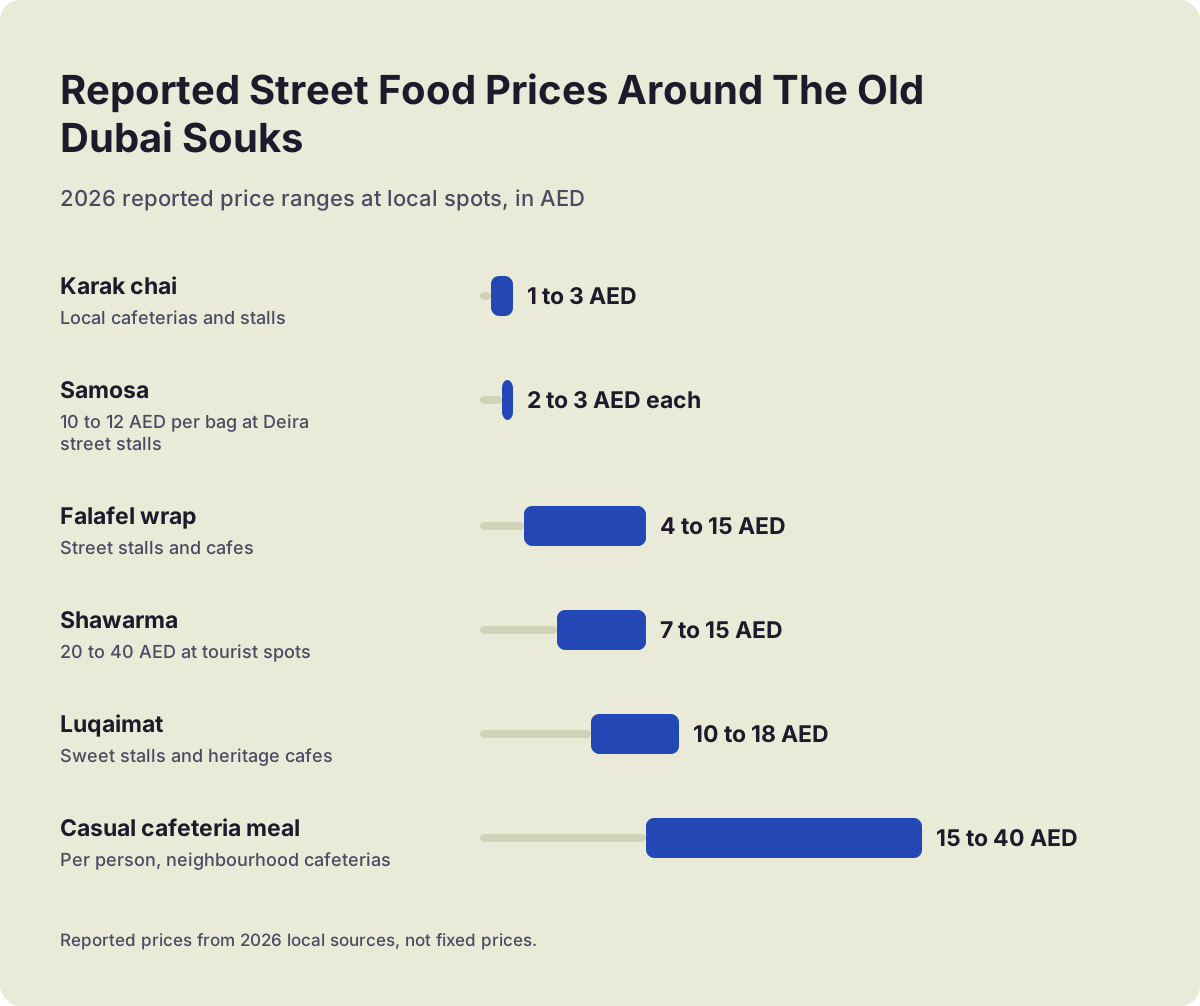
Food sits at both ends. Around Deira, reported 2026 figures have samosas at about 2 to 3 AED each or 10 to 12 AED for a bag, and luqaimat, the crisp date-syrup dumplings, at 10 to 18 AED. Around Al Fahidi, the options shift to sit-down Emirati breakfasts: balaleet, the sweet saffron vermicelli with egg, chebab pancakes, and regag bread, washed down with karak. One reported example puts balaleet at a heritage cafe in Al Fahidi at around 52 AED, which tells you the difference between a street snack and a sit-down plate.
A guided walk ties these ends together. The featured tour on this page, the Authentic Old Dubai, Souks, Tastings and local boat walk, is a 2-hour route that pairs the souks with tastings and a local boat crossing, and the operator's listing carries the current price, meeting point and what is included. Check availability if that pace suits you.
The Old Dubai Souk Route: Textile, Spice And Gold
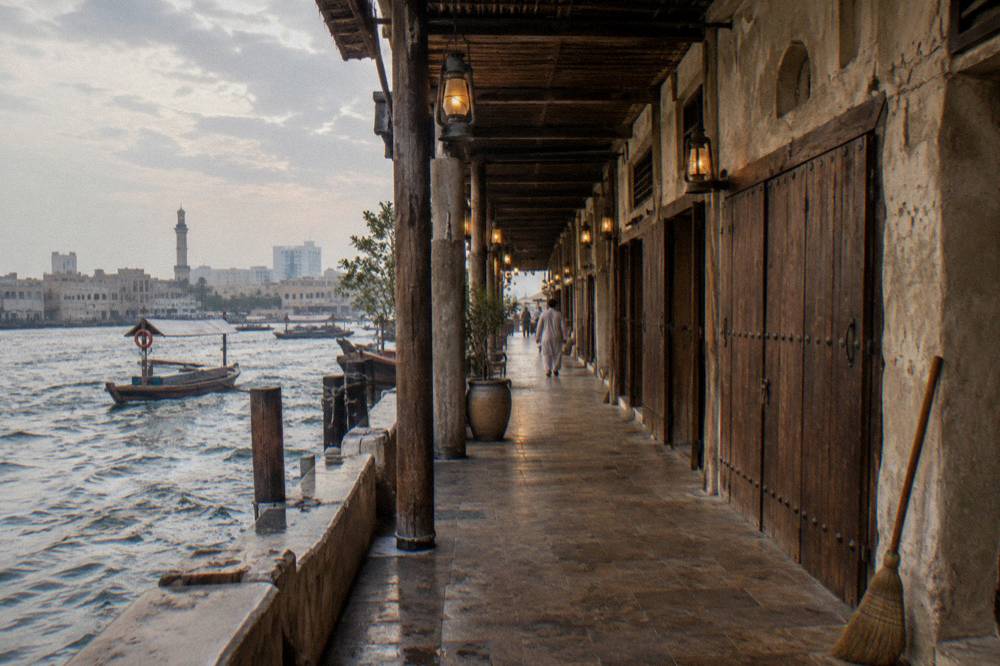
The classic route runs Textile Souk and Al Fahidi on the Bur Dubai side, an abra crossing of the Creek, then the Spice Souk and Gold Souk in Deira, all on foot. Walking the whole loop takes a relaxed half-day, and the souks sit within a few minutes of metro stations on the Green Line, so you can start or bail out at either end.
Start on the Bur Dubai side. The Textile Souk's stalls sell fabric, pashminas and souvenirs, and while no official opening hours are published, guides typically describe vendor hours of roughly 9am to 8pm, with some Friday afternoon closures. From there, Al Fahidi Historical Neighbourhood is a short walk: its lanes, courtyards and galleries are open to the public, with Dubai Culture stating neighbourhood hours of 7am to 8pm daily. The Al Seef promenade runs along the water from there.
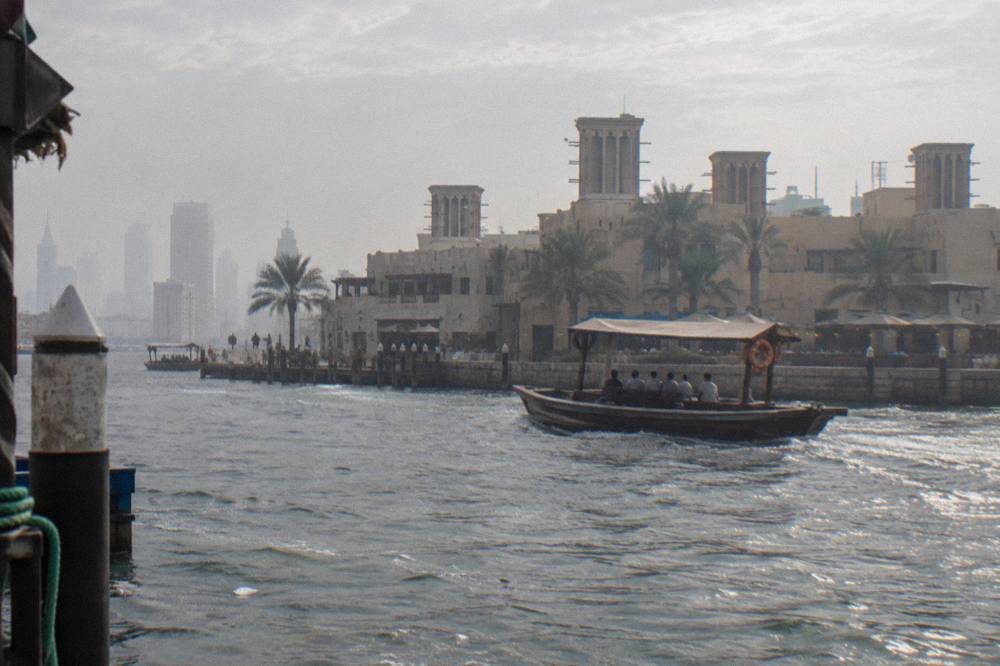
The abra crossing is the hinge of the route. The Roads and Transport Authority runs traditional commuter abra routes across the Creek, including the Bur Dubai to Deira Old Souq line and several others connecting Al Seef, Al Fahidi, Al Sabkha and Baniyas, per the RTA's Creek abra page. The ride is short and it puts you within a few minutes' walk of the Spice Souk.
On the Deira side, the Spice Souk's shops generally open earlier than 8am and run past 9pm, with many closing during the daytime on Fridays and taking midday breaks, as reported by tourism sources. The Gold Souk's shops mostly open around 10am to 10pm, though individual shop hours vary and no single official timetable exists. Both districts are covered in more detail in the guide to the Creek abra ride and waterfront eating.
| Souk | Side of the Creek | What it sells | Reported hours pattern |
|---|---|---|---|
| Textile Souk | Bur Dubai | Fabric, pashminas, souvenirs | Roughly 9am to 8pm, some Friday afternoon closures |
| Spice Souk | Deira | Spices, dried limes, frankincense, saffron | Earlier than 8am to past 9pm, Friday daytime closures, midday breaks |
| Gold Souk | Deira | Gold and jewellery by weight | Most shops around 10am to 10pm, hours vary by shop |
A 2.5 to 4 hour guided version of this exact loop exists: the Al Fahidi Old Town, Souks, Street Food and Abra Cruise walk covers the old town, the souks, tastings and a Creek cruise, and its listing carries the current price and inclusions.
If you would rather trace the route yourself before committing, the Old Dubai walking pace guide breaks down distances, stop counts and what to wear on the lanes.
How Much Does Souk Food And Shopping Cost?
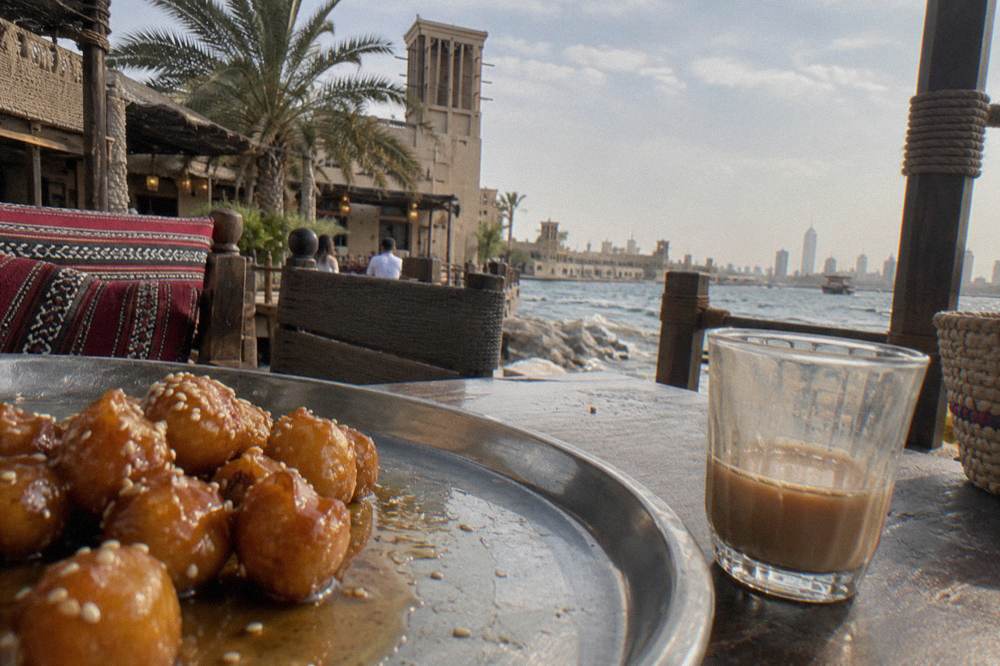
Street snacks around the old souks are cheap in absolute terms: reported 2026 figures put karak at 1 to 3 AED, samosas at 2 to 3 AED each, falafel wraps at 4 to 15 AED and shawarma at 7 to 15 AED at local spots. A casual cafeteria meal runs about 15 to 40 AED per person. Shopping is a separate budget entirely, and gold and textile prices are negotiated, not listed.
The eating side is the easy half to plan. The figures below are reported prices from 2026 local sources, not promises: stalls vary, tourist-adjacent spots charge more, and the cluster notes shawarma climbing to 20 to 40 AED at tourist locations. Check the price at the counter before you order, as you would anywhere.
| Item | Reported price range | Where you find it |
|---|---|---|
| Karak chai | 1 to 3 AED | Local cafeterias and stalls |
| Samosa or samboosa | 2 to 3 AED each, 10 to 12 AED per bag | Deira street stalls |
| Falafel wrap | 4 to 15 AED | Street stalls and cafes |
| Shawarma | 7 to 15 AED local, 20 to 40 AED tourist spots | Deira and Bur Dubai |
| Luqaimat | 10 to 18 AED | Sweet stalls and heritage cafes |
| Casual cafeteria meal | 15 to 40 AED per person | Neighbourhood cafeterias |
Two bill mechanics are worth knowing before you sit down anywhere. Restaurants commonly add a service charge of up to 10 per cent, which is venue-retained rather than a government fee, plus 5 per cent VAT; the standard breakdown is that an additional cash tip of 5 to 10 per cent is common but voluntary. On a street snack none of this applies; you pay at the counter.
The shopping side has no fixed price list. Gold is sold by weight plus a making charge you negotiate; textiles and souvenirs are bargained from an opening price. The only honest advice is to decide your ceiling before you start and to enjoy the negotiation as part of the experience.
A guided walk changes this budget in one direction only: you pay a single per-person price for the route and the tastings, and the operator's listing states exactly what is included. If you want the tastings counted and listed rather than improvised, a private walk such as the Private Food Tour with 10 Tastings pairs a local guide with a set tasting count.
The full cost comparison of Dubai food walks breaks down what different formats charge and what you get for the difference.
Getting Between The Souks: Metro, Abra And Walking
The Green Line serves both souk districts: Sharaf DG station serves the Al Fahidi and Textile Souk side, while Baniyas Square, Gold Souq and Al Ras stations sit in Deira. The abra crossing connects the two sides on the water, and the whole old souk loop is walkable in a half-day, with the markets themselves a few minutes from each station on foot.
The metro is the simplest way in. The RTA's official station map lists Sharaf DG on the Green Line for the Al Fahidi area, and Baniyas Square, Gold Souq and Al Ras stations on the same line in Deira, with Union as the Red and Green interchange. Trains run from 5am to midnight Monday to Thursday and Saturday, from 5am to 1am on Friday, and from 8am to midnight on Sunday, per the RTA timetable. A Nol card, the reloadable fare card, costs 25 AED including initial credit.
| Transport option | What it connects | Reported figures |
|---|---|---|
| Green Line metro | Sharaf DG to Al Fahidi; Baniyas Square, Gold Souq and Al Ras in Deira | Nol card 25 AED including initial credit |
| Metro hours | All lines | 5am to midnight most days, 5am to 1am Friday, 8am to midnight Sunday |
| Creek abra | Bur Dubai and Deira sides of the Creek, several routes including Al Seef and Al Fahidi | Short crossing, fare on the RTA marine page |
| Taxi | Door to door, the practical option for Madinat Jumeirah | Starting fare 5 AED daytime, 5.5 AED overnight |
Madinat Jumeirah Souk is the one destination in this guide that the metro does not serve directly. It sits in the Jumeirah beach area, so a taxi is the practical option; the RTA lists road-pickup starting fares of 5 AED between 6am and 10pm and 5.5 AED overnight, with the meter running from there. Budget the ride time as well as the fare, since the beach side and the Creek side are on opposite ends of the built-up city.
Weather should shape your timing more than anything else. December to February brings the lowest average daytime highs of the year, 24 to 26 °C per NCM-derived monthly normals, which is walking weather by any standard. Summer inverts the plan: walk early, walk the shaded lanes, and treat a midday cafeteria karak as the point of the exercise rather than a delay. The best time to visit guide covers the month-by-month trade-offs.
Souk Etiquette: Dress, Photography And Tipping
Cover shoulders and knees in the souks and heritage districts; this is cultural respect rather than a legal requirement, but it fits the setting. Always ask before photographing individuals, especially Emirati women and families. Tipping is voluntary: restaurants may add a service charge of up to 10 per cent, and an additional 5 to 10 per cent cash tip is common for good service.
The dress point is consistent across official and local sources: there is no single dress-code law for tourists, but heritage areas, souks and malls call for covered shoulders and knees, with swimwear kept to beaches and pools. In the old souks you will be walking, bargaining and stepping into small cafes, so loose, cool clothing does double duty.
Photography deserves more care than most visitors expect. Ask permission before photographing individuals, particularly Emirati women, families and anyone in traditional dress, and accept a no gracefully. Privacy rules are taken seriously, and a friendly request usually gets a warmer photo than a long lens anyway.
At the table, the mechanics are simple. Service charge of up to 10 per cent may appear on the bill; it is venue-retained, not a government fee. VAT is 5 per cent. Cash tips of 5 to 10 per cent are common but voluntary, and at a street stall there is no expectation at all. The tipping and paying guide covers cards, cash and the small bill situations the souks throw at you.
One food rule worth knowing before you shop the spice sacks: all meat sold in restaurants and markets in Dubai is halal, and pork is sold only in designated licensed sections. If a dish question matters to you, message the operator before booking any walk; the listings do not all state dietary accommodations, and a guide can usually adapt a route when asked in advance.
Should You Book A Guided Souk Food Walk?
A guided walk earns its fee if you want the souks explained and the tastings counted: the Old Dubai walks run 2 to 4 hours, pair the Textile, Spice and Gold Souks with street-food tastings and an abra or boat crossing, and remove the guesswork of which lanes and stalls to pick. Independent walking is cheaper and slower. Madinat Jumeirah needs no guide at all.
The honest case for a guide is not access, since the souks are free to enter and easy to reach. It is editing. The old districts have dozens of lanes and hundreds of stalls, the good snacks are not always the visible ones, and a guide who works the area turns a half-day of wandering into a route with a story attached. The featured walk on this page, the Authentic Old Dubai, Souks, Tastings and local boat tour, is a 2-hour format for exactly this, and the listing states the current price and meeting point.
The case against is equally honest. If you enjoy working out a district on foot, the metro and abra make the loop easy, the snack prices are low enough that a wrong turn costs a few dirhams, and the souks' opening patterns reported above give you the timing frame. The Old Dubai street food guide covers what to try and where, for walkers who want the independent version.
A longer format suits visitors who want the walk to carry more of the day. The Old Town, Souks, Street Food, Guided Tour and Abra Ride runs 3 to 4 hours and layers the abra crossing and street-food stops into one guided route.
Whichever way you go, keep the two souk worlds straight in your plans: Madinat Jumeirah for a curated evening, the old souks for the trading lanes and the food, and an abra ride in between if you can fit both sides of the Creek into one day.
Common Questions About Dubai Souks
What Is A Souk In Dubai?
A souk is a traditional market. In Dubai the word covers both the historic trading districts around the Creek, where spice, gold and textile merchants work, and modern market-style destinations like Madinat Jumeirah Souk, built as a shopping and dining complex.
Is Madinat Jumeirah Souk A Real Souk?
It is a real shopping and dining destination styled after an old Arabian market, with boutiques, galleries and canal-side restaurants in the Jumeirah beach area. It is not a trading souk; the historic buying and selling happens in Deira and Bur Dubai.
Which Dubai Souk Is Best For Food?
The Deira souks, the Spice Souk and Gold Souk, sit in a dense street-food district, and the Bur Dubai side adds Al Fahidi and Al Seef with heritage cafes and Emirati breakfast spots. Madinat Jumeirah offers restaurants rather than street food.
How Do I Get Between The Old Souks?
Walk the Bur Dubai side from the Textile Souk through Al Fahidi, cross the Creek by abra, and finish at the Spice and Gold Souks in Deira. The Green Line serves both sides, with Sharaf DG for Al Fahidi and Baniyas Square, Gold Souq and Al Ras stations in Deira.
What Should I Wear To The Dubai Souks?
Cover shoulders and knees. There is no single dress-code law for tourists, but heritage districts and souks call for modest dress as a matter of cultural respect, and loose clothing is more comfortable for walking the lanes anyway.
How Much Does Souk Food Cost?
Reported 2026 figures put karak at 1 to 3 AED, samosas at 2 to 3 AED each, falafel wraps at 4 to 15 AED, shawarma at 7 to 15 AED at local spots, and a casual cafeteria meal at 15 to 40 AED per person. Prices vary by stall, so check at the counter.