Are Food Tours In Dubai Worth It
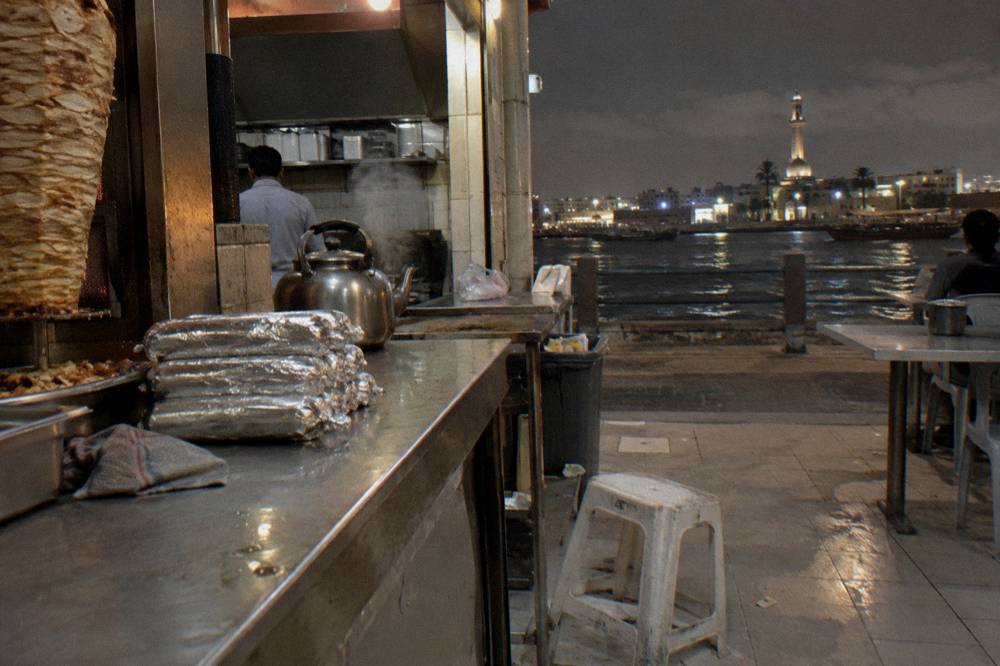
A shawarma at a local counter costs a reported 8 to 15 AED, and a guided tasting walk costs many times that. The gap is the whole question.
Short answer
For most first-time visitors, yes. A guided walk bundles a route through Al Fahidi and the Deira souks, counted tastings, an abra crossing, and a guide who explains each dish, into roughly 2.5 to 4 hours. Travelers with days to spare, strict diets, or a tight budget can eat just as well alone.
Old Dubai is one of the few places in the city where a plate of food still costs less than a coffee in a Downtown hotel lobby. Reported 2026 figures put a shawarma at 8 to 15 AED at local spots, karak chai at 1 to 3 AED, and a full casual cafeteria meal at 15 to 40 AED per person. Against that, a guided tasting walk, at the sort of price a 3 to 4 hour tour charges, looks expensive at first glance. The question is what the premium buys, and this guide works through it honestly, with the numbers that exist and clear flags where a figure depends on the operator's booking page.
What Does A Dubai Food Tour Actually Include?
Most guided food walks in Old Dubai run 2.5 to 4 hours and bundle four things: a walking route through the heritage district and souks, a set of counted tastings, a Creek crossing by abra, and a guide who explains the dishes and the neighborhoods. Some listings add a sit-down meal or a museum stop. Exact tastings and stops vary by listing, so the booking page is the final word on what is counted.
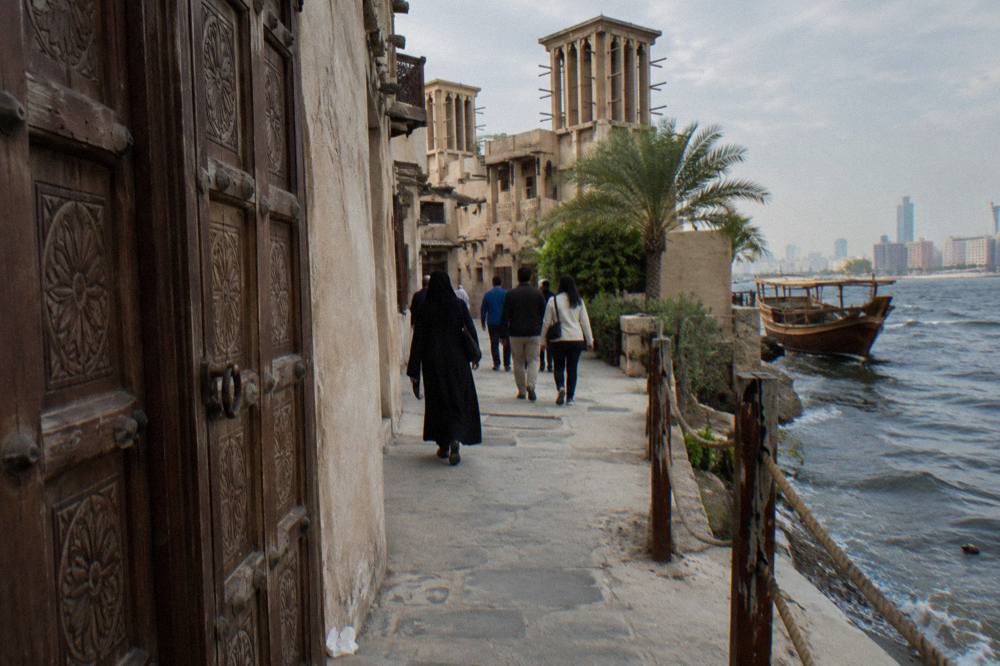
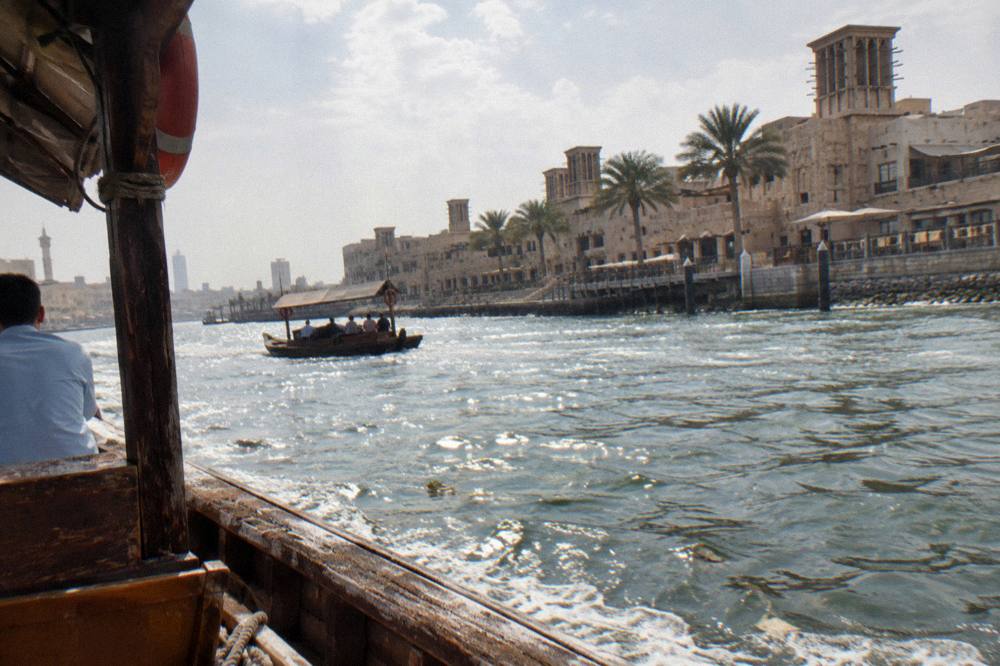
The format is consistent across the range of food walks compared here. A typical listing starts at a named meeting point in Bur Dubai or Deira, walks the lanes of the Al Fahidi Historical Neighbourhood or the Al Seef waterfront, crosses the Creek by abra, and finishes among the Spice and Gold Souks in Deira. Meeting points seen on listings include Al Khayma Heritage Restaurant in Al Fahidi, Al Ras Metro Station exit 2 in Deira, the Al Seef Heritage Hotel entrance, and Sharaf DG Metro exit 4. That last one matters for anyone arriving by Metro: Sharaf DG is the Green Line station that serves the Al Fahidi area, per the official RTA station map.
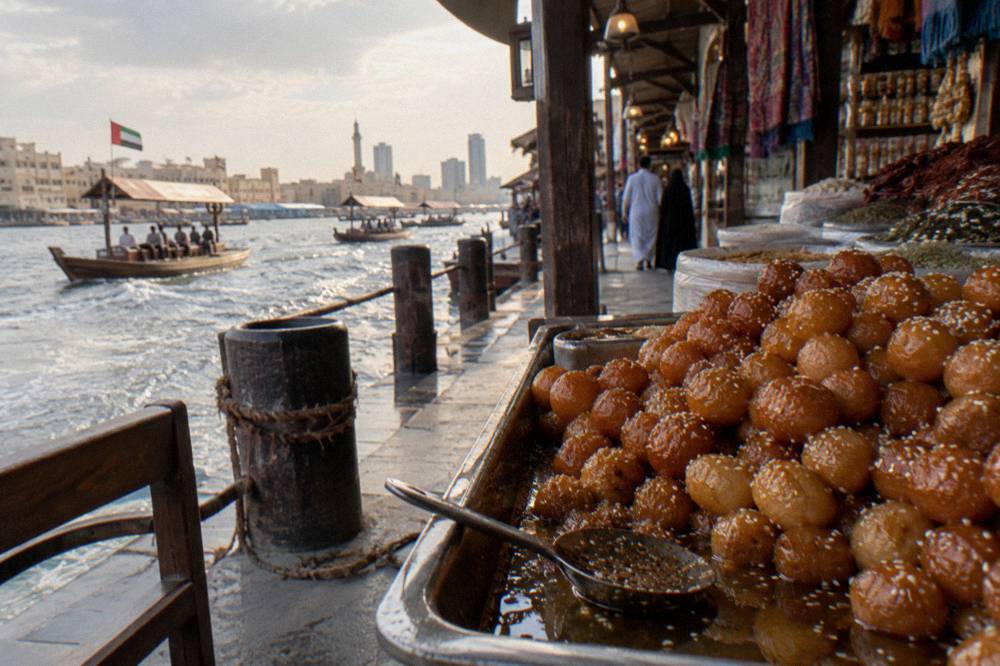
What separates a food walk from a sightseeing walk is the tasting count. One option, the 4 Cuisines tasting walk and souk route, runs 3 to 4 hours and samples dishes across four cooking traditions, with the tasting list stated on the listing. Other walks in the same family describe street food tastings, an Emirati house visit, or a boat ride on the Creek. The general pattern to expect: several small savory bites, a sweet such as luqaimat, and a karak or Arabic coffee, though the exact dishes depend on the listing. Solo women planning the same souks-and-Creek route often ask about comfort and safety, and the guide to Dubai for female travellers covers dress code, cultural norms, and why a guided Old Dubai food walk makes the area feel welcoming.
One honest caveat. Tasting counts and included dishes are set by each operator and can change with the season or the stalls open that day. If a specific dish matters to you, the booking page and a message to the operator before paying are the reliable sources. No listing here is described as vegetarian, gluten-free, or kosher unless its own description says so, so dietary needs need that pre-booking message.
How Much Does A Dubai Food Tour Cost Compared To Eating Solo?
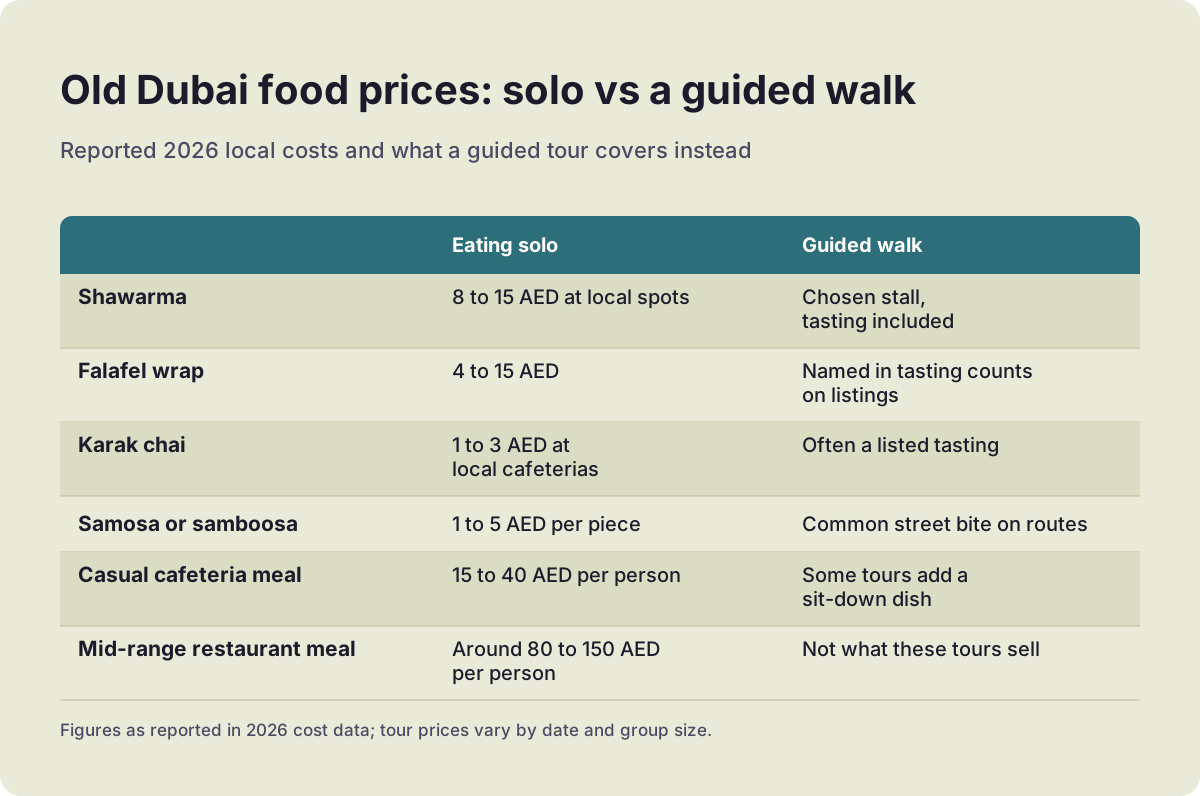
Eating solo in Old Dubai is genuinely cheap: reported 2026 figures put street bites at 1 to 15 AED each and a casual cafeteria meal at 15 to 40 AED per person. A guided walk costs a multiple of that, and one established local operator lists a 3.5 hour guided walk at 435 AED per person, as reported. The tour price buys the route, the counted tastings, and the guiding, not just the food.
This is where the worth-it question gets concrete, so it is worth laying the two budgets side by side. The figures below are reported local prices from 2026 cost data, plus the one reported guided-walk example. Tour prices for the walks compared on this site sit on each operator's booking page and vary by date and group size, so check the live listing for the figure on your travel dates.
| Item | Eating solo, reported cost | What a guided walk does instead |
|---|---|---|
| Shawarma | 8 to 15 AED at local spots, 20 to 40 AED at tourist spots | Chosen stall, tasting included in the tour price |
| Falafel wrap | 4 to 15 AED | Included in tasting counts on listings that name it |
| Karak chai | 1 to 3 AED at local cafeterias | Often a listed tasting, with the story behind the drink |
| Samosa or samboosa | 1 to 5 AED per piece | Common street bite on guided routes |
| Casual cafeteria meal | 15 to 40 AED per person | Some tours include a sit-down dish or dinner |
| Mid-range restaurant meal | Around 80 to 150 AED per person | Not what these tours sell, but a fair comparison point |
The solo column adds up fast in the walker's favor, and honesty requires saying so. Four or five street bites bought independently might cost a fraction of a tour price. What the solo walker does not get is the counted, pre-arranged tastings, the guide's explanation of machboos versus biryani, and the confidence to walk into a Deira cafeteria where no English is spoken. Whether that is worth the price depends entirely on the traveler, which is what the rest of this guide tests.
There is also a hidden cost on restaurant bills that the solo diner pays and the tour diner usually does not, because it is baked in. Dubai restaurants commonly add a 10 per cent service charge plus 5 per cent VAT, and some hotel-affiliated venues add a municipality fee. A solo mid-range meal at 80 to 150 AED therefore lands higher than the menu suggests. The Visit Dubai tipping guide notes there are no set rules and that 10 to 15 per cent is usual in restaurants where no service charge applies.
For a visitor weighing a guided walk against the cost of a self-guided day, the 4 Cuisines tasting walk is the one to price first. Check availability and compare the live figure against a solo day budget before deciding.
Guided Or Independent: Which Suits You Better?
A guided walk suits a first-time visitor with one or two days in Old Dubai, anyone uneasy about walking into unfamiliar cafeterias, and anyone who wants the history explained while tasting. Independent eating suits repeat visitors, long-stay travelers, confident street-food eaters, and tight budgets. Both deliver the same food city, because the stalls do not change.
The honest framing is that the food is identical either way. The shawarma stall does not cook better for a guided group. What changes is the friction. A guide removes the search time, the language barrier, and the ordering guesswork, and adds context: which dish is Emirati rather than Levantine, why gahwa is served in small cups, why the Spice Souk closes during the day on Fridays. Independent eating keeps the money in your pocket and the schedule in your hands, at the cost of doing that research yourself.
A practical middle path exists, and it is worth naming. Book one guided walk for the first day, treat it as a paid orientation, then return solo on day two to the stalls and dishes the guide surfaced. The Bur Dubai food walk guide covers the same ground independently if you go that way, and the Dubai food prices guide breaks down what each meal type costs across the city. One tour plus one solo day often beats two tours or two lost days.
Who Gains The Most From A Guided Food Walk?
The visitors who gain most are first-timers with limited time, travelers who do not eat street food at home, anyone with dietary questions needing a translator, and visitors who want Emirati dishes specifically rather than generic street bites. For these groups the tour converts a day of uncertainty into three reliable hours. The gain is time and confidence, not better food.
The time-poor visitor is the clearest case. Old Dubai rewards wandering, but wandering eats hours, and a first-time visitor can spend half a day finding a single trustworthy karak stall in Deira. A guided route compresses the discovery phase into one walk. Weather matters too: December through February brings the lowest average daytime highs, with a December mean maximum of 26.5 °C and minimum of 17.3 °C per NCM-derived normals, so a three-hour walk is comfortable in winter and harder in summer, a timing question covered in depth in the summer heat and timing guide.
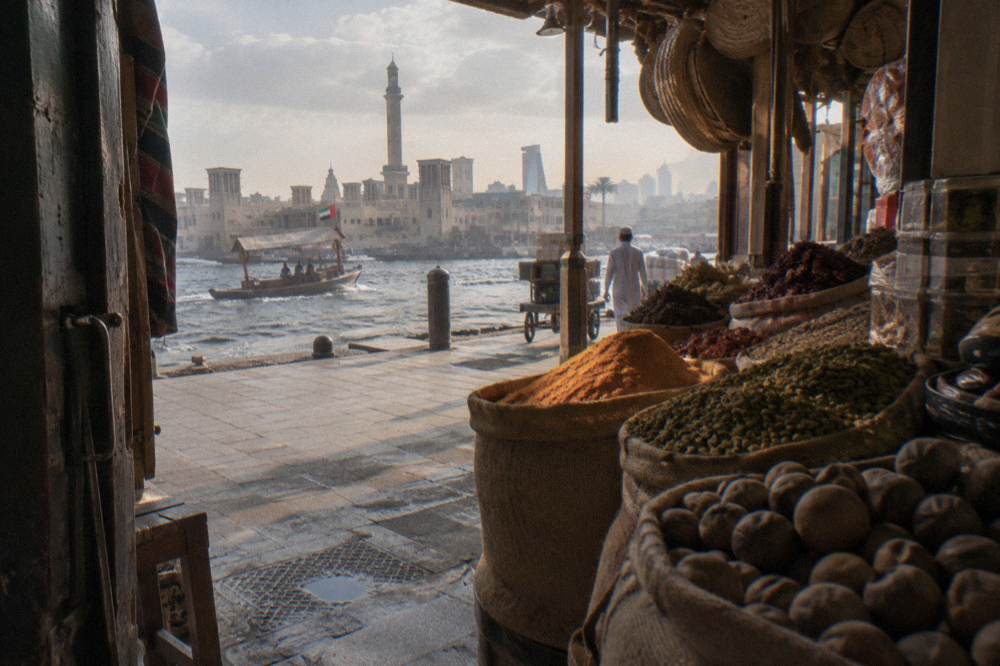
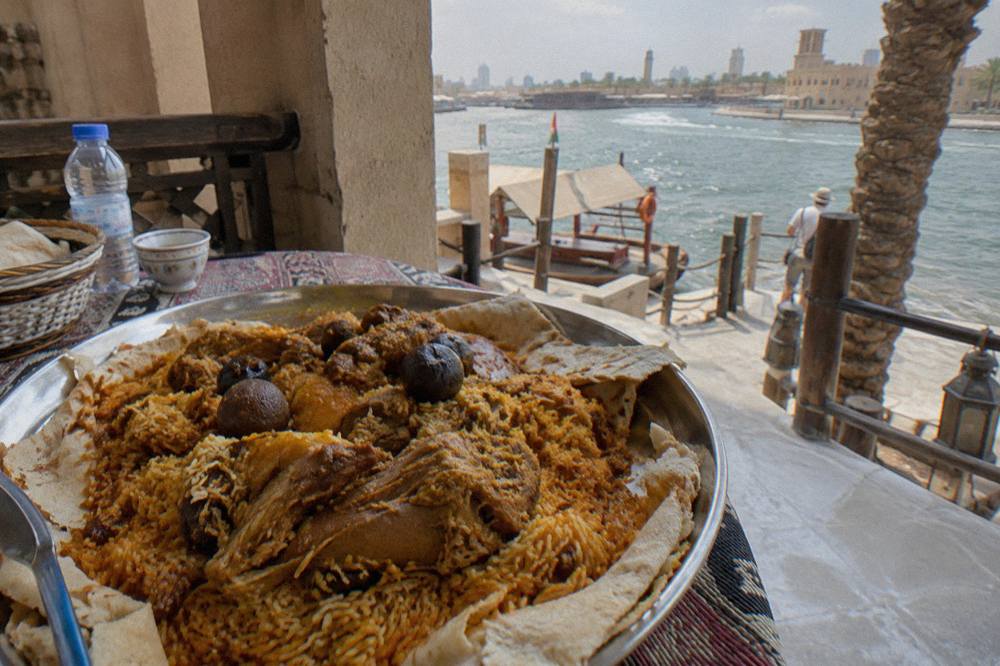
Visitors who specifically want Emirati food gain the most of all, because Emirati dishes are the hardest category to find unguided. Machboos, harees, and balaleet sit in heritage restaurants that do not advertise on tourist streets. The Flavors of Arabia souk tour with tastings and dinner runs 2.5 hours and builds a sit-down dinner with tastings into the walk, which is a different shape of experience from a street-bite route.
Another strong candidate is the cultural meal format. The Sheikh Mohammed Centre for Cultural Understanding in Al Fahidi hosts 1.5 hour cultural meals with Emirati hosts and a question-and-answer session on customs and daily life, with reported prices of AED 130 for breakfast up to AED 160 for dinner, booking required. That is not a tour in the walking sense, but it answers the same worth-it question for visitors whose real interest is understanding the table rather than walking between stalls.
Who Should Skip A Food Tour In Dubai?
Skip the tour if you have three or more days in the city, if you already eat confidently at street stalls anywhere in the world, if your budget is fixed tightly, or if you have strict dietary restrictions the listings do not cover. The same dishes are available solo at reported prices from 1 AED for karak upward, and no guide is needed to buy them.
The budget case is straightforward. A traveler who happily navigates Deira alone can assemble the same tasting list for the price of a few snacks. The dietary case is more subtle. All meat in Dubai restaurants and markets is halal, and pork is sold only in designated licensed sections, so halal eaters are fully served everywhere. But a listing that does not describe itself as vegetarian or gluten-free may not be able to adapt its route, and a private option then makes more sense than a group walk.
Private tours solve exactly that problem, at a price premium. The private 10 tastings option runs 3 hours with a local host and a route shaped around the group, which is the format to choose when a dietary need, a family pace, or a special occasion makes the fixed group walk a poor fit. The trade-offs between private and group formats, including price basis differences, are laid out in the private versus group food tour guide.
One more skip case deserves honesty. If a visitor's interest in food is casual and their interest in shopping, beaches, or the skyline is primary, a food walk may feel like three hours of someone else's enthusiasm. The souks are genuinely worth seeing, but a sightseeing walk without tastings, or a solo hour in the Spice Souk, serves that visitor better and costs less.
What Does A Guided Food Day Actually Look Like?
A typical day starts mid-morning or late afternoon at a Metro-accessible meeting point in Bur Dubai, walks Al Fahidi and the Al Seef waterfront, crosses the Creek by abra, and finishes among the Deira souks with tastings spread along the route. The whole circuit covers a compact, walkable area where no leg of the walk is long.
The geography makes this format work. Al Fahidi Historical Neighbourhood is open to walkers from 7am to 8pm daily with free access, per Dubai Culture hours, and the Al Seef promenade runs about 1.8 km with free entry. The abra crossing connects Bur Dubai to Deira on several RTA routes, including the traditional CR1 commuter route between Bur Dubai and Deira Old Souq. Standard walking connections between Al Fahidi, Al Seef, the Textile Souk, the abra stations, and the Deira souks all exist with no reported route closures.
The typical route breaks into a handful of recognizable stages, and knowing them helps you judge any listing quickly:
| Route stage | District | What the listing usually describes |
|---|---|---|
| Meeting point and intro | Al Fahidi or Al Seef, Bur Dubai | A named cafe or hotel entrance, a short briefing |
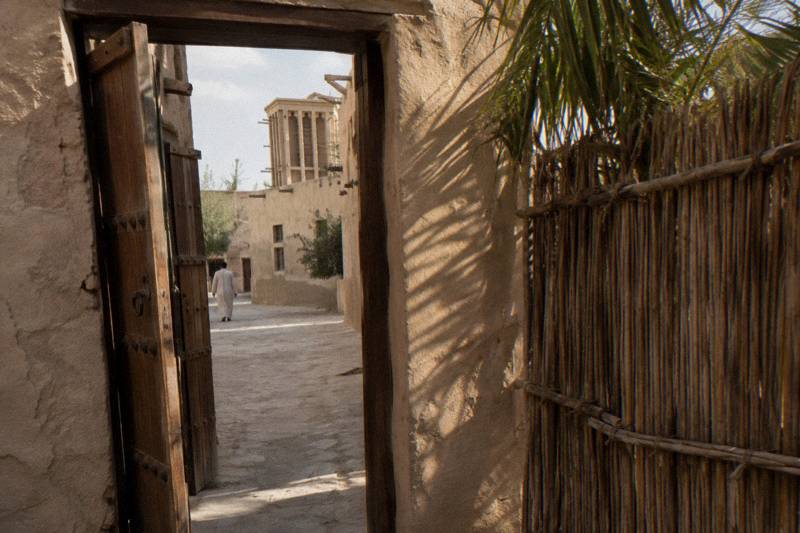
| Heritage lanes walk | Al Fahidi Historical Neighbourhood | Wind-tower houses, courtyards, first tastings |
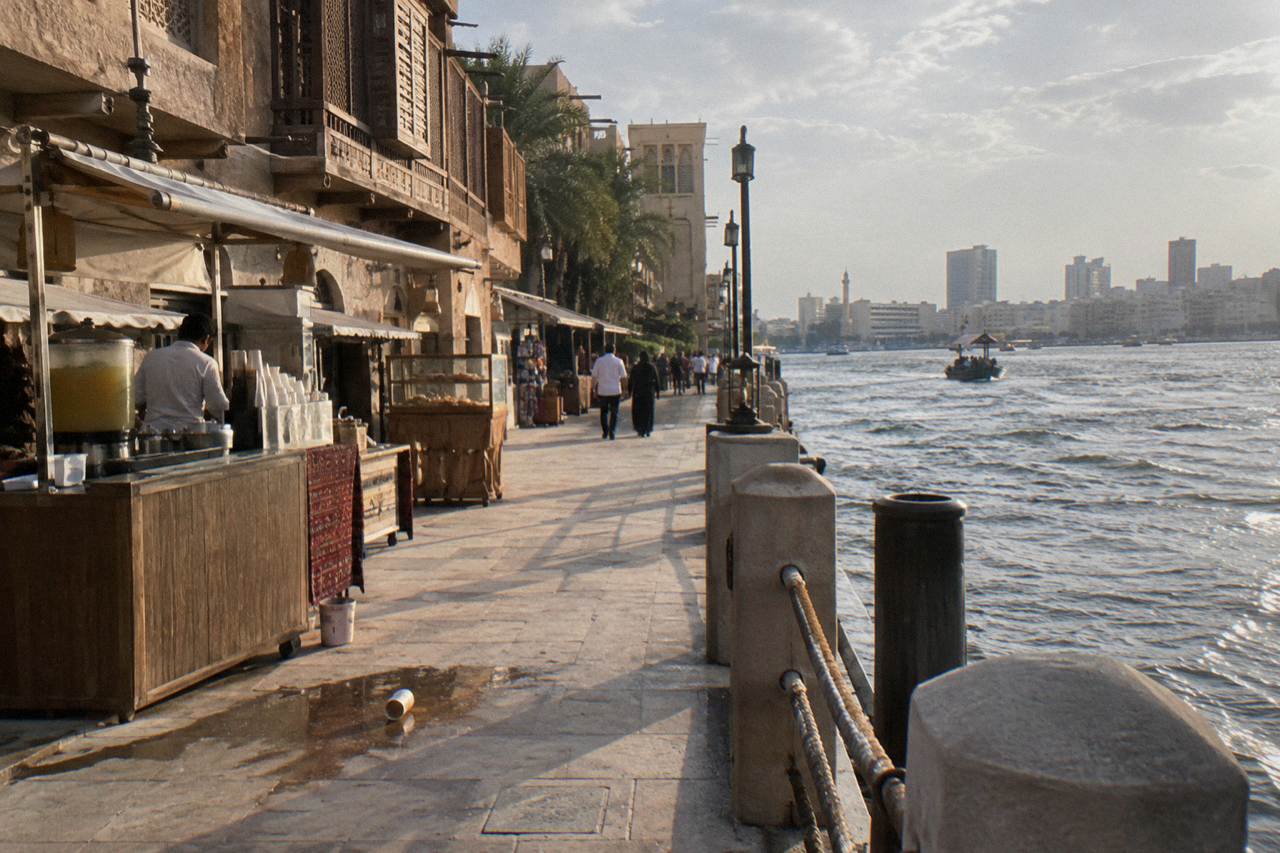
| Waterfront stretch | Al Seef promenade | Creek views, heritage and modern sections |
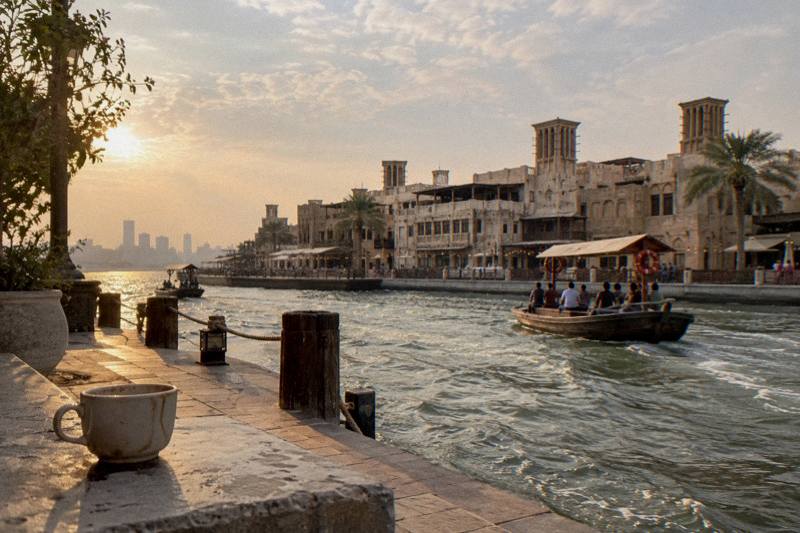
| Creek crossing | Bur Dubai abra station to Deira | A traditional abra ride on an RTA route |
| Souk finish | Spice Souk and Gold Souk, Deira | Final tastings, spice and gold browsing |
Timing matters more than most visitors expect. The Gold Souk's shops mostly open around 10am to 10pm, per Visit Dubai descriptive hours, while Spice Souk shops generally open earlier than 8am and run past 9pm, closing during the daytime on Fridays. A tour that starts too early or on a Friday afternoon may find a quieter version of the route, which is one reason operators schedule around these patterns. Individual shop hours vary, and no single official timetable covers every stall, so the meeting time on the booking page is the practical anchor.
The half-day street food tour format stretches the same idea to 4 hours, which suits visitors who want the fuller version of the route rather than the shortest. For anyone comparing formats, the how to choose between Dubai food tours guide maps the differences by length, category, and price basis.
Dress and etiquette shape the day too. Covering shoulders and knees is the standard advice for heritage areas and souks, not a legal requirement for tourists but the respectful choice in traditional districts. Photography etiquette matters in the same districts: ask permission before photographing individuals, particularly Emirati women and families. And alcohol plays no part in these walks, since food routes through Old Dubai serve no alcohol unless a listing says otherwise. Visitors over 21 can drink at licensed venues, but public drinking outside licensed premises is prohibited.
How Do You Judge A Tour Before Booking?
Judge a listing on four things: the tasting count and dishes named, the duration and route described, the price basis as shown on the booking page, and the cancellation terms. Where a listing does not state a detail, message the operator before paying rather than assuming. A listing that answers a dietary question clearly before booking is usually a well-run tour.
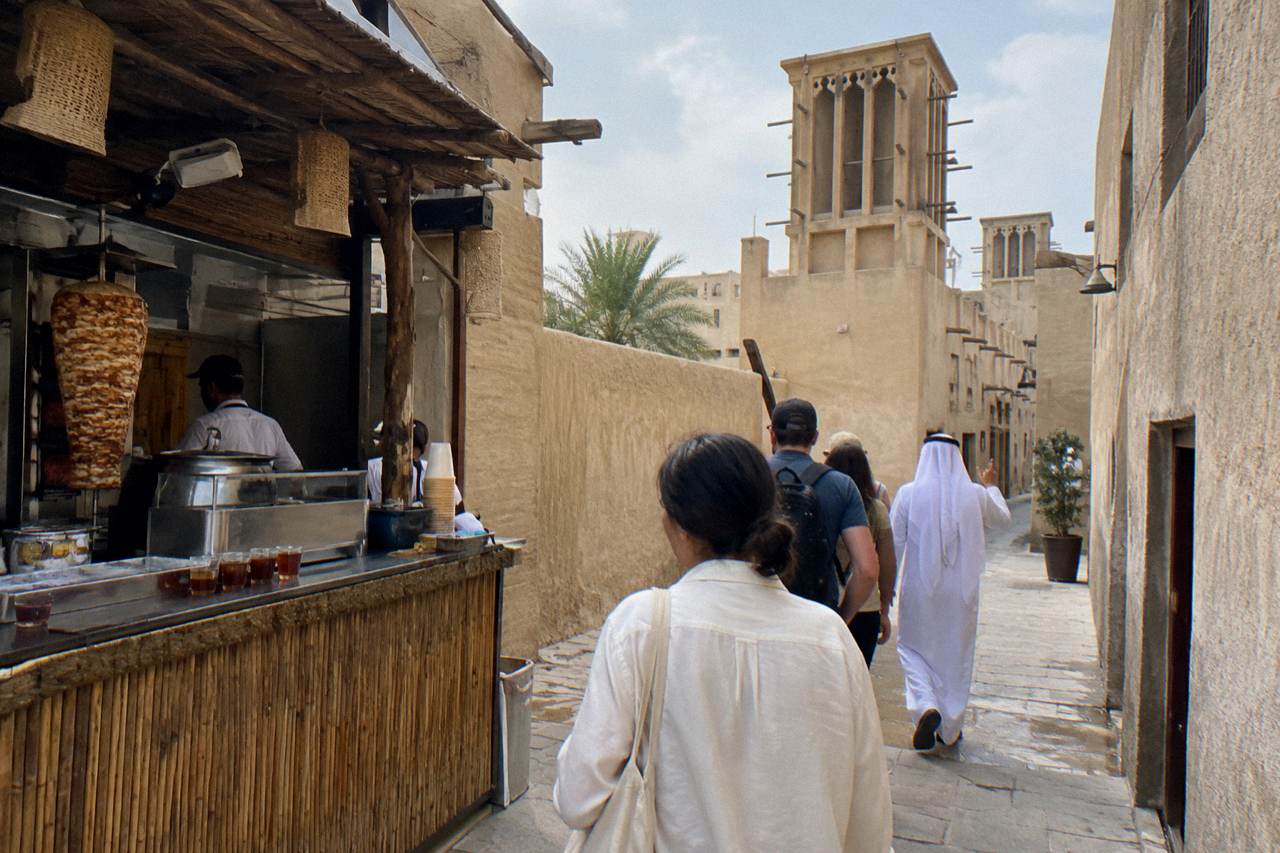
The tasting count is the single most useful number on any listing. A walk that names its tastings, like the 4 Cuisines walk's four-cuisine sampling, tells you exactly what the food budget inside the tour price is. A listing that says only "street food tastings" leaves the count to the day, which is a fair thing to ask about in a pre-booking message. The same applies to drinks: karak or gahwa is a common inclusion, but each listing states its own.
| Check before booking | Where the answer lives | Why it matters |
|---|---|---|
| Tasting count and dishes | The listing description | Defines the real food value inside the price |
| Price basis | The booking page | Per-person from-prices vary by date and group size |
| Meeting point | The listing | Al Fahidi, Al Seef, and Deira starts shape the route |
| Duration | The listing, 2.5 to 4 hours typical | Determines whether a sit-down dish fits |
| Dietary flexibility | Message the operator | Listings rarely state vegetarian or gluten-free coverage |
| Cancellation terms | The booking page | The protection if plans or weather change |
Cancellation terms deserve a specific look. Dubai's weather window is generous in winter and punishing in summer, and plans shift on any trip. The booking page states each operator's cancellation window, and it is the one detail worth reading before paying rather than after. Tipping on a tour follows the same no-set-rules approach as restaurants: personal preference, with cash tips of 5 to 10 per cent common for good service in the city generally, per the Visit Dubai tipping guide at the official tipping article.
Finally, judge the operator's own transparency. An operator who names its meeting point, states its tasting count, and answers a dietary question before payment is showing you how the day will be run. Getting to the start is easy either way: the Green Line serves the area through Sharaf DG, Baniyas Square, Gold Souq, and Al Ras stations, per the official RTA metro map, and a Nol card costs AED 25 including initial credit, per the RTA Nol page.
The verdict, stated plainly: a guided food walk in Dubai is worth it for a first-time visitor with limited time, and it is not worth it for a confident street-food eater with days to spare. Both travelers eat well in Old Dubai. The tour sells certainty, context, and a compressed route, and for the right visitor that is a fair purchase. For everything else, this site's Dubai Food Tours guides cover the same dishes, routes, and prices for the independent eater.
Common Questions About Food Tours In Dubai
Are Food Tours In Dubai Worth It?
For most first-time visitors, yes. The tour compresses a day of route-finding into 2.5 to 4 hours, includes counted tastings, and adds a guide's context. Confident street-food eaters and travelers with several days in the city can eat the same dishes solo for far less.
How Much Does A Food Tour In Dubai Cost?
Prices sit on each operator's booking page and vary by date and group size. For scale, one established local operator lists a 3.5 hour guided walk at a reported 435 AED per person, while solo street eating costs a reported 1 to 15 AED per item.
Can You Do Old Dubai Food On Your Own?
Yes. The area is compact and walkable, the Al Fahidi lanes and Al Seef promenade are free, and abras cross the Creek on several RTA routes. Solo eating costs a reported 15 to 40 AED for a casual meal, though Friday daytime souk closures and stall choice take some planning.
Are Dubai Food Tours Good For Vegetarians?
Only where a listing says so. Falafel and vegetable dishes are common in the city, but listings rarely state vegetarian coverage, so message the operator before booking. A private tour is the format most able to adapt a route.
Do Food Tours In Dubai Include Drinks?
Karak chai and Arabic coffee are common tastings, and some listings include water, but each listing states its own inclusions. Alcohol is not part of Old Dubai food walks unless a listing says otherwise.